

The convenience channel remains a bright spot for beer as the category tackles declines elsewhere, and growth in the channel is expected to continue through 2024, Goldman Sachs analysts reported in the company’s latest Bev Bytes retailer survey.
Respondents to the Goldman Sachs survey represent 40,000 retail locations across the U.S., equivalent to roughly 27% of total c-stores in the country.
C-store beer dollar sales increased +7% year-over-year (YoY) in Q4 2023, accelerating from the +5% YoY growth recorded in Q3, according to retailers. The category ended 2023 with dollar sales up +7% YoY, up from the +5% growth recorded in 2022.
In 2024, c-store retailers expect beer dollar sales to increase +5%. Some of that growth will come from price increases, as 67% of consumers believe “brewers can continue to push through more pricing,” up from the 60% of respondents who said so in Goldman Sachs’ Q3 survey.
Retailers were in agreement that all brewers, with the exception of Anheuser-Busch InBev (A-B), will take modest price increases in 2024 – equivalent to less than +3%. The majority of retailers believed A-B will also take price this year. However, 14% expect A-B to maintain price, making it the only manufacturer retailers think will do so.
“Spirits sales could benefit” from beer price increases, as the former category becomes “relatively more affordable versus beer,” analysts wrote, noting that the average price of a 30-pack of domestic beer will “likely” cross the $30 threshold in some markets in 2024.
Retailers also noted that consumers are “being more thoughtful on their purchases” and, if that continues as expected through 2024, the “inelasticity of beverage pricing and promotions will hurt unit and dollar sales.”
Despite beer’s recent gains, the majority of retailers (53%) don’t expect to make changes to the category’s shelf or cooler space during the upcoming spring resets. Two-fifths (41%) of respondents plan to increase shelf space, equivalent to a +1.2% increase in space on a weighted average store basis.
Constellation Brands is expected to be the biggest space gainer, with 88% of retailers expecting to add incremental space for the company’s Mexican import brands, equivalent to a +4.3% increase in space on a weighted basis. Within those gains, Modelo is expected to benefit the most.
Molson Coors (TAP) will likely be the second largest space gainer, with 65% of retailers expecting to give the company’s brands incremental space, equivalent to a +2.1% increase on a weighted basis. Goldman Sachs analysts also noted that Molson Coors is likely benefiting from Constellation’s gains, as 75% of Molson Coors distributors also distribute Constellation products.
“We believe these distributors have collective power to influence retailers as well as to influence space gains with independents,” analysts wrote. “Ultimately, we believe this has been a key reason behind TAP’s success in gaining incremental shelf/cooler space in both the fall and upcoming spring resets.”
A-B is expected to lose the most shelf space, estimated to be down -3.6% on a weighted basis. All other big beer brands are expected to maintain their space.
Craft is expected to lose -3.5% of shelf space, while Monster’s flavored malt beverage (FMB) brands The Beast Unleashed and Nasty Beast Hard Tea are expected to increase shelf space +0.7%.
A-B: Retailers Suggest Improved Trends for First Time Since Decline Acceleration
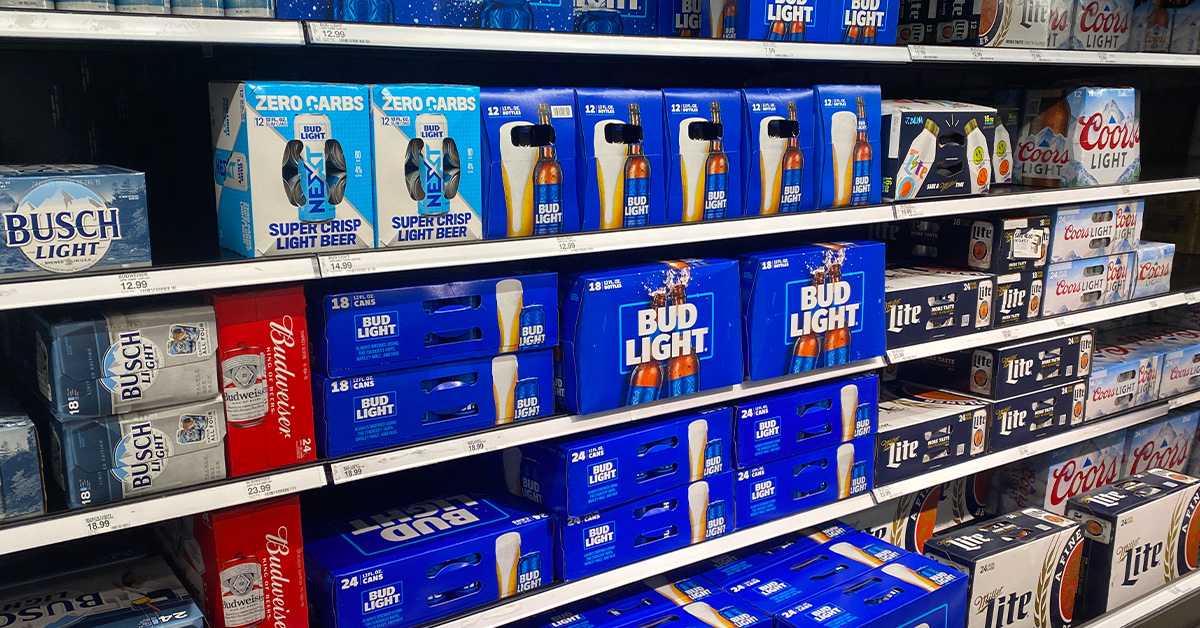
A-B Q4 c-store dollar sales were down -4%, a significant improvement over the -12% declines recorded in Q3, according to retailers. The company ended 2023 down -2%, a decline from the +1% growth recorded in 2022.
Looking ahead, retailers expect A-B to end 2024 flat YoY, an improvement from the -2% decline previously expected by retailers in Goldman Sachs’ Q3 survey.
Recent trends for A-B’s Bud Light brand have “stabilized” and “in some instances improved” through Q4, with 29% of retailers indicating improved trends, the “first time any retailers have suggested so in our prior three surveys,” according to Goldman Sachs. All other respondents (71%) said recent trends have stabilized.
The majority of retailers (43%) expect Bud Light to regain zero to one points of market share that it lost in 2023. The next largest cohort (29%) expect the brand to regain 1.5 share points, while 19% expect the brand to gain back two share points.
On a store-weighted average, retailers expect Bud Light to gain +0.6 share points of lost share. Even the most optimism for Bud Light is not near the total share the brand lost following its accelerated declines that started in April 2023. Bud Light lost about four points of share last year, according to NIQ.
Molson Coors’ Miller Lite and Coors Light will “likely” hold onto “at least some” of the share gains they recorded during Bud Light’s declines, according to 86% of respondents. Nearly one-third of respondents (29%) said the brand will retain “a lot” of the recent share gains, up from 20% in the Q3 survey.
The remaining respondents (14%), said they don’t expect Miller Lite or Coors Light to hold onto any recent share gains, up from 10% in the Q3 survey.

Boston Beer: Truly Declines Continue; Twisted May Have a Significant Challenger
Boston Beer c-store dollar sales increased +9% YoY in Q4, up from the +6% YoY gains recorded in Q3, according to retailers. The company ended 2023 with dollar sales growth of +10%, up from +2% in 2022, and ahead of the overall beer category.
For 2024, Boston Beer is expected to increase c-store dollar sales +6%, an increase from the +2% expectations shared in the Q3 survey.
Truly Hard Seltzer continues to record declines, with trends accelerating in Q4 to -6% YoY versus -3% in Q3. The brand was down -5% overall in c-stores in 2023, versus -2% in 2022, and is expected to be down -4% in 2024.
Truly has outpaced declines for the overall hard seltzer segment (-5% in Q4, -3% in Q3) and is expected to be in-line with segment declines in 2024 (-5%). Retailers’ outlook for hard seltzer appears to be more pessimistic, as respondents in the Q3 survey had projected the segment to decline -2% in 2024.
Meanwhile, Mark Anthony Brands’ White Claw continues to add to its dominant share of the segment. White Claw dollar sales increased +4% in Q4, up from the +1% increase recorded in Q3. White Claw is expected to be up +4% through full-year 2023, up from +2% in 2022. Growth is expected to continue in 2024 (+1%). However, retailer optimism is down, as respondents had previously projected +4% 2024 growth for the brand.
The momentum behind Boston Beer’s FMB Twisted Tea continued through Q4, but 2024 expectations are mixed. The majority of respondents (57%) said they expect trends to continue or accelerate – up from 44% in the Q3 survey – while 43% said they expect momentum to slow down through the rest of the year, down from 56% in Q3.
Some respondents indicated that Twisted Tea could see some share fall to Monster’s Nasty Beast Hard Tea. Retailers are “broadly upbeat” about Nasty Beast, with 17% expecting the brands to take “at least some share” from Twisted Tea, and 33% indicating the brand could “maybe” take some share.
How Other Brands Fared
- Constellation: Q4 dollar sales +16% (versus +15% in 2022); 2023 dollar sales +15% (versus +7% in 2022); 2024 expected to be up +7% (up from +3% predicted in Q3);
- Heineken: Q4 dollar sales +4%; 2023 dollars +5%; 2024 expected to be up +3% (up from +1% growth predicted in Q3 survey);
- Overall Craft: Q4 dollar sales +4%; 2023 dollar sales +2%; 2024 expected to be flat (down from previous prediction of +3% growth).