
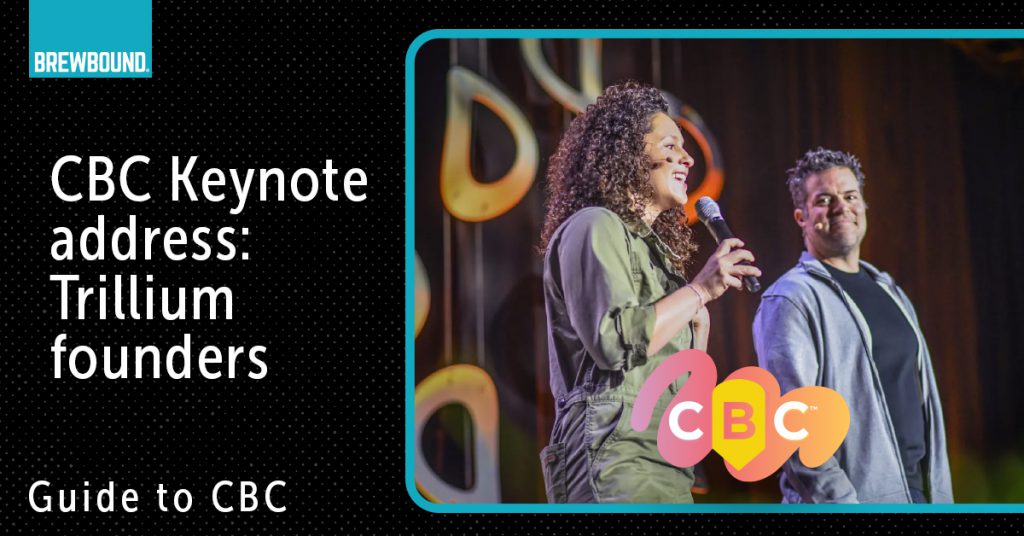
When her husband told her he wanted to start a brewery, Trillium co-founder Esther Tetreault had a pair of questions for him.
“Do you want to be a brewer, which is cool, or do you want to start a business in craft beer?” she asked JC Tetreault.
The Tetreaults, who founded Massachusetts-based Trillium in 2013, delivered the keynote address at the Brewers Association’s (BA) annual Craft Brewers Conference on Tuesday in Indianapolis. They shared Trillium’s growth story from a tiny “shoebox” in Boston’s Fort Point neighborhood to a regional hospitality empire with three locations in Boston, a production headquarters and flagship taproom in nearby Canton and a farm in North Stonington, Connecticut.
In 2023, the most recent year for which production data is available from the BA, Trillium was the fourth-largest taproom brewery in the BA’s northeast region (Maine to West Virginia). The company’s volume declined 5%, to 13,451 barrels.
“JC and I attribute a huge portion of our success to our unwavering commitment to our vision and our values,” Esther Tetreault said. “The products, the locations, the brands, even our organizational structure – it can all change, and you need to know when to pivot. But what we never compromise is the end goal or who we are.”
The keynote came as the craft beer industry navigates a challenging period, punctuated by a 4% volume decline in 2024. Craft brewers have worked against headwinds for years beginning with shutdowns and operating restrictions during the COVID-19 pandemic, followed by inflationary pressures, middle-tier consolidation, waning consumer interest, increased competition from spirits and now potential impacts from looming tariffs.
Esther Tetreault encouraged attendees to examine their values and driving forces from a business perspective, no matter the size or age of their brewery.
“If you’re a small brewery with just a few team members, it might feel corporate to talk about mission statements, core values and writing formal policies,” she said. “But while writing all this stuff down might not come easily, it was a pretty powerful thing for us to be able to articulate to ourselves first and then find the best way to communicate that to existing and future team members.”
For Trillium, the brewery’s six core values were spelled out in a letter Esther Tetreault penned for early new hires and is still used today. They include safety, teamwork, work ethic, quality, innovation and humility. She expanded on humility’s presence on the list.
“We make it clear that no matter what department or which location, we are all one team and we work to support each other,” Esther Tetreault said. “Not being clear about this distinction led to problems in the past. We had team members who felt they added more value than others, which led to feelings of entitlement over others and a lack of respect for the integrated nature of everything that we do.”
One throughline in Trillium’s 12-year journey has been the Tetreaults’ refusal to relinquish control of the company’s destiny. In the early days, a college friend offered JC Tetreault “a couple hundred thousands dollars for 5% equity.”
“I initially wanted to take it. I mean, what’s 5% in the grand scheme? It really wasn’t about the money for us, and it wasn’t a controlling vote,” JC Tetreault said. “Ultimately, we never wanted to have to compromise on our values, and you never know what motivates someone else. And those motivations can and will change over time, especially as the reality of the grind sets in.”
On the way to opening Trillium’s brewery and restaurant in Boston’s bustling Fort Point neighborhood, the Tetreaults signed a letter of intent to lease a space with a developer who was working with several restaurants. As negotiations continued, the developer kept pushing for more control over Trillium’s operations, external branding, hours and menu.
“JC and I felt strongly that we knew what was best for Trillium’s brand and our business, and we needed to be able to assess and adapt to demand as we saw fit. So, we had a long talk about whether we were willing to give up on our dream to stay in Boston,” Esther Tetreault said. “Rents were too expensive, space was limited, and we were running out of time. Ultimately, we decided that the sacrifices and potential control we would lose weren’t worth the opportunity, so we walked away.”
Several months later, another lease opportunity materialized, and Trillium opened an 18,000 sq. ft. restaurant with a 450-person capacity in 2018, in a neighborhood that has only grown busier in the years since.
Developing clear delineation of roles has been key. A decade ago, when the company was just two years old, the Tetreaults found that running its operations on their own was growing untenable. Esther Tetreault detailed an exercise similar to a SWOT [strengths, weaknesses, opportunities, threats] analysis they ran to better understand how to divide responsibilities.
“I wrote down all the things that I like doing for Trillium and all the things I think JC is good at,” she said. “Then we compared notes and found overlaps. All the areas JC liked doing and I felt he were good at, were his to own, without my input. I just trusted him to take care of business, and then vice versa for me.”
Business responsibilities that did not automatically land with either of them were delegated to external hires, and the team has since grown to 300 employees.
“There was more than one moment where we were having discussions about whether we can keep it up, if it was all worth it, and a couple of times and questioned whether we were going to stay married, all because what we were doing was not sustainable,” Esther Tetreault said.
The unsustainability of the entrepreneurial lifestyle came to a point several years ago, when JC Tetreault suffered a transient ischemic attack, or a small stroke. The scare helped the Tetreaults reassess their role within the Trillium ecosystem.
“Trillium certainly wouldn’t be sustainable as a business or as a career for the 300 people that we employ if JC or I were integral for day-to-day operations,” Esther Tetreault said.
The Tetreaults encouraged attendees to embrace the community build during the three-day conference.
“Use this week to learn, meet people who are doing things differently, be open to inspiration from unlikely places, but always stay true to your mission. Why else would you wake up every day and just keep grinding?” Esther Tetreault said. “The details of our path might be different from yours, but the core tenets are the same. You have a vision, you have core values that you want to share with others, and you can be successful as you define it.”