

While beer consumers – particularly core craft fans – once cared more about brand and where a product was made, most bev-alc consumers are now prioritizing price, quality and availability, among other factors. This has caused not only a shift in how craft beer is produced and marketed (hello, contract brewing boom), but also trends in imported beer.
Enter: Beer imports that are no longer physically imported.
In the last two years, several imported beer brands have announced they are moving production to the U.S. in an effort to increase their availability and create production efficiencies.
In 2022, Brewbound first broke the news that Japanese beer maker Sapporo would be acquiring San Diego, California-based craft brewer Stone Brewing in a $165 million deal. The purchase combined Japan’s oldest beer brand with a top-10 craft brewer and top-20 overall U.S. brewery.
Stone produced more than 320,000 barrels of beer in 2023, and still has many craft loyalists still hanging onto its portfolio. However, what seems to have attracted Sapporo to the craft brewery isn’t optimism for a bounceback of the craft segment, but rather its multiple production facilities and open capacity.
In May, Sapporo-Stone – the new joint entity – unveiled details of a three-part expansion plan, with phase one nearly complete. The first phase included a $20 million investment in Stone’s Escondido, California-based facility and a $40 million investment in the company’s facilities in Richmond, Virginia. The two breweries – which provide bi-coastal production options for Sapporo – now have a production capacity of 700,000 barrels.
And that capacity is being used for Sapporo beers.
“The goal was to transition from an importer to a U.S. brewer, ultimately brewing, selling, and marketing all of Sapporo’s beers for the U.S. market locally,” Sapporo-Stone said in a press release.
Sapporo-Stone first started producing Sapporo beers and putting them in consumers’ hands in 2023, under the guise of a limited-release, taproom-exclusive Stone lager. With the recipe locked down, Sapporo’s beers are now being produced at both the Escondido and Richmond facilities, with the goal of producing 360,000 barrels of Sapporo beer alone by the end of 2024.
“Operationally, this acquisition looks a lot like a merger,” CEO Zach Keeling said in the release. “Our two companies are now fully integrated – innovating, brewing, selling, marketing, and operating as a single, combined business. The Sapporo and Stone Brewing brands will maintain their individual identities, but we are Sapporo-Stone in name, operations, and culture.”
Consumers – whether fully aware of the move or not – seem unfazed by the change in where their beer is being made. Year-to-date through August 10, Sapporo has increased dollar sales +12.4% and volume (case sales) +12.6% in NIQ-tracked off-premise channels (total U.S. xAOC plus convenience). Its flagship offering Sapporo Premium has increased its own dollar sales +13.3% and volume +13.5%.
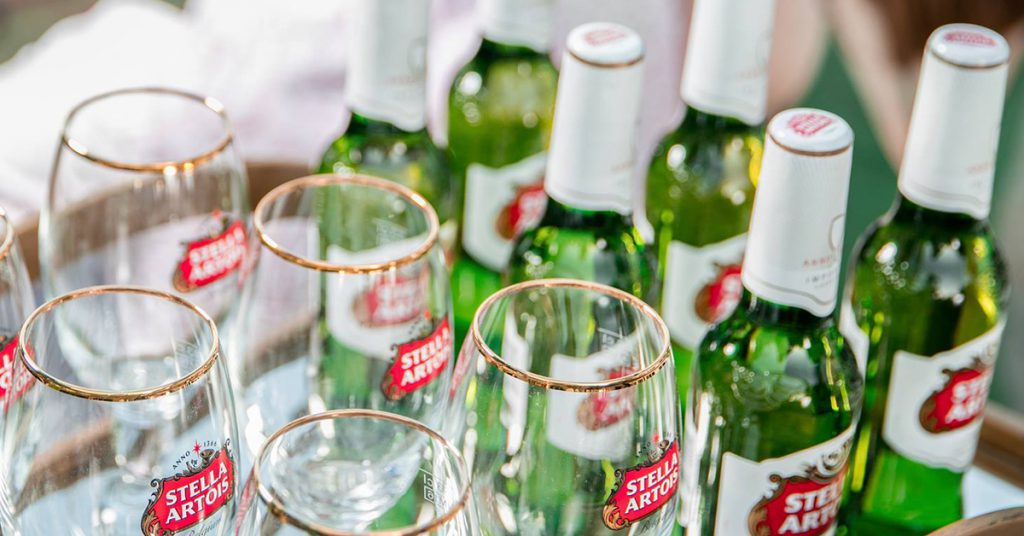
Sapporo isn’t alone in its U.S. strategy. Anehuser-Busch InBev (A-B) moved production of Belgian import brand Stella Artois to its U.S. brewing facilities, including St. Louis; Los Angeles; Newark, New Jersey; and Jacksonville, Florida, with A-B designating part of its two-year $1 billion investment plan in the facilities to help with the transition and capacity expansion, and an additional $296 million explicitly for domestic Stella production and distribution.
At the time of the transition announcement, then-A-B U.S. chief sales officer, North America Brendan Whitworth – now CEO of A-B’s U.S. operations – said the move was due to “the instability of the international supply chain when it comes to some of our imports.”
More recently, in May, Molson Coors announced it would shift production of its full-strength Peroni Nastro Azzurro to its brewery in Albany, Georgia, starting in August. (Japan-based Asahi Breweries acquired Peroni in 2016; Molson Coors owns the import rights in the U.S.)
The decision to move Peroni production to the U.S. was made so on- and off-premise retailers could “have access to a fresh steady supply of Peroni,” according to the announcement. Product made in Albany began hitting on-premise accounts in September, with plans to make can and bottles of the Italian lager “widely available” in 2025.
“Over the past several months, our brewers in the U.S. have worked tirelessly to stay true to the brand’s crisp refreshing taste and honor its original recipe from 1963,” Molson Coors chief supply chain officer Brian Erhardt and CMO North America Sofia Colucci said in a note to wholesalers.
“We also believe this expanded production will enable us to secure more distribution and bring Peroni to even more drinkers,” they added.

Peroni has also reaped rewards in scan data. The brand family has increased dollar sales +4.5% and volume +1.2% in off-premise channels year-to-date (YTD) through October 5, according to NIQ data shared by 3 Tier Beverages. However, much of that growth could be credited to Peroni 0.0, its non-alcoholic offering, which continues to be produced in Italy. Peroni 0.0 has increased dollar sales +118.9% and volume +123.4% YTD.
In a move closer to Sapporo-Stone, Japanese beverage company Kirin Holdings announced its own production move to acquired craft brewing facilities in July.
Kirin’s Australian subsidiary Lion acquired Colorado-based New Belgium Brewing in late 2019, followed by Michigan-based Bell’s Brewery in late 2021. With leadership and distribution adjustments now in place at the breweries, Kirin has announced all U.S. production of Kirin Ichiban and Kirin Light will move to New Belgium’s Brewing facilities in Fort Collins, Colorado, and Asheville, North Carolina, at the end of 2024.
Kirin contract brews some of its products with A-B, but that deal will expire at the end of the year. Production, marketing and sales of the two beers is expected to begin in January 2025, with A-B continuing to brew and distribute until then.

And in January, Japanese brewing giant Asahi announced its own deal to acquire Wisconsin-based contract brewer Octopi Brewing. Reports had been circulating since late 2022 that Asahi was on the hunt for brewing capacity in North America.
With the deal, Octopi will produce Asahi Super Dry and Kozel, a Czech beer, for U.S. distribution, along with several other Asahi brands, including Peroni Nastro Azzuro and Grolsh, that will be exported to Canada (note: Asahi owns Peroni, while Molson Coors holds the U.S. import rights for the Italian beer brand). Asahi has a mid-term production target of 1 million hectoliters (approximately 850,000 barrels) following the deal.
“The Octopi acquisition will allow us to push Asahi Super Dry into other channels and other areas that we’ve been really keen to expand in going forward,” Victoria Segebarth, managing director of EMEA & Americas at Asahi Europe & International, told Brewbound earlier this year.
“And Octopi will enable us to produce different SKU formats than we’ve been able to traditionally that are more applicable to the U.S. or the Canadian beer markets,” she continued. “It also gives us more flexibility to enable us to respond more quickly than importing the brand.”
Bucking the production move trends so far has been Constellation Brands and its Mexican import brands. The company’s beer division – including Modelo, Corona, Pacifico and Victoria in the U.S. – recorded an +8% increase in shipments and +6.4% increase in depletions in the first quarter of fiscal year 2025. And despite continued headwinds in the beer category, Constellation Brands leadership recently doubled-down on its expectations for its beer brands, including remaining the No. 1 share gainer in scans.

Constellation is the second largest beer vendor in Circana-tracked off-premise channels, increasing dollar sales +6.2% and volume +5.1% YTD (ending October 6). The company has gained +1.32 share points of total beer dollar sales YTD, which increases to +4.5 share points when including all CPG products, president and CEO Bill Newlands said during Barclays’ Consumer Staples Conference in September.
To keep up with demand, Constellation is deepening its presence in Mexico, rather than the U.S. In 2022, the company announced a $1.3 million planned investment into the southeastern part of Mexico over a four-year period, as part of a $5.5 billion investment plan being dished out across all its Mexico facilities through 2026. The investments will support a capacity increase of more than 30 million hectoliters (nearly 25.6 million barrels), with a new brewery in Veracruz, and expansion at its existing facilities in Nava and Obregon.
The risk in moving production, along with the heavy investment required to make the transition, may be unavoidable for many imported beers with the demand increase from consumers. The segment is the largest beer segment by dollar sales YTD through October 6 in Circana-tracked off-premise channels (total U.S. multi-outlet plus convenience), outpacing No. 2 domestic premiums by more than $200 million – a ranking switch that occurred in May.
Imports recorded a +3.9% increase in dollar sales and +2.5% increase in volume YTD, one of only three beer segments to consistently record growth over the past year, along with flavored malt beverages and non-alcoholic beer.
Imports were also the only beer segment in expansion in the August Beer Purchasers’ Index (BPI) from the National Beer Wholesalers Association (NBWA), indicating wholesalers are continuing to purchase import brands even as total beer sales slumped in a late-summer slowdown. A reading below 50 indicates a segment is in contraction, while a reading above 50 indicates expanded ordering trends. Imports outpaced the total category, with a BPI reading of 55, while total beer had a BPI of 38.
Additionally, in July, imports set a new monthly record for beer volume, with nearly 4.2 million barrels of beer imported into the U.S. in the month. Imports have increased +8.3% YTD through August, to nearly 30 million barrels.
A majority of that volume is Mexican imports, which have increased +10.2% YTD, to more than 763.76 million gallons (nearly 24.64 million barrels). However, other top 10 import countries have also recorded growth YTD, including No. 2 Netherlands (+4.9%), No. 3 Ireland (+15%) and No. 9 Guatemala (+24.3%).
With many craft breweries dealing with vacant capacity as craft demand continues to falter (dollar sales -3.6%, volume -5.2% YTD in Circana-tracked channels), using that space to help meet import demand may be the best business decision for all parties.
Editors Note: This story was first published in the September/October issue of BevNET Magazine.