
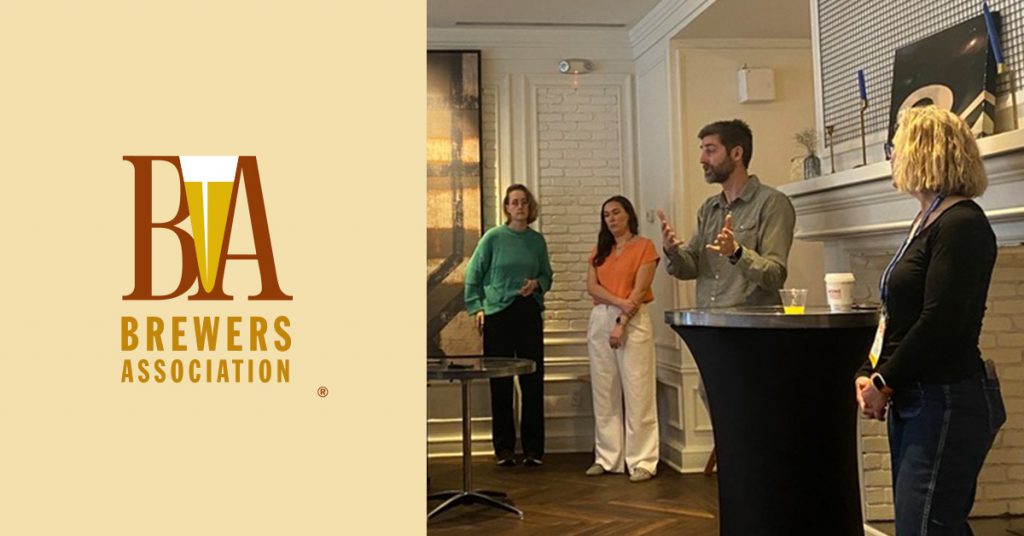
Under new leadership for the first time in more than a decade, the Brewers Association (BA) is “relentlessly focused on members and what their needs are,” CEO and president Bart Watson said last week.
Watson spoke to members of the beer-centric media during the BA’s annual Craft Brewers Conference (CBC) in his first press event since taking the helm in January of the largest trade group representing small and independent brewers.
Craft brewers are facing a potent cocktail of challenges – looming tariffs on ingredients and other inputs, waning consumer interest, encroachment from spirits-based cocktails and cannabis drinks and economic uncertainty spooking drinkers, to name a few. As the BA prepares to meet the moment, Watson underscored that the BA’s approach to serving its members has not changed, even though some of the challenges it is tackling are unprecedented.
“We serve as a gathering place, a place where we can aggregate resources so we can do things for members that they can’t do themselves,” he said. “What those things are might be different than I thought it would be as I took the job. Tariffs weren’t on my radar as a thing we would be spending so much of our time on.
“So the specifics have changed, but the overall vision hasn’t that much – that we need to be thinking about in these evolving times what it looks like for our members as their businesses change and evolve, where those new pain points then emerge because of that, and how we can play a role in solving,” he continued.
Attendance at CBC, the BA’s largest industry-focused event each year, was “down a little bit,” Watson said and pointed to a decline in international attendees. He estimated that registered attendees reached about 8,000, with an additional 1,000 people registering on site, historically.
Below are Watson’s remarks on key topics during the briefing, which have been lightly edited for clarity. [Revisit Brewbound’s coverage from Watson’s State of the Industry address for more information and look for a conversation with Watson on this week’s Brewbound Podcast.]
On how nearly half of all craft brewers grew in 2024 …
“We can play a little bit more of a finger-on-the-dial role in telling the positive of 43% of breweries grew last year. You walk around the trade show, talk to brewers, and there’s a lot of people who had great years. We need to find more ways to celebrate that … Rumors of craft’s demise are greatly exaggerated.”
On why the brewery openings/closings numbers aren’t the best indicator of health …
“To put it into context, 5% closings is still relatively low for an industry that is now largely hospitality operators, without understanding that that flip is driven much more by the openings declining following a sharp increase in openings, and without understanding that the vast majority of those closings are very, very small businesses that don’t actually shift the overall industry that much.”
On whether the BA board of directors may explore changing the organization’s makeup …
“What a craft brewer was and what our community looked like in 1985 is not what it looked like in the 2000s. It’s not what it looks like today. So I think they’re thinking about ways to continue to evolve that. In general, our ethos has been one of inclusion and broadening, so I don’t think anything’s off the table.”
On how the BA’s embrace of cider, ready-to-drink canned cocktails and full-strength spirits at the Great American Beer Festival (GABF) has not changed the association’s dedication to its members …
“We’re still the Brewers Association. And I’ve said some variants of this, our guiding light is still what our brewery members need. We’re not thinking, ‘Hey, what does a distillery first need?’ It’s ‘What does a brewer, who also distills, need?’”
On how perspectives on “craft” as a designation are shifting …
“As you get to a bigger tent, keeping everybody under the same labels is challenging. You’ve heard us in our messaging use ‘small and independent’ a lot more. I think that’s one of the things that ties our members together.
“As we move to this omnibibulous total beverage world, craft was a word that was used in beer. It’s also been used by spirits, but is less used in cider, it’s less used in wine. So there may be producers who don’t think of themselves as quite that same craft brewer bucket as they become total beverage companies.
“We’re going to try to focus on the businesses. We’re talking about those small, independent businesses, those local businesses. Craft’s still going to be one of those tools in the toolkit, but it’s one that maybe we’re going to go to a little bit less than in the days where our members looked more alike in their product mix and craft was more unified.”
On middle-tier consolidation reducing routes to market for small brewers …
“There’s only so many shelf sets and distributor trucks, and so we’re already seeing this. There’s only so many brands that could succeed. I would separate that somewhat from the total number of breweries.
“Could we see a world in which there are a lot fewer brands that are going out in broad distribution to the supermarkets in the next five, seven years, but that the total brewery number is roughly similar? I think that’s a possibility.
“One of the places I think we’re going to see this is the hollowing of the middle. You’re going to need to have a certain scale to play in distribution and that scale is relative. It’s your scale of your distribution footprint.”
On how the prevailing narrative that Gen Z consumers are eschewing alcohol may be overblown …
“Somewhere between 33% and 36% of Americans haven’t drunk for the last 100 years. So when you put it in context, this isn’t really actually a change. There have been subtle shifts that the media has latched onto to tell a story.
“I do think some of it in recent years is also coming from cannabis. Cannabis is telling a self-serving story of, ‘Hey, they’re leaning into our products because they don’t drink anymore,’ and that there hasn’t been enough critical look at that.”
And how the BA can help members adapt to demographic changes within the youngest legal-drinking-age consumers …
“We can continue to arm our members with lots of information about how legal-drinking-age consumers are changing. Rabobank’s done a couple of great reports on this and covered it in a variety of ways, but female drinkers [are] increasingly important to the beverage-alcohol market and with a different set of preferences.
“Letting them know how those preferences are changing, how they might adapt. BIPOC, the next generation is majority minority, and having brewers understand that again, where that might shift some of their strategies.”
On how the BA can boost draft beer sales, where craft brewers over-index …
Watson called flagging draft sales “a multi-faceted challenge” that “certainly has not re-emerged from COVID the way we would like,” and offered several tactics.
“One is legislative – support of the CHEERS Act, which, in and of itself, isn’t going to fix everything, but having on-premise operators who are more willing to invest in draft and are healthy is going to be a part of that picture.”
For example, the U.K. lowered excised tax rates for draft products to boost pub business in 2023, Watson said.
As an organization, the BA can tweak the way it displays and discusses draft with members, including providing them with draft profit calculators to educate on-premise accounts during sales calls.
“We can make sure we’re featuring draft in lots of images, making sure that the story we’re telling of beer is not just one of shiny cans, but of the beauty of a well poured pint. And we’re open to ideas like. It’s a place where our members are gonna come to us and tell us what’s working. And then we can magnify those things.”
On legislative priorities …
Watson detailed the BA’s other priorities, including potential regulation of intoxicating hemp beverages and possible changes to alcohol consumption guidance in the 2025-2030 Dietary Guidelines for Americans (DGA).
On hemp beverages …
“We’re going to be advocating that if there’s legalization, brewers should be able to participate. This should be a closed system, and that beverage-alcohol should have a role here.
“And we’re going to advocate for a level playing field. If these players are going to come into the intoxicating products market, they shouldn’t be able to do it with no excise tax, with the ability to make spurious health claims. They shouldn’t be able to do some of the things that have long been prohibited in alcohol.”
On the Dietary Guidelines for America process …
“There’s a lot of wild cards and question marks in this process. What we’re trying to do, along with the broader coalition of beverage alcohol associations, is make sure that that process is rooted in the science and not in particular politics.”
[Revisit beer trade group leaders’ thoughts on both hemp and dietary guidelines in this story from the National Beer Wholesalers Association’s legislative conference last month.]