
As some suppliers and wholesalers warm to intoxicating hemp beverages, bev-alc trade group leaders are looking for regulatory parity between their members’ products and the burgeoning segment.
“What our members want to see is a level playing field,” Brewers Association (BA) president and CEO Bart Watson said last week. “They want to see a regulatory system for these products that doesn’t give them advantages.”
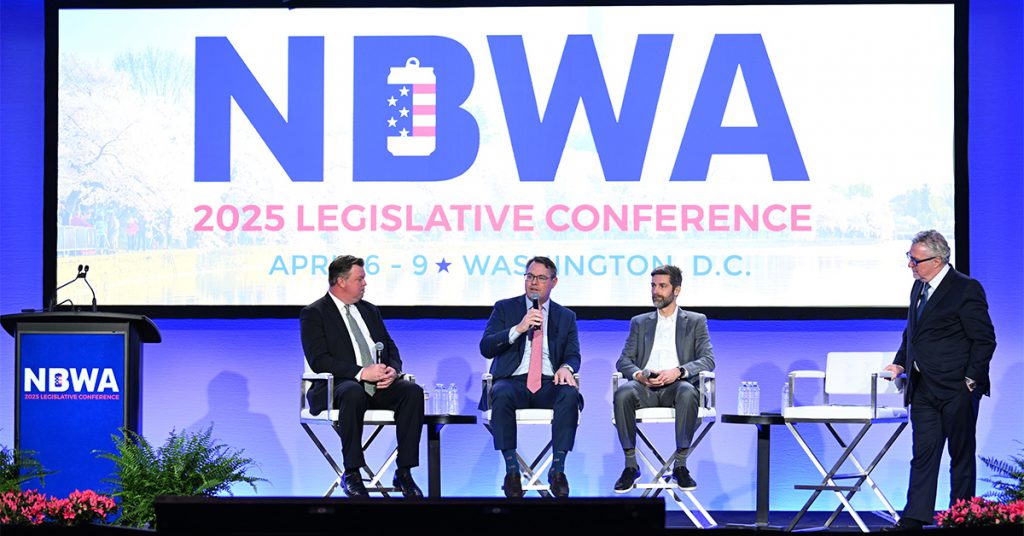
Watson spoke at the National Beer Wholesalers Association’s (NBWA) annual legislative conference last week in Washington, D.C. It marked his first major industry event speaking as the leader of the trade group representing craft brewers since taking the BA’s helm in January.
He was joined on a leadership panel by Beer Institute (BI) president and CEO Brian Crawford and American Beverage Licensees (ABL) executive director Jon Bodnovich, moderated by NBWA president and CEO Craig Purser.
The panel discussed issues facing all three tiers of the bev-alc industry, including intoxicating hemp beverages and the 2025-2030 Dietary Guidelines for Americans (DGA).
Intoxicating Hemp Beverages
Although laws regarding non-alcoholic, hemp-infused drinks vary by state, evolving middle-tier attitudes toward the segment began to shine through last year.
During the NBWA’s annual convention in September 2024, Purser pointed out that the three-tier system’s safeguards could benefit the hemp beverage industry, but noted that industry suppliers were “very concerned” about the rise of these products. At the time, several attendees had already begun distributing them in states where it was legal to do so.
Bodnovich, whose trade organization represents the nation’s licensed bev-alc retailers in on- and off-premise channels, acknowledged that his members sat out of many early cannabis legalization conversations because they “didn’t want to be in the cannabis business.”
“We realized, and our members realized 10 or a dozen years ago, that was probably a mistake,” he said. “We need to be at the table. We need to be there helping whether you’re going to sell it or not, and a lot of people are already selling.”
Both Watson and Crawford underscored the disparity between regulatory expectations for intoxicating hemp beverages and beer, especially as alcohol’s relation to health has been scrutinized during the DGA review process.
“We already talked about dietary guidelines, and you have hemp derived products out there making a whole range of health claims that they shouldn’t be making, particularly as you see more research on some of the negative effects of THC,” Watson said.
“I’m not going to bash those or the beverage-alcohol industry, but they should be on a level playing field, where there’s a clear taxation system, where there’s a clear system for age-gating, where they can’t make health claims willy-nilly and that they have rules about that,” he continued.
Watson noted that BA members have launched hemp-infused drinks in states where legal, such as Minnesota, where several craft brewers were early movers in the space.
Crawford, whose organization represents some of the country’s largest brewers, echoed Watson’s calls for fairness in regulation.
“You cannot compete with intoxicating hemp beverages when they do not have to pay an excise tax, when there is no regulatory regime in place, when there is no responsibility, and there is absolutely no research into these products,” he said. “The health claims are infuriating, especially in light of what we’re dealing with with dietary guidelines, but I will say that from a BI perspective, those four components have to be part of any debate, and that’s what we’re seeing on the state level.
“And kudos to the state executives that are in the room that have been leading the fight to bring a level playing field and to allow beer companies to compete with these intoxicating hemp companies that currently get a free pass.”
Although recreational cannabis is not federally legal, the 2018 Farm Bill removed hemp from the list of substances controlled by the U.S. Drug Enforcement Administration (DEA), opening the door for hemp-infused beverages. The five-year bill was set to expire but was granted a one-year extension in late 2024.
“Our hope is that Congress will address it,” Crawford said. “But the reality is that we are not getting the genie back in the bottle, and so we’ve got to put forward a regulatory regime that protects consumers and allows for a level playing field.”
Dietary Guidelines Review
Another topic where Crawford called for congressional action was the DGA process, which differed from prior norms with the commissioning of two studies about alcohol’s relation to health outcomes.
The dietary guidelines are released every five years by the Dietary Guidelines Advisory Committee (DGAC), a collaborative effort between the U.S. departments of Agriculture (USDA) and Health and Human Services (HHS). Existing recommendations are two drinks per day for men, and one for women.
The latest efforts by the DGAC have come under industry scrutiny as the process concerning alcohol consumption guidelines has been altered from the DGAC’s traditional process. The two reports in question have been conducted by the National Academies of Sciences, Engineering and Medicine (NASEM) and the Interagency Coordinating Committee on the Prevention of Underage Drinking (ICCPUD). The former has largely been accepted, but the latter has drawn the ire of industry leaders, due to what they perceive as biased researchers and overstepping the organization’s stated goal of keeping minors from drinking.
“We need Congress to step in and say this ICCPUD report is so far outside the bounds that it cannot be considered,” Crawford said. “It is tainted, it is biased and it is not based upon the preponderance of science.”
Crawford contextualized what the industry perceives as overreach into adults’ consumption of alcohol.
“This is a hugely important issue for all of us. This is an existential threat,” he said. “When you take a step back and you think about what’s happening with the World Health Organization and the notion of no safe level of alcohol consumption, and then the Surgeon General advisory that he dropped on the way out the door, which calls for beverage-alcohol labels that cite cancer risks, this is a coordinated attack on our industry, and we need to stand up.”
Tariffs and Trade Policy
The NBWA legislative conference took place against the backdrop of the rollercoaster of the Trump Administration’s tumultuous tariff-driven trade war. President Donald Trump ordered a 90-day postponement on “reciprocal” tariffs on April 9, while increasing tariffs on China to 145% and instituting a baseline 10% tariff on nearly all global imports.
Despite the postponement of reciprocal tariffs and carveouts for certain products, brewers are concerned about increasing costs on some of their inputs due to the administration’s trade policy. Trump imposed an across-the-board 25% levy on imported aluminum and steel on March 12, upping the aluminum tariff from 10% and removing exemptions.
“I represent small American manufacturers, so we understand what the president’s doing, and we certainly support efforts to support American manufacturing,” Watson said. “What we’re trying to educate on right now is where specific parts of those tariffs affect our members directly and don’t allow them to invest and grow here in the United States.”
“Team Beer” – the nickname the three beer-centric trade groups occasionally adopt – has long opposed the 2018 Section 232 aluminum tariffs, which did little to boost domestic aluminum production.
“We buy all of our cans here in the United States, mostly from American-made can sheet, but we don’t make enough aluminum,” Watson said. “We don’t smelt enough aluminum here in the United States currently to satisfy our can needs, so some percentage of that, if you do all the math, about 10% of every can in the United States comes from Canada.”
Similarly, U.S. craft brewers obtain about 40% of their malt from Canada, Watson said. While some products that comply with guidelines set forth in the United States-Mexico-Canada Agreement (USMCA) are not subject to tariffs, the fluidity of the situation may not instill confidence in brewers whose business is dependent on raw materials.
“U.S. barley is down 2% for 2025, so this isn’t a situation that’s going to change overnight,” Watson said. “We’re trying to educate about how our American manufacturing businesses could be supportive of the wider environment, if we had smart exemptions and carveouts.”