
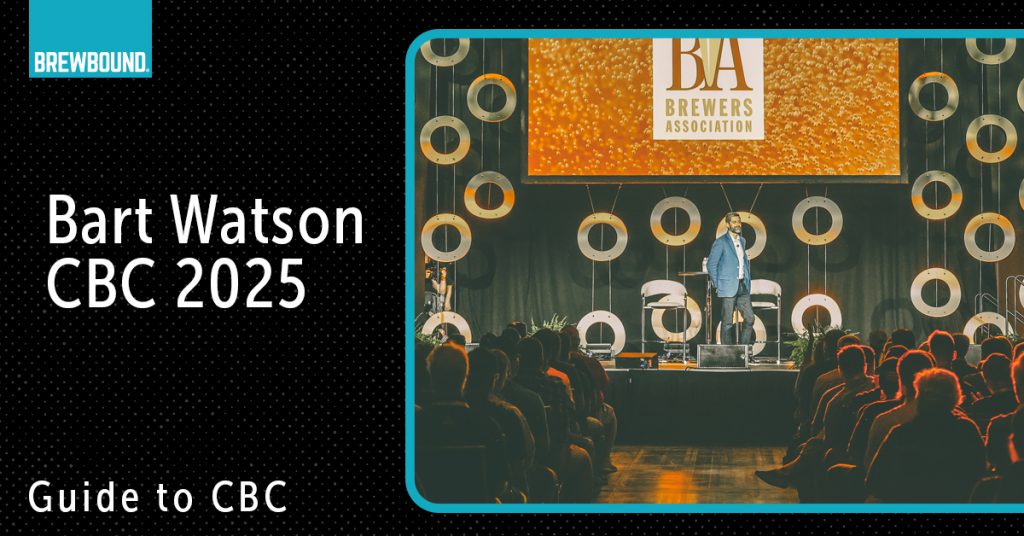
Anyone looking for an answer to when craft’s current era of compounding hurdles and declines will come to an end received a reality check Wednesday during Brewers Association (BA) president and CEO Bart Watson’s state of the industry address, held at the start of Day 2 of the Craft Brewers Conference (CBC) in Indianapolis.
Watson acknowledged that the most common question members are asking the BA now is “some version of ‘When are we going to get through this?’” Some trends are more short term, while others are “structural” changes, but at the end of the day “if you’re just trying to ride out the short term headwinds and make it to this long-term picture, you should probably reconsider that strategy,” Watson said.
As reported a few weeks ago, small and independent craft beer volume declined 4% in 2024, to 23.1 million barrels, while brewery closings (524) outpaced openings (430) for the first time since 2005, excluding the COVID-19 pandemic. Watson stressed that the vast majority of closures were breweries making fewer than 500 barrels of beer.
More than two-fifths (43%) of craft breweries recorded production volume growth last year, according to the BA’s annual production survey, on par with 2023 trends (44%).
“However, a declining industry limits the breadth of that growth opportunity, as well as how much one brewery’s success draws on another brewery’s volume,” Watson said in his remarks. “So while the overall growth number isn’t necessarily determinative of your company’s success – -4% doesn’t mean you can’t grow – it does set the overall balance of growth versus failure.”
The largest contributor to craft volume, regional breweries – those that produce more than 15,000 barrels of beer annually and sell the majority of their volume through distribution, according to the BA’s definition – performed slightly better than the overall segment, with volume declining 3% year-over-year (YoY).
In a shift from 2023, smaller regional breweries led growth, while top volume producers dragged overall performance down, Watson said. In 2023, regional brewery production volume grew 0.5% YoY, but would have declined 4% if the top three regional growth companies were removed.
The shift is likely due to distributors and retailers “leaning in on larger and more familiar brands” that consumers recognize, with brand identity vital on today’s crowded shelves, Watson said. Additionally, regional breweries have “put in the hard work in recent years” to focus their brand portfolios and condense their distribution footprints, “and that’s now paying dividends,” he added.
Contract brewers and brewpubs also each recorded a 3% production volume decline in 2024. The latter – defined as breweries that produce 1,600 to 15,000 barrels of beer, with at least 25% of their beer sales made onsite – took one of the largest hits in 2023, with production declining 3% versus 2022, and continues to tackle the extra business complications of running a food-led, on-premise business.
Microbreweries – those that produce fewer than 15,000 barrels annually and sell less than 25% of their volume on-site – recorded the largest YoY volume decline (-7%), adding to the 5% decline recorded in 2023. Those losses are partially a result of regional brewery growth, as distributors narrow their focus on a handful of craft brands, creating a “tyranny of space,” according to Watson.
“In a world of physical constraint, craft beer can’t be digital music that supports as long a tail as consumers will buy from, or the algorithm will show you,” he said. “So if you’re in distribution, you need to constantly be thinking about how you’re going to remain relevant to your customers, to your distributors – distributors are your customers – and your retailers, or risk being cut as part of that long tail that’s getting cut from shelves and from distributor trucks.”
The Benefit of a Total Beverage Approach
Craft breweries that also produced beyond beer products in 2024 recorded a median production volume growth of 1.1%, according to the BA’s survey – a stark contrast to the median decline of all respondents (-6.5%).
More than half (52%) of craft brewers that produced beyond beer products last year recorded production volume growth, outpacing aforementioned total industry trends (42%), suggesting that “companies that were diversifying are seeing stronger trends,” Watson said.
“Now we don’t know if that’s translated into profits or requires further investment, but that’s certainly a positive sign that many of you are finding new, innovative ways to grow,” he added.
Craft breweries are expanding their portfolio variety as consumers continue to diversify their bev-alc intake, particularly craft consumers, which tend to be more “omnibibulous” (drink a wider variety of bev-alc products) than other bev-alc consumers.
In the last five years, the percentage of craft beer drinkers that also drink other segments has increased across hard cider, hard seltzers, flavored malt beverages (FMBs), spirits and more. Meanwhile, their craft consumption habits have remained relatively stable.
Of the craft drinkers who say they are drinking less craft beer, the majority continue to say they do so because they’re drinking something else – a stat Watson has been sharing for several years.
In Wednesday’s presentation, Watson dove deeper into why consumers are drinking other products, analyzing results from a Harris Poll survey, sponsored by the BA. The survey collected responses from consumers who drink bev-alc “several times a year, or more often, but do not drink craft beer that often,” which is approximately 29% of the population.
The No. 1 factor, selected by more than half of respondents, as to why they do not drink craft beer very much, is “I do not like the flavor.”
“Craft’s broad success over the past decade has been driven by three letters: I, P and A,” Watson said. “And that’s been great for a lot of you – I’m sure a lot of you built flagship brands around that.
“And all of you know that there’s a lot of different styles out there, but I’m not sure consumers have gotten that message,” he continued.
Educating consumers on the flavor variety within craft beer is key to bringing in new consumers to the segment, particularly younger legal-drinking-age adults, Watson said. Part of that may be emphasizing fruity or tart beers, which can be a “gateway” to other beer styles that show off more of “the glory of malt,” he added.
“Until we get them in that door, we’re not going to get the opportunity to see them on that journey,” Watson said.
“I’m a firm believer that craft is the brands and the flavors that we need to win in the beverage-alcohol environment today,” he continued. “It’s an environment driven by flavor and variety. But what we need to get back to is focusing on delighting the customer, connecting with them and what they’re looking for.”