

Editor’s Note: The below news items were initially reported in the Brewbound Insider Newsletter between August 27-29. Become an Insider today to get earlier access to what’s going on in the industry.
Gordon Bowker, Redhook and Starbucks Co-Founder, Dies at Age 82
Seattle entrepreneur Gordon Bowker, who co-founded Redhook Brewery and Starbucks, died August 21 at age 82.
In 1971, Bowker, Jerry Baldwin and Zev Siegl founded Starbucks. Bowker and Baldwin sold Starbucks to Howard Schultz and an investor group in 1987.
Bowker’s beer industry ties run deep, from his advertising firm creating the Rainer Beer ads of the 1970s and 1980s, to the founding of Redhook with Paul Shipman in 1981.
Redhook would go through several ownership changes. In 2008, Redhook merged with Widmer Brothers (Portland, OR), forming Craft Brew Alliance (CBA). The breweries sold minority stakes to Anheuser-Busch (A-B) in exchange for access to A-B’s distribution network. A-B acquired CBA in 2020, but would sell Redhook and Widmer to Tilray Brands in 2023.
The Seattle Times offered an in-depth look at Bowker’s life, which you can read here.
David Macon Joins Ration Ale
Beer industry veteran David Macon has joined non-all (NA) beer brand RationAle Brewing as VP of sales.
Macon’s resume includes stints at major brewers from leading West Coast sales for New Belgium to leading sales at Firestone Walker to most recently serving as VP of commercial strategy for Karl Strauss. He also worked for ready-to-drink (RTD) bev-alc brand Jiant as chief sales officer and a business advisor.
Tilray Escapes Delisting, Regains Nasdaq Compliance
Tilray Brands is no longer at risk of being delisted. The Canadian cannabis and craft beer firm has received a written notice from the Nasdaq Stock Market confirming the company is back in compliance with the exchange’s minimum bid price of $1 per share.
As we reported in March, Tilray was in danger of being delisted after failing to maintain the $1 per share price for 30 consecutive days. Nasdaq gave the company until September 21 to regain compliance by achieving a closing price of $1 or higher per share for at least 10 consecutive days. At one point in the last 52 weeks, the stock (TLRY) was trading at a low of $0.35.
Tilray’s stock price rebounded after an August 11 comment from President Trump saying his administration was exploring reclassifying marijuana from a Schedule 1 drug, with heroin, LSD and ecstasy, to a Schedule 3, in line with ketamine, anabolic steroids and testosterone.
The company’s stock ended trading on Friday, August 8, at $0.65. After the comment, the stock spiked to $0.92 on Monday, August 11, and then crossed the $1 threshold on Wednesday, August 13.
At press time (August 28), Tilray’s stock was trading at $1.41.
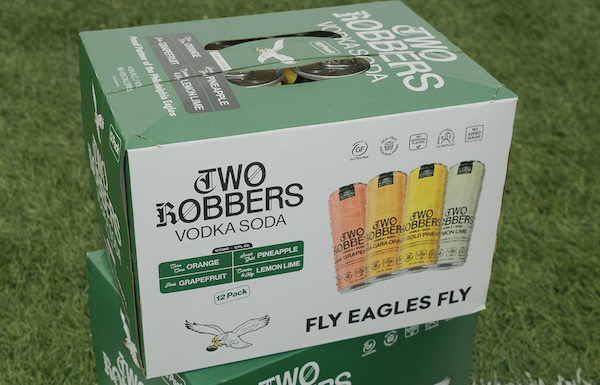
Two Robbers Drops Philadelphia Eagles Branded Packs
Just in time for the 2025 NFL season, Philadelphia’s Two Robbers Spirits Co. is adding Philadelphia Eagles-branded vodka soda 8- and 12-packs to more than 500 retailers across Eastern Pennsylvania, New Jersey and Delaware. Standard Distribution (Delaware) and Allied Beverage (New Jersey) will begin distributing the packs on September 1.
Retailers carrying the variety pack – featuring Cara Cara Orange, Gold Pineapple, Pink Grapefruit and Lemon Lime – include Giant, Whole Foods, Fine Wine & Good Spirits, Acme and Weis, as well as independent retailers.
The packs are part of Two Robbers’ multiyear partnership with the Eagles. Two Robbers products are also being served at all events at Lincoln Financial Field.
Two Robbers CEO Vivek Nayar said: “As a Philly-born brand, bringing our Eagles-branded packaging to more fans across the region is a huge moment for us. Whether it’s at the stadium or at home with family and friends, we’re proud to be part of how Eagles fans celebrate game day.”
Wall Street Journal: Recycling Could Be Key to Tackling Rising Aluminum Costs
Consumers may be able to help ease the impact of aluminum tariffs on beverage-alcohol producers and other industries, according to a recent report by the Wall Street Journal.
The key: improving recycling habits and supporting aluminum recycling plants.
More than $1 billion in beverage cans ended up in landfills in 2024, the WSJ reported, citing figures from the Aluminum Association. If more of those cans ended up recycling centers to be smelted down and reused, the U.S.’s aluminum import needs could be slashed in half, according to the trade group.
Such efforts could be vital for bev-alc brands that continue to tackle rising aluminum costs and unpredictable trade policies. The industry has been dealing with a 10% tariff on aluminum imports since 2018, when President Trump enacted Section 232 tariffs in his first term. That percentage increased to 25% this year at the start of Trump’s second term, and was then doubled to 50% in June. Numerous exemptions have also been eliminated over the course of this year, with more expected.
43%
^ That’s the percentage of consumers who “typically purchase more U.S. produced drink brands” when visiting bars and restaurants this year compared to 2024, according to a recent survey by CGA.
That percentage increases to 63% when including only 21- to 34-year-old consumers and 54% of 35 to 54 year olds, but declines to 21% among consumers 55 and older.
Just under half of total survey respondents (49%) said they would be very likely (24%) or likely (25%) to “consider a brand’s country or origin when deciding to make a purchase in the on-premise.” Just over one-quarter (28%) said they are “neither likely nor unlikely,” while 8% said “somewhat unlikely” and 14% said “very unlikely.”
CGA did not provide reasons for why consumers are leaning more towards U.S. brands, but it wouldn’t be a stretch to assume it’s in part due to the country’s political and economic environment, including rhetoric from the Trump administration and related trade policies.
The imports segment is certainly feeling the changes in the off-premise. While still the largest segment in the beer category, import beer dollar sales (-2.3%) and volume (-4.1%) are both down year-to-date (YTD) in Circana-tracked off-premise channels through August 10. A year ago, the segment was still growing, with dollar sales increasing 4% and volume up 2.7% YTD through August 11, 2024.
Meanwhile, the domestic super premium segment continues to record growth, with dollar sales and volume both up 3.1% YTD. During the same period in 2024, the segment was about flat (dollar sales and volume +0.5%).