
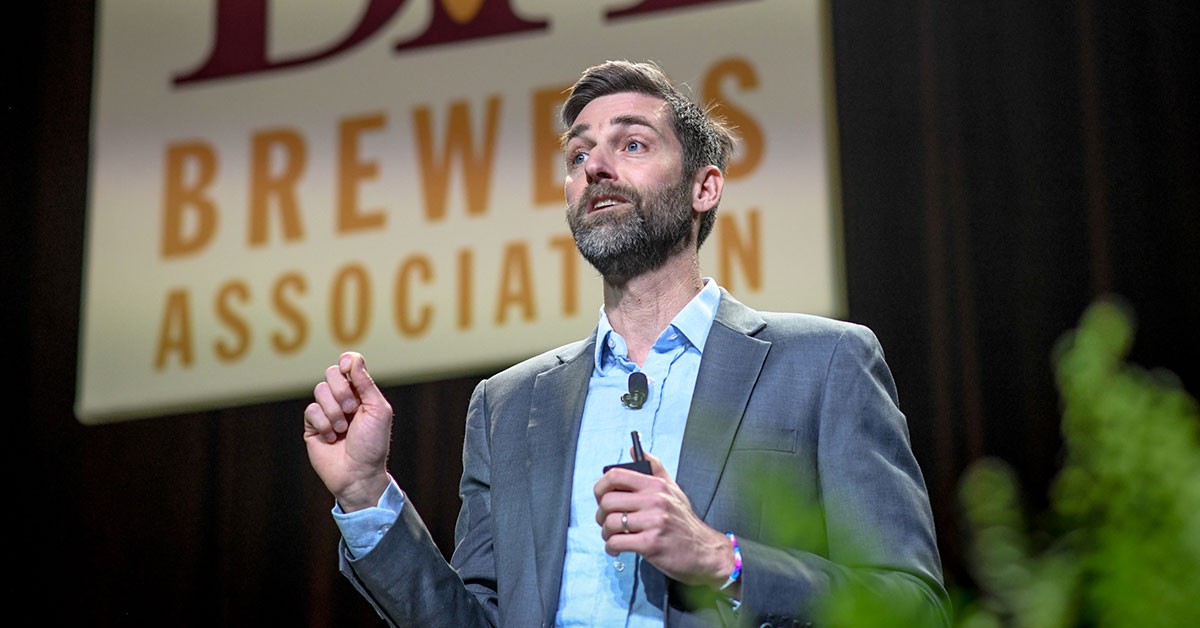
Craft volume is down an estimated -2% through the first six months of 2024, according to Brewers Association (BA) chief economist and VP of strategy Bart Watson in his annual midyear webinar Tuesday.
Watson evaluated craft’s midyear performance using BA survey results, scans, data from the Alcohol and Tobacco Tax and Trade Bureau (TTB) and more. He noted that the BA’s pool of survey respondents is not as robust at midyear as its year-end survey, and that there might be a bias, as breweries with more positive years so far are more likely to report their figures.
A majority of respondents to the BA’s survey said they have increased production volume since the same midpoint of 2023. However, those reporting growth have likely taken volume from other craft breweries, Watson noted.
Depending on how responses are weighed to account for bias, BA-defined craft breweries are either static or slightly below 2023 performances, suggesting “fairly similar” trends to 2023, Watson said.
Additionally, growth in the amount of breweries in the U.S. has remained low, if not static, so far in 2024. An estimated 9,528 breweries were in operation through mid-2024, up slightly from 9,456 in operation at the end of June 2023. The number of TTB brewery permits issued per quarter declined slightly, suggesting it will probably level out in the next few years, Watson added.
While the craft numbers are not positive, craft’s problems are not unique to the segment, or to the overall beer category, Watson emphasized.
Total beer shipments have seen “more of a leveling” in 2024 after steadily declining each month in 2023, Watson said, citing rolling 12-month beer shipment numbers from the Beer Institute (BI), through May. Meanwhile, 2024 for total bev-alc “has been a tough one,” with wine and spirits facing questions around demand, changing consumer preferences and concerns over the economy – all questions that are commonly asked of beer, Watson said.
Watson also analyzed off-premise scan data for BA-defined independent craft, which differs from the way many market research firms define craft. The BA also includes non-alcoholic (NA) beers in its definition, while not all scan data firms include NA in craft. Most market research firms include craft brands that are owned by large, global brewers such as Blue Moon (Molson Coors), Goose Island (Anheuser-Busch InBev) and New Belgium (Kirin).
Total craft beer volume, measured in case sales, in NIQ-tracked channels (multi-outlet plus convenience) in the 24-week period ending June 15 has declined -3% year-over-year (YoY). However, independent craft volume has declined -2.1% in the same period. Other NIQ-defined craft – most of which falls outside of the BA’s definition – has declined -4.4% YoY.
The discrepancy is likely due to large brewers pulling out of the craft segment and pulling down volume growth, Watson said.
“We’re seeing some companies that have a wide range of products focus less on craft,” Watson said “And that shouldn’t affect how independent brewers look at their business.”
Independent craft’s volume decline is about in the middle of other segment’s performances so far this year. Flavored malt beverages (+20.8%), domestic super premiums (+40.4%) and below premiums (+40.6%) continue to record significant volume gains YoY, while hard seltzer (-21.2%), domestic premiums (-4.8%) and hard cider (-2.4%) are not only in the red, but performing below independent craft.
Looking beyond the top 30 companies in each beer segment – defined as “all other companies” – craft volume remains at -2.1%, with about 75.37% of beer volume outside the top companies. The other segments recorded a collective +8.9% increase in volume from “all other companies,” and 24.63% share of the long tail’s volume.
Segment performances changed more beyond the top 30 than craft changed, with cider (+5.3%), FMBs (+41.7%), below premiums (+20.6%), and domestic super premiums (+4.1%) all in the black YoY, and hard seltzer (-4.5%) and domestic premiums (-11.7%) in the red.
In the on-premise, there is some growth for craft, which is “a change” from past trends, though how much growth has yet to be determined, Watson said.
With relatively static trends, smaller trends and changes will likely have a larger impact on breweries’ bottom line moving forward, Watson noted. He pointed to varying craft performances by state, and how many breweries reported the significant impact of the weather and city and taproom events on whether their taproom numbers went up or down.
“That’s what you’re gonna expect to see in a more static marketplace,” Watson said. “Little things can push you up or down because you don’t have that baseline of growth.”
Watson also noted a widening gap between the “winners and losers” when it comes to keg volume share in the on-premise, which is a result of distributors leaning more on the companies they know can move volume, as well as breweries making hardline decisions on whether to pull back on distributed draft, or leaning in and investing.
Looking at the economy – which tends to be less important for craft than other supply-and-demand dynamics, according to Watson – there is a general stability in supply chain costs. Input costs have “remained high,” following an economic trend of “up like a rocket, down like a feather,” where prices spiked during the COVID-19 pandemic, followed by a slight come-down in price, but not anywhere near the rate prices increased in the first place, Watson said.
Consumer spending across food and beverages has grown in 2024, but much of that is due to price increases, Watson said. In “real terms,” i.e. when price is adjusted to control for spending and price increase, “there really hasn’t been growth” in food and beverage sales.
“Yes, consumers are spending more, but they’re spending more on everything,” Watson said.
A trend to watch will be any shifts in consumer spending, as the combined Consumer Price Index for food and beverages both at- and away-from-home have fallen below trend expectations within the past six months, Watson said, citing the U.S. Bureau of Labor Statistics.