
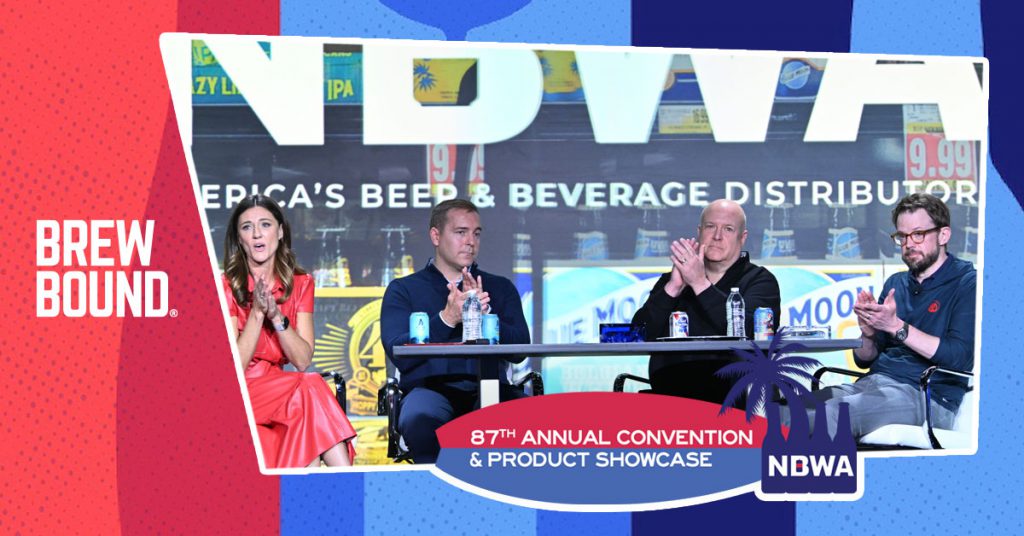
An industry-wide effort is needed to reverse soft beer category trends, elevate the category and appeal to young legal-drinking-age (LDA) consumers, leaders from New Belgium, Pabst Brewing and Athletic Brewing shared during a discussion with consultant Amy Jo Martin as part of the general session of the National Beer Wholesaler Association (NBWA) Annual Convention in San Diego.
A recurring theme within Monday’s panels was the health of the on-premise channel.
Pabst CEO Paul Chibe said: “One of the things I really have a strong conviction on is that the on-premise has a big role in the health of the off-premise.”
Chibe acknowledged there are labor and time costs to service bars and restaurants, but “the question that I think needs to be asked is, what’s the cost, not the serve.” He stressed the benefits of brand building, “taste imprinting” and trial in the channel.
“One of the opportunities that we have as an industry is to reignite that segment and make sure that our industry is paying attention to it in the proper way, because again, I don’t expect that we can have a healthy off-premium business unless we’re appropriately attending to the on-premise.”
New Belgium CEO Shaun Belongie shared that the maker of Voodoo Ranger takes a holistic view of the beer category and cautioned the “danger of seeing the world through the Nielsen lens,” referring to market research firm NIQ, which tracks off-premise scan data in retail outlets and convenience stores.
“The danger is that you start thinking of it as a consumer way of thinking, and only thinking through those lenses, you can really trap yourself into potentially limiting where you can take the category,” he said.
Belongie added that New Belgium looks for ways to disrupt those conventions and find opportunities to forge a new path, especially with the Voodoo Ranger franchise of IPAs and now hard teas.
Athletic Brewing co-founder and CEO Bill Shufelt said the non-alcoholic (NA) beer segment often comes with the caveat of “off a tiny base.” However, Shufelt offered that NA beer is “almost 5% of all 6-pack business” in the U.S. and in states with higher household penetration “we’re one of every seven 6-packs sold in total beer.” One retailer is on pace to sell 30,000 6-packs this year.
With those bonafides, Athletic is investing in the future of the beer category.
“As the non-alcoholic beer guy in the room, I want to reassure everyone that we are not trying to bring back prohibition,” he said. “We are here for category growth. We’re here for jobs. We’re here for the love of beer. And we’re investing heavily in that.”
Athletic has created more than 250 U.S. jobs and invested more than $100 million in U.S. manufacturing, he continued. Athletic will continue investing into a business that is pulling in new consumers, with 30% of Athletic shoppers new to the category or a lapsed drinker, and a majority (59%) of those consumers are coming from soda and water.
Reaching new LDA consumers and capturing occasions will be key to category health moving forward. New Belgium, for example, sees eight beverage occasions a day and the question is which occasions are able to win within, Belongie said.
“Beer has done a really good job of winning occasions where you’re looking for sessionability,” he said.
Beer producers shouldn’t get hung up on beer being just “malt, hops and water” or they may miss the opportunity to connect with consumers on what they’re seeking in products, Belongie said.
Belongie explained that Voodoo Ranger Juice Force, which became the No. 1 new craft product launch, was born from brewers experimenting by mixing flavor attributes from New Belgium’s hard seltzer trials with the Voodoo Ranger line’s hazy IPA profiles.
Chibe added that core beer has several attributes that are strong, including low ABV, low calories and low carbs – attributes that should be marketed and leveraged to win consumer occasions.
Shufelt also cautioned suppliers against the rush to copycat when there’s a “sliver of growth” within the category.
“Convenience buyers don’t want to see 3,000 19.2 Voodoo Ranger copies,” Shufelt said. “They want to see new-to-world innovation.”
“When I think of the category, there are so many powerful brands,” Belongie added. “But we do have this tendency to all crowd in when a new opportunity is developed and I think the real play for us is to think about where there is more of an incremental thing, where this is actually going to grow the category, not just steal share from each other.”
Appealing to the new generation of LDA consumers was a consistent theme of the panel. Shufelt said the industry needs to tell a consistent marketing message to share the “romance of beer” with those consumers.
“As this new generation that we’re all trying to wrap our heads around turns 21, how are we teaching them to fall in love with beer, like the romance of beer, the ingredients, the occasions, when you’re celebrating or relaxing after a day of work, beer is in their hand in those occasions,” he said. “That’s a responsibility of all of us to tell our communities.”
Meeting younger LDAs where they are through video game culture, streaming platforms such as Twitch, and discussion groups such as Discord is important, Belongie said. It’s about “being creative and thinking through the consumer lens.”
Chibe said “we can win the war on alcohol,” pointing to “misinformation about health impacts” as federal agencies craft dietary guidelines for 2025. He relayed a conversation with Beer Institute president and CEO Brian Crawford that found that over a lifetime, the difference between drinking two beers a day versus none was a shortened life expectancy of two months.
“If the general population knew that, ‘Hey, I could have two beers a day or I could have none and it’s going to have none and it’s going to cost me two months of my life,’ they’d sign up instantly,” he said.
The beer industry has struggled with younger consumers who aren’t going out as much and have become more isolated, Chibe admitted. He believes that there are positive aspects the industry plays a role in creating a “better life experience that leads to positive mental health” through camaraderie and friendship.
“We can’t forget that. We can’t turn our back to that. We need to push back on the war on alcohol,” he said to applause.
Chibe called for the industry to do a better job of marketing beer and elevating the image of beer as a “special” beverage with an “aspirational view of life.”
“We can’t let there be a fundamental attitudinal shift toward the consumption of beer,” he continued. “We can’t let that happen.”