
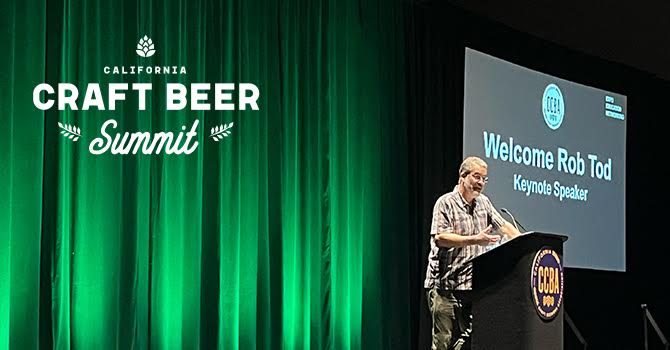
Allagash founder Rob Tod kicked off the 2024 California Craft Beer Summit discussing how the Portland, Maine-headquartered craft brewery is approaching the “tough” post-pandemic beer market.
In his keynote address, Tod recalled the easy growth years from 2005 to the start of the pandemic, when craft brewers didn’t have to work too hard to bring consumers into their orbit. Those years have given way to a more “unsettled period” with an “uncertain future” that is increasingly more competitive within a more mature marketplace, Tod said.
He estimated that there are now around 10,000 breweries now across the U.S., and competition isn’t limited to other beer producers, with ready-to-drink canned cocktails and hard seltzers taking up space in beer coolers. Consumers’ appetites for craft have also changed, with the days of just putting out a beer and hoping it sells are gone. Meanwhile, input costs are up, and interest rates have doubled.
Where does that leave craft brewers?
Tod said it’s time to focus on the fundamentals: quality, efficiency and being more thoughtful and methodical with go-to-market strategies. Craft brewers need to work now to bring people into their experiences, physical spaces, mission and brands.
A word coming up more in conversations around Allagash is “optimize,” Tod shared.
“We need to optimize our breweries in a way that just wasn’t very critical pre-COVID,” he said. “There wasn’t the pressure to optimize like there is now, and we’re absolutely talking about all those things a lot at Allagash.”
Those conversations include discussing how to attract more and diverse consumers to their spaces and experiences, Tod said. The answer for Allagash is community building.
“New customers, they’re out there,” Tod said. “We just have to reach them and there’s no question that all of us would benefit from more craft beer customers and a broader audience.”
The proliferation of breweries across the country makes craft brewers “really uniquely positioned to reach new customers through building community,” Tod added.
Allagash’s community efforts have included achieving B Corp certification in 2019, which Tod said takes all of the company’s positive initiatives and rolls them into “a cohesive and powerful brand proposition.” All of this leads to a strong commitment to the brewery’s stakeholders, community and employees. Included among Allagash’s initiatives is a $0.10 per barrel donation to Sebago Clean Waters, an initiative aimed at protecting water quality.
“There’s a lot of breweries in the Portland area that use Sebago Lake water,” he said. “Through this program, we’re creating a unique connection to what we do and we’re bringing people into the craft beer community with this messaging in this program.”
Allagash is also working to connect with its community through philanthropic and volunteer work. The brewery’s workforce is averaging around 2,000 hours of volunteer work each year, he said. Through collaborations and events, the company is aiming to include more diverse partners and people into the experience by broadening its reach, including the brewery’s taproom.
“When someone walks in there, I want people to feel like they can be part of that experience,” Tod said. “That’s important to me, philosophically. I want people to feel welcome. But it’s good business. It’s building our customer base.”
Allagash is also committing to its local community through ingredient sourcing. In 2016, the company pledged to grow the amount of Maine-grown, processed and packaged grains, barley and oats it uses from 65,000 pounds annually to 1 million pounds by 2021.
“We hit 1 million pounds in December 2021, and we keep building on that program,” he said. “In 2023, we actually bought 1.8 million pounds. If we keep growing, it’s another example of the good that can come with growth.
“It’s good business,” he continued. “People really have become engaged with this story and become engaged with craft beer because of the story. And interestingly enough, we’ve built a micro-economy in Maine that just didn’t exist before for supplying brewers.”
Tod added that Allagash can now purchase more inexpensive wheat in Maine than sourcing it from the Midwest, while also reducing its carbon footprint. He admitted that community building initiatives aren’t cheap in an environment with little slack, but he views them as an investment that is resonating with consumers.
“We don’t have any illusions that we’re going to double or triple our business through these efforts over the next five or so years, but it’s gonna make a difference,” he said. “Like I say to our crew all the time, it’s a game of inches these days. So for us to bring more people into our experiences and bring more people into craft, we’re gonna have to work at it. I learned that lesson back in the ’90s when I was struggling to sell a cloudy beer, and the lesson is still more relevant than it ever was.”
Tod said he sees more parallels now to Allagash’s early days in the mid-1990s than over the last decade in a more “forgiving” environment.
“We don’t have limitless budgets, but we can be creative doing this community-building work,” he said. “We’re really uniquely positioned because we’re an industry that has a presence in pretty much every single community in this country. We’re really well-positioned to effectively do this work. So let’s keep building community and welcoming people to our experience and knock on wood, we’ll keep growing.”