
At its simplest translation, the Hawaiian word aloha means both hello and goodbye – opposites in English.
In a similar vein, the idea of market retrenchment in craft beer can sometimes indicate a brewery in decline. But for Kihei, Hawaii-based Maui Brewing, it’s the opposite. The brewery is preparing to slice its mainland footprint in half because the growth in western states far outweighs any possible upside in other markets.
“We’re actually going to be discontinuing our mainland co-manufacturing arrangement at the end of this year, so we’re winding that down,” Maui president and COO Scott Metzger told Brewbound. “We’re also going to be pulling out of a few markets where we’re just really unable to support it in the way we’d like to, or maybe it didn’t even make a whole lot of sense for us to really be there to begin with.”
The move will take Maui’s footprint down to a fraction of its current 26 states, concentrating on the West Coast.
“What we’re finding right now is that we have a few states outside of just Hawaii, primarily in the Western U.S., that are really kicking butt, and we’re not doing the best job at customer service, because we’re trying to allocate product that absolutely will sell in California, Oregon, Washington, Nevada, and we’re shorting those customers to make sure we get beer out to Florida or Massachusetts,” Metzger said. “Obviously it’s not inexpensive to get beer to those states, and we’re passing up more profitable volume in order to do it.”
Other states that will continue to receive Maui products include Idaho and Alaska, where Maui’s Washington distributor the Odom Corporation operates branches. Colorado is “a little bit of a question mark” depending on the complex logistics of shipping beer from Hawaii to the mainland. Maui’s soon-to-be-former contract production partner is based in Colorado, which made operations much simpler.
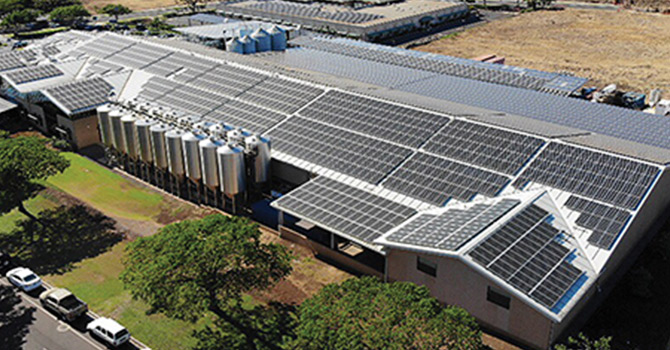
Year-to-date (YTD) through September 14, Maui is the sixth largest brand family by dollar sales in Hawaii, according to scan data Metzger shared. It trails only the country’s largest brands: No. 1 Anheuser-Busch InBev’s (A-B) Michelob, No. 2 Heineken, No. 3 A-B’s Bud, No. 4 Constellation Brands’ Corona and No. 5 Molson Coors’ Coors.
Dollar sales of Maui’s portfolio are up 12.1%, and it holds a 6.4% share of beer category dollars (+0.56 share points year-over-year [YOY]). The brewery’s volume is up 9.5% YoY. Maui has the second-largest dollar sales and volume gains in the beer category, behind Michelob (+25.8% in dollars and +22.4% in volume), which is riding a historic wave as it continues to absorb the volume sibling brand Bud Light began shedding in 2023.
The Hawaiian market has not been so kind to Maui’s local competitor Kona, which is owned and operated independently from A-B-owned mainland Kona. The islands’ second largest craft brand family has recorded double-digit losses in dollars (-11.4%) and volume (-14.2%) YTD through September 14, according to the data Metzger shared.
“We have almost perfectly inverse growth trends, but we’re at a significantly higher premium price point, so it’s not a matter of drinkers flocking to the value brand,” Metzger said. “In fact, the opposite is happening, which is really interesting and telling, especially given the economic climate and all the views around pricing.”
In 2024, Kona Hawaii’s production volume declined 25%, to 60,000 barrels, making it the country’s 37th largest craft brewery by volume, according to data from the Brewers Association (BA). In the same year, Maui’s output increased 10%, to 115,645 barrels, ranking it 17th. Overall volume comparisons aren’t apples to apples, because Maui sells beer to half the country, while Kona Hawaii only distributes within its home state.
“What speaks to our brand and what’s working is the authenticity of our brand here in Hawaii,” Metzger said. “We have our restaurant locations on two islands where people can continue to connect with our brand. We’re doing a really good job just getting out on the street with our sales team, reaching accounts, getting that message across, and I think it’s really resonating.”
Maui’s Hawaiian origins make the 20-year-old brewery relevant to islanders and aspirational for mainlanders. To study Maui’s spiritual brand peers, the brewery partnered with Chicago-based data and insights firm 3 Tier Beverages to create a custom tracker of “vacation lifestyle brands,” Metzger said.
The 11 brands in the cross-category data set – which include offerings such as Corona, Kona, Gallo’s High Noon Sun Sips spirits-based ready-to-drink (RTD) cocktails and Mark Anthony Brands’ White Claw and Cayman Jack – have significantly outpaced the beer category in dollars and volume.
Beer-based vacation lifestyle brands posted growth in both dollar sales (+4.5%) and volume (+2.1%) in the 13-week period (L13W) ending September 6, according to NIQ data shared by 3 Tier. In the same period, total beer was down 2.4% in dollars and 3.6% in volume. When spirits-based RTDs were included in the vacation lifestyle set, gains accelerated to 16.3% in dollars and 23.1% in volume, 3 Tier told Brewbound.
In the L13W, Maui increased dollar share and velocity (+17.6%), which is impressive considering that the brand’s dollar sales (-1.2%) and distribution (-16.2%) dipped amid its ongoing market contraction, according to data 3 Tier shared.
Hard Seltzer Success
As Maui pares its footprint back, a trend emerges in the states where it will continue to distribute, which is resoundingly hard seltzer.
“Our POG [passion fruit, orange, guava] seltzer is far and away our biggest seller,” Metzger said. “In some states, that’s really all they carry, and they’re crushing it with it.”
Maui’s hard seltzer portfolio makes up 75% of its volume in Oregon and about two-thirds in Washington, where the brand family is up 49% in sales YTD, Metzger said.
The company’s hard seltzer philosophy has always been one of simplicity. Maui Hard Seltzer includes four island-inspired flavors (POG, Dragon Fruit, Hibiscus Lime and Lemonade), which check in at 5% ABV and 100 calories, excluding Lemonade, which has 120 calories.
“We really try to avoid going down the route of ‘Hey, we’ve got 14 different varieties and three different mix packs in eight different sizes,” Metzger said. “We’d like to keep it pretty simple, and it’s working for us.”
The company has kept beyond-beer innovation to a minimum. POG Harder, an 8% ABV version of POG hard seltzer, has “had some mixed results.”
This fall, Maui began shipping Peach Mango hard tea (5% ABV, 130 calories) to other markets after initially distributing it only within Hawaii. The wider launch has delivered “some incremental growth force,” Metzger said.
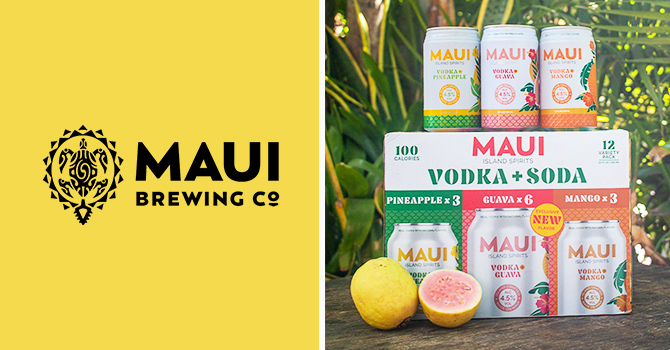
In early 2025, the company introduced Maui Island Spirits, a vodka-based hard soda line featuring Vodka + Pineapple and Vodka +Mango, both 100 calories and 4.5% ABV. Notably, the new RTDs are under the Maui brand and not Kupu Spirits, the company’s long-standing spirits brand family. Kupu will focus on full-strength spirits and wind down its RTD offerings, Metzger said.
Core Beer is ‘Strong’
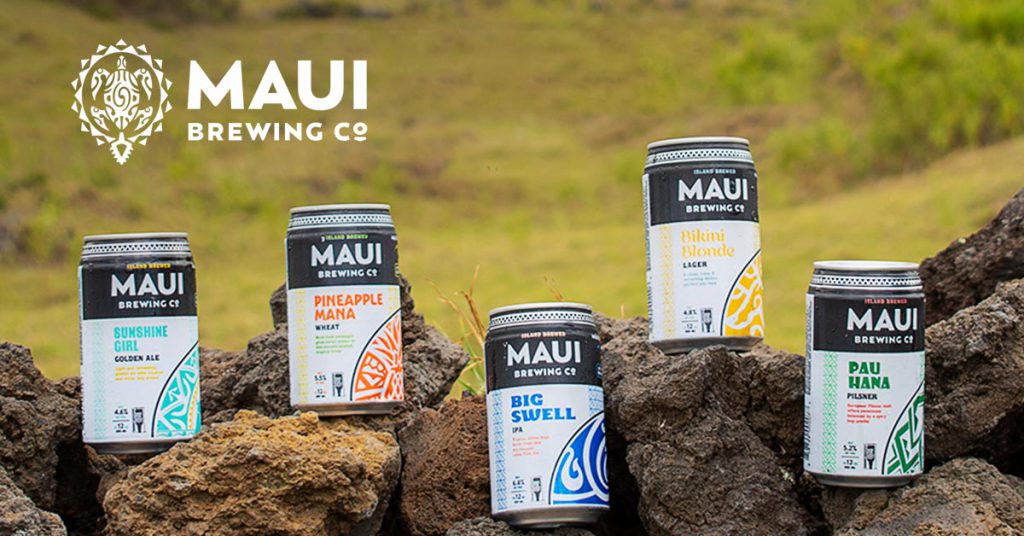
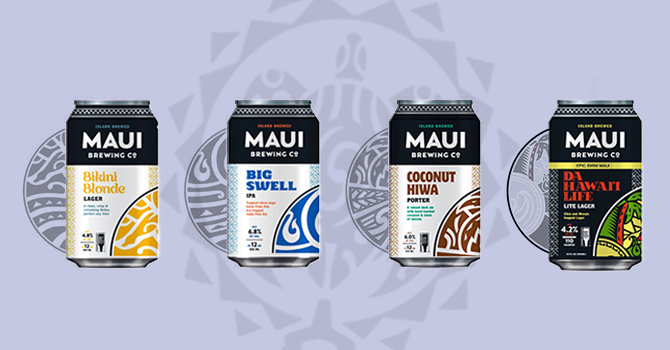
Maui’s core craft beer portfolio centers around eight offerings:
- Bikini Blonde Lager (4.8% ABV);
- Big Swell IPA (6.8% ABV);
- Coconut Hiwa Porter (6% ABV);
- Da Hawaii Life Lite Lager (4.2% ABV);
- OMG Hazy IPA (7% ABV);
- Pau Hana Pilsner (5.2% ABV);
- Pineapple Mana Wheat (5.5% ABV)
- And Sunshine Girl Golden Ale (4.6% ABV).
The beer portfolio isn’t recording the same growth as Maui’s hard seltzers, but “they’re both growing really rapidly,” Metzger said.
“Beer is strong,” he said, pointing to Oregon as an example where Maui’s beer portfolio grew 12%.
2025 was a light innovation year for Maui’s beer portfolio on the heels of a broader launch of Da Hawaii Life Lite Lager in 2024. Metzger hinted at new beers in 2026 that the company is “not quite ready to talk about yet.”
With the offloading of Modern Times complete, Maui – which will eventually shed the Craft ‘Ohana platform name it adopted when it acquired the San Diego-based brewery – has evolved its self-concept. At a time when many craft breweries have begun to envision themselves as total beverage producers, Maui recognizes its brand and home state afford it the status of lifestyle purveyor.
“At some point, we need to stop thinking about ourselves as a craft brewery or craft beverage company,” Metzger said. “We’re just a beverage company with a unique value proposition, being that we’re from Hawaii, and that’s what we need to lean into and not worry so much about what are the craft trends, or what’s happening in craft beer, for whatever that means, and say we’re just some other competitor in the beverage space.
“We’re competing for the domestic lager drinker as much as we’re competing for the high-end craft drinker,” he continued. “Our target demo is anyone who would be interested in a vacation in Hawaii. I think that’s a pretty broad demo – maybe the broadest demo we can think of.”