

After ending fiscal year 2024 (FY24) with single-digit volume declines, Boston Beer is planning to dial in on key innovation items and support its portfolio with increased advertising in 2025.
The company – whose brands include Twisted Tea, Truly Hard Seltzer, Sun Cruiser, Samuel Adams, Dogfish Head, Angry Orchard and Hard MTN Dew – ended 2024 with shipments (sales to wholesalers) -2.4% and depletions (sales to retailers) -2% compared to FY23. However, its fourth quarter volumes outperformed the full year, with shipments -0.5% and flat depletions.
“I’m encouraged with the progress we’re making to be a more focused organization,” CEO Michael Spillane said during a conference call to discuss financial results Tuesday evening. “Although we still have work to do to be sharper in our execution, there are multiple areas of opportunity ahead for Boston Beer and I look forward to sharing our progress with you as we go through the year.”
For 2025, Boston Beer is embracing its status “as a diversified beyond beer company” with a drive “to focus on achieving the potential of all of our brands and in a disciplined, ‘fewer-things-better’ strategy,” Spillane added.
Boston Beer plans to increase advertising and promotional spending by $30 million to $50 million in 2025, which it expected to front-load into the first half of the year with a “significant” increase in Q1, according to a press release. Podcast partnership, particularly with Bartstool Sports-owned shows, feature throughout the portfolio.
2025 Priorities by Brand
Twisted Tea has been the company’s largest brand for several years, and its growth has begun to slow after years of posting double-digit gains.
“Past performance is not an indicator of future performance,” founder and chairman Jim Koch said in response to a question about the brand’s slowing growth. “We’re basically saying that time period is over, and it’s a big brand. It’s one of the top 10 brands in all of beer.”
In the last 12 weeks, ending January 26, Twisted Tea dollar sales have increased +4.3% and volume, measured in case sales, +2.7% versus the same period in 2023, according to Circana-tracked off-premise data, marking a stark difference from the double-digit gains posted a year ago.
As the 24-year-old brand adjusts, Boston Beer is focusing on innovation at the upper and lower ends of the ABV spectrum: Twisted Tea Light (4% ABV) and Twisted Tea Extreme (8% ABV).
“Those will bring in new drinkers,” Koch said. “So those are our primary stimuli to basically turn around the scanner trends that you’re seeing.”
Twisted Tea Light “continues to be highly incremental” and increased sales +24% in off-premise scan data last year through points of distribution that are less than 25% of Twisted Tea Original’s, Spillane said.
Twisted Tea Extreme launched in trial markets, but will get a wider rollout in 2025 as the company works toward national distribution.
Promotional efforts for Twisted Tea include partnerships with DraftKings, Barstool’s Bussin’ With The Boys podcast and Top Rank Boxing. The brand is also creating in-store advertising to appeal to Hispanic consumers, among whom Twisted Tea is underrepresented.
Truly Hard Seltzer is following a similar playbook, with a focus on Truly Unruly (8% ABV) and Barstool podcasts. The brand is partnering with Barstool’s Pardon My Take sports podcast and Chicks In The Office, a culture and entertainment show. These relationships will extend beyond in-pod ads to include digital and retail activations, Spillane said.
“Our higher ABV Truly Unruly offering has performed above our expectations and we expect it to be a key contributor in improving the trajectory of Truly,” Spillane said. “Unruly is the No. 1 growth driver among high ABV brands in the U.S. beer market and as I mentioned earlier, we believe it is bringing new drinkers to the category.”
Boston Beer plans to ramp up Truly’s ad spend heading into the summer, and its messaging will evolve from “emphasizing functional attributes to a more compelling new brand message,” Spillane added.
The portfolio’s transition to “lighter flavors” is “mostly complete,” Spillane said. The only “bold flavor” variety packs remaining on Truly’s website are lemonade and punch.
Sun Cruiser, the vodka-based hard tea Boston Beer launched last year as a challenger to Stateside Vodka’s Surfside, will be nationwide in the first half of 2025, Spillane said. The company has added 24 oz. single-serve cans, additional flavors and a lemonade variety pack.
Boston Beer trialed Sun Cruiser in its New England and Atlantic divisions (Maine to Virginia) in 2024 and found success in the on-premise and independent off-premise channel, neither of which are entirely captured by scan data. The company expects to triple the brand’s points of distribution in time for this summer.
“In 2025, we are focused on driving awareness of this new brand by increasing marketing investments and expanding the product offering in a disciplined way,” Spillane said. “Our brand investments are focused on increasing our sales force and local marketing programs as well as Let The Good Times Cruise television and digital campaign with media investment in key sports moments such as the Super Bowl, AFC Conference Championship, MLB Opening Day and the PGA Tour Golf.”
Asked if Sun Cruiser’s growth has negatively affected Twisted Tea, leadership offered a rare split opinion. Spillane said the company has seen “very minimal to no cannibalization,” but Koch insisted “frankly there has to be some interaction.”
“We’re not really seeing it because what Michael alluded to – they’re positioned differently, they’re priced differently, the packages look and feel different, but it can’t be zero,” Koch said. “So yes, there’s going to be some. I don’t have a good estimate, but there has to be some interaction between them, and that’s both Surfside and Sun Cruiser.”
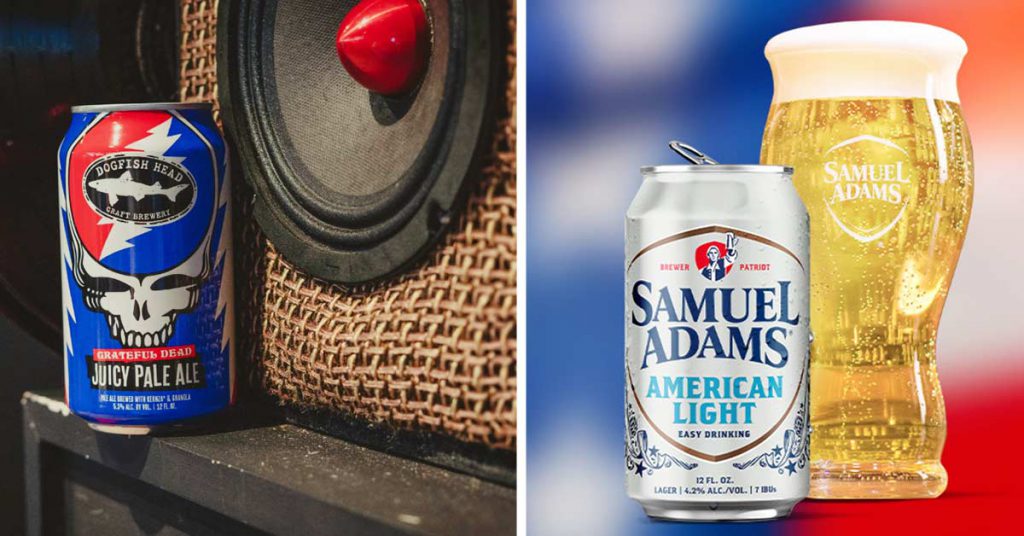
Samuel Adams will also focus on the national roll out of Samuel Adams American Light, which launched in test markets in 2024, as well as the brand’s seasonal family and its Just the Haze non-alcoholic IPA.
American Light (4.2% ABV) will be supported with a March Madness-focused on-premise campaign in Q1, Spillane said. The new, 115-calorie offering fulfills a “long-term, unmet need” in the beer category, Koch said.
“There’s really no trade up from light beer. There’s no high end light beer,” he said, adding that the country’s leading domestic super premium Michelob Ultra is “often sold at the same price” as its sibling Bud Light.
Dogfish Head has partnered with the Grateful Dead to launch Juicy Pale Ale, which uses the band’s iconic imagery on its packaging. [Watch founder Sam Calagione debut the beer at Brewbound Live 2024.]
The launch, the largest in Dogfish’s history, will be supported by “media and local marketing,” Spillane said.
Hard MTN Dew will launch a Code Red flavor next month. The brand is available in 30 states, according to its website. The company was “encouraged” to see Hard MTN Dew’s depletions turn positive in late 2024, Spillane said.
“We expect growth for Hard MTN Dew in 2025, but it will be a multiyear effort for this product to become a meaningful part of our volume mix,” he said.
2025 Guidance
For FY25, Boston Beer expects both shipments and depletions to land “between a decrease of low-single-digits to an increase of low-single-digits year-over-year,” CFO Diego Reynoso said.
“Where we land within this range will be impacted by the pace of improvement in the overall consumer environment and the time it takes our marketing initiatives to drive market share improvements,” he said.
The company plans to increase pricing +1% to +2%, which will “cover commodity and inflationary impacts,” Reynoso added.
Boston Beer is beginning Year Three of a five-year financial plan to improve margins. Progress has been made in procurement savings, but the company is beginning to examine its distribution footprint and “there’s more work to come,” Reynoso said.
One cost-saving measure is to bring more production volume in house from third-party partners, which accounted for 26% of the company’s volume last year, he said. “More consistent and predictable volumes” will help the company plan better and identify areas for saving.
Intoxicating Hemp, Dietary Guidelines and Other Concerns
Boston Beer is “ready” with an intoxicating hemp beverage, should it choose to release one, Spillane said. The company created a beverage-focused subsidiary in Canada in 2021, which launched THC-infused teas under the TeaPot brand in 2022.
“If we saw that the opportunity was there where we felt we could scale a profitable business in that space in the United States, we are prepared to do so,” Spillane said. “We just haven’t seen that at this time.”
The company is keeping tabs on the legal permissibility of THC drinks on this side of the border, which vary by state.
“It’s kind of the Wild West out there,” Koch said. “You’ve got Minnesota, where you could basically sell a can with 70 mg of THC in a Toys ‘R Us … and then you’ve got California, where it has to go through dispensaries and maybe even is totally outlawed.”
Koch noted that middle tier opinions on intoxicating hemp beverages are evolving, with beer wholesalers becoming more open to selling the products. However, he sees the drinks as being “a much bigger threat than weed, because you’ve got it in Total Wine, you’ve got it in liquor stores in Louisiana, it’s in grocery stores.”
“It’s there next to beer and that’s the first time that’s happened,” he said. “So, it’s just too early to tell, but to me, it is a more serious challenge to beer and beer occasions.”
He pointed out that beer sales remained stable in Colorado and Washington, the first states to legalize recreational cannabis, but the current drinks are “a new animal, and they bear watching.”
If intoxicating hemp beverages pose a threat to consumers’ bev-alc buying habits, the national discourse around alcohol and health is another, Koch said.
The Dietary Guidelines Advisory Committee (DGAC), which evaluates alcohol’s place in the Dietary Guidelines for Americans (DGA) every five years, commissioned two studies on alcohol consumption’s relationship to overall health. The discourse has garnered national attention, and has sparked conversations about alcohol’s connection to some forms of cancer and other health outcomes.
“It’s getting diffused through the population that wasn’t there before,” Koch said.
The rise of GLP-1 medications, which some users report suppress their appetite for alcohol, are another potential factor that could lead to an overall decline of bev-alc consumption, which Koch said has been steady for decades.
“Add all those together and … instead of [bev-alc] growing 1% a year, it could be down 1% a year,” he said. “It’s not sudden or catastrophic, but there could be an erosion.”