
Lord Hobo Brewing and Lone Pine Brewing announced plans to merge today, bringing together a pair of New England craft breweries under a single ownership structure.
The companies declined to share financial terms of the transaction, which is expected to close in Q4, pending regulatory approval. However, Valterra Partners, the private equity firm that first acquired a minority stake in Lord Hobo in 2017, is the principal investor behind the new ownership group.
Woburn, Massachusetts-based Lord Hobo and Portland, Maine-based Lone Pine said the merger centers on a strategy of creating a platform for the “breweries to invest in brand-building, quality and innovation” in their home states.
“What we’re striving to do is to create something that’s quite different, which is a solution where we can thrive in craft, rather than just survive,” Lord Hobo CEO Simon Thorpe told Brewbound. “The basic idea of what we’re trying to build here is a platform that is focused very much on brands that can grow, that can stretch, can travel, can move across categories and brands that resonate with the consumer in a very deep way.
“So if you compare us with other platforms that are developing, there are some quite strong differences,” he continued.
Valterra co-CEO Scott Macintosh said in the announcement: “Having changed management and turned around both the financial health and growth trajectory of Lord Hobo in 2023, this merger represents an important second step in realizing our long-term vision of investing behind a scale, branded company that establishes itself as a pillar of the craft community in the Northeast. Bringing Tom [Madden] and John [Paul] into the combined company considerably strengthens our board, our leadership team and our culture.”
Under the new combined entity, both Lord Hobo and Lone Pine will maintain their own names and identities, director of marketing Aubree Karls told Brewbound.
Conversations between Lord Hobo and Lone Pine started in early 2023, but Lord Hobo’s search for a partner has been going on for three years, Thorpe said. In that time, the company has screened 400 breweries and entertained “serious discussions” with 12 in 2023.
Lord Hobo’s goals for growth are ambitious. Thorpe explained that companies need “somewhere in the region of $120 to $140 million in revenue to be credible.
“You need to be generating somewhere in the region of $20 to $25 million of EBITDA [earnings before interest, taxes, depreciation and amortization] to have the internal motor to really be able to do the things that you want to do,” he continued.
To do that, Lord Hobo is looking for partners with brands that “can grow and stretch relatively quickly” as well as other M&A deals to “bolt on additional scale to reach that cohesive critical mas,” Thorpe said.
Lone Pine’s deep Maine roots were extremely attractive to Lord Hobo, which recognized parallels to its own ties to Greater Boston, Thorpe said.
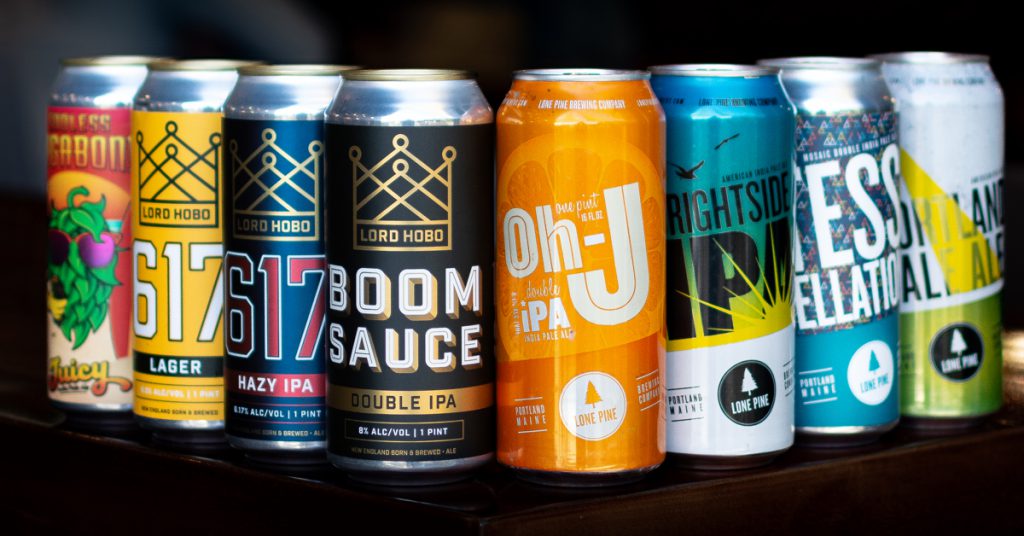
“The important part of this is that it’s not just at Lord Hobo, where we have brands like Boom Sauce, which really resonates at a deeper level, and 617, which is the local area code and really resonates inside Boston,” he said. “You’ve got a brand in Lone Pine that really resonates in Maine and the whole of New England, and it stands for something that is aspirational to people in the whole of the Northeast.”s
High school friends Tom Madden and John Paul founded Lone Pine in 2016. Madden and Paul will join Lord Hobo’s board of directors and will serve as the combined company’s COO and VP of sales, respectively.
Lone Pine has grown to include a production brewery in Gorham and taprooms in Portland, Westbrook and Old Orchard Beach, which the company will continue to invest in. The Portland location, on Anderson Street in the brewery-dense city’s East Bayside neighborhood, has particular potential for expansion.
The Gorham brewery has been running at its full 16,000 barrel capacity “with really no means to do anymore,” Madden told Brewbound.
“Part of our instigation for seeking partnership has been that we’ve been operating this facility at a critical mass for about three years now where we’ve had to outsource a fair amount of our production into contract brewing, especially during our peak seasons,” he said. “Maine is a very transient vacation state where we see a huge spike in sales in the summertime, and it’s been difficult to manage the peak and valley of the production process.”
Lone Pine’s 2023 output was similar to Lord Hobo, at 17,917 barrels of beer, according to data provided by the Brewers Association (BA). Production was flat year-over-year (YoY), but down from its 2021 peak year of 21,179 barrels of beer.
Lord Hobo produced 17,074 barrels of beer in 2023, a -27% YoY decline, according to the BA. Production has declined from its peak of 47,145 barrels of beer in 2019.
Lone Pine’s volume will shift from contract brewing partners to Lord Hobo’s Woburn facility in time for next summer.
“We’re stepping into a system that has headroom and that can allow us to grow the brand in a very thoughtful way,” Madden said.
The move will also free Lone Pine production employees to explore product innovation and quality, he added.
“There’s a lot of very positive enthusiasm from our group about what we can really do with products,” Madden said.
Both brands will remain dialed in on the New England market to start.
“In a world of limited resources, it’s all about focus,” Thorpe said. “It is more important for us as a group to create a strong consumer franchise in a constrained geography than it is to go shallow and wide.
“That way, we can reinforce the brand in 20 different ways with a core consumer group who grows to love us, and then maybe 10 years down the line, we’ll be able to expand it geographically,” he continued. “The initial focus is all in a fairly tight geography that stretches probably somewhere from the Carolinas up to New England. And certainly, this first move is very much a northeast New England play.”
The breweries share similar distribution footprints, with both selling in Maine, Massachusetts, New Hampshire, Rhode Island, Connecticut, New York, New Jersey, Pennsylvania and Florida. Lone Pine also distributes to Vermont, Maryland, Virginia, North Carolina, Utah, Colorado and Michigan. Lord Hobo distributes to Ohio in addition to the shared markets.
Distributor networks for the companies are about 60% aligned, leaders told Brewbound. Notably, they are not aligned in their respective home markets. Lone Pine is sold by Nappi Distributors and Central Distributors in Maine, and Homegrown Distribution and Merrimack Valley Distributing in Massachusetts.
In Massachusetts, Lord Hobo is sold statewide by Atlantic Beverage Distributors, while Vacationland Distributors carries the brand in Maine.
“We’re naturally going to be looking at the best path forward for each organization by territory,” Lone Pine co-founder John Paul said.
On the sales side, the company plans to add headcount in Maine, where Lone Pine “already does about 100,000 to 130,000 cases” statewide, Paul said.
“And that’s with one sales rep and one national account manager,” he said. “There is a vast, vast level of growth that we can achieve if we were to add more bodies into the market.”
All sales employees will represent both brands once the companies merge, and the extra headcount will provide an immediate boost, Paul said.
“With these additional resources, we can see those numbers increasing exponentially,” he said of Lone Pine’s case sales in Maine. “Obviously in Massachusetts, it’s quite similar for us. We have one rep who handles Massachusetts and New Hampshire, so I think there’ll be an immediate, incremental lift with adding additional resources.”
When it comes to channel strategy, the breweries have complementary strengths, Paul said.
“Lone Pine is very strong in the chain channel and in that platform, whereas Lord Hobo is phenomenally strong in Mass. liquor and convenience,” he said. “There’s a lot of crossover there that will naturally be realized.”
Unlocking growth through retail chains is a core driver of the deal and Lord Hobo’s strategy for the developing platform overall, Thorpe said.
“No one craft brewery today can afford to have a really good chain presence, but combined we can, and that’s part of the puzzle,” he said.
As a point of differentiation as the platform comes together, the company plans to deploy pull marketing strategies more akin to traditional CPG marketing rather than craft beer’s typical push marketing, which usually entails investing 4%-5% of revenue on “fairly conventional things like in-store promotions or some events,” Thorpe said.
“We’re committing in this to spend north of 10%-12% of revenue on consumer pull marketing, which is closer to the way that you might think real consumer goods companies like Kellogg’s, Coca-Cola – people who really understand how to drive consumer pull – that’s the kind of level that they would be spending,” he said. “We’re trying to create a completely different investment model in a way that the consumer thinks about the brands that we’re creating.”
Lone Pine planted a flag in spirits last year with the launch of Lone Pine American Craft Vodka, which has secured a foothold in Maine.
“Vodka is the absolute most competitive category you can enter, and we’re winning close to home, and that’s what matters,” Paul said. “That’s really a key thing in all this is – how deep can you go close to home?”
Three years ago during the hard seltzer boom, Lone Pine launched its own version, which has found an audience for its variety pack in Maine.
“That is our North Star for that brand – we’re not going to be competing with Truly and White Claw in Wisconsin. It’s just not going to happen,” Paul said. “Being that lead seltzer brand that’s local in Maine was our goal with that, and we’ve definitely accomplished that.”
Similarly, Lord Hobo is working on expanding into the spirits category next year, Karls said.
“We are looking to launch spirits in 2025,” she said. “Combining resources with Lone Pine is really going to help bring that to life.”
Lord Hobo started as a pub in Boston’s Cambridge suburb in 2010 before starting brewing and distributing beer in June 2015. The company sold a minority stake to Valterra Partners in 2017 to fuel growth.
The years that followed were somewhat turbulent due to the COVID-19 pandemic and allegations of inappropriate behavior from founder and former CEO Daniel Lanigan, which came to light in 2021 during the craft beer industry’s reckoning with sexual harassment and gendered discrimination in its workplaces.
Lanigan vacated the executive post in 2021, but had begun to transition responsibilities in 2020, when then-COO Nathan Whipple, who has since departed the company, was promoted to president. Since then, Lanigan sold his stake back to the company and exited completely, according to an All About Beer story published earlier this year that detailed his brash persona and penchant for sports cars.
Today, the brewery operates taprooms and restaurants at its breweries in Woburn and Boston’s Seaport District.
Through the rollercoaster of the past near-decade, Lord Hobo has been able to forge a culture of resilience, which employees recognize in Lone Pine, making them an ideal partner for the next phase.
“The strength, hard work, dedication and loyalty of the Lord Hobo team and culture are truly remarkable,” Karls told Brewbound. “As we approach our 10-year anniversary, we’re not only celebrating a decade of success but also honoring several employees who have been with us for this entire journey.
“Some new and long-standing team members even rock a Lord Hobo tattoo, which I find incredibly powerful and a testament to their commitment,” she continued. “Through everything I’ve learned from John Paul, Tom, and the Lone Pine team, I’ve seen how grounded and welcoming they are, fostering a strong and dedicated group of people.”
An immediate benefit of the merger is the ability for both companies to provide growth opportunities for employees, which would not have been possible as independent breweries, Thorpe said.
“There’s a limited number of things that you can achieve in your professional, personal development in a craft brewery of a certain size, but if you put it together, it grows, it’s bigger,” he said. “There’s more opportunity for our existing people. It’s a really important point in terms of how we think about developing our people, our culture, creating the opportunities for the people who’ve been with us for the long-term.”
The Lord Hobo-Lone Pine merger follows a string of similar M&A activity in New England. Last month, Framingham, Massachusetts-based Hendler Family Brewing (HFB), parent company of Jack’s Abby Craft Lagers, acquired Everett, Massachusetts-based Night Shift Brewing. HFB was founded earlier this year when the company acquired Worcester, Massachusetts-based Wormtown Brewery. In January, Finestkind Brewing, the parent company of Hampton, New Hampshire-based Smuttynose Brewing, acquired Massachusetts’ Wachusett Brewing.