Search across the BevNET CPG Media network including BevNET, Nosh, Brewbound, Taste Radio, Nombase and CPG Jobs.
Sponsored Workshop: Turning AI Into Front-Line Growth and Margin Impact
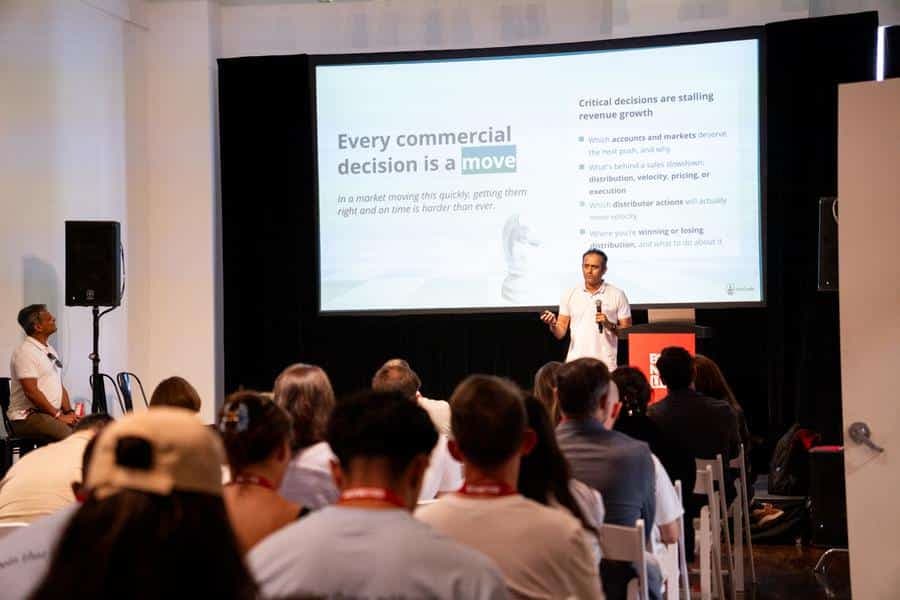
AI has created more insights across the beverage industry — but not necessarily better execution. This workshop explores how beverage organizations are using AI to reduce decision latency, identify execution gaps faster, and turn fragmented commercial data into coordinated action, front-line growth, and measurable margin impact.
Srinivas Jagannathan, Chief Product Officer, BevGenie
Shyam Jayakumar, CEO, BevGenie
Gauri Sharma, Head of Data & Analytics, BevGenie
Transcript
Note: Transcripts are automatically generated and may contain inaccuracies and spelling errors.
Sham Jay Kumar [00:27] I'm going to get started. I know the title of this session you're here for turning AI into frontline growth and margin impact. Um The reality is there's not going to be a lot about AI in this conversation. It's going to be more about decisions. Um, so I'm excited to spend the next hour with you, introduce my team, go through what we have built here, um, and yeah, let's get started. My name is Sham Jay Kumar. I'm the founder and CEO at Bevgenni. I've spent the last 25 years in enterprise tech, helping organizations with data and analytics and building dashboards and insights, everything that sits on top of data. I have a team supporting me here. Gauri Sharma, my analytics lead, and she's an industry advisor for us. She comes from the beverage industry. Shrini Jagannathan, he's our chief product officer, classic Silicon Valley tech guy. So he's, I'll let him introduce himself when he comes to the stage. Um, And Like I mentioned, a lot of conversation today. What we're going to show to talk about today is decision making, right? We've seen enterprises invest a lot of money and time building infrastructures and data, and we've had a lot of conversations with our customers, business leaders, sales and marketing folks, suppliers, and one thing kept coming back up again and again. Uh, is, is the ability to make the right decisions at the right time or lack thereof. So we want to solve that problem here through Bevgeni. Before we jump in, um, I want to talk about where we are at today. By the way, Knicks, any Knicks fan, any Knicks fans in the room? New York Knicks. All right, awesome. So today they have Game 4, right, and they are probably going to get one step closer to history, hopefully, and that's something that was in the making for a long time, but you look back, it looks like the last 6 months really got them to where they are, right? The momentum was there. There was team coming together. They played amazingly well. It looked like things clicked in the last 6 months, but something that has been in the works for a long time. In our own small way. That's how we feel, 6 months. It wasn't just the last 6 months. The last 6 months, a lot of ground was covered. We were in a small room in LA in December launching our beta product. I should be seeing here, launching our beta product. Bevgeni and sharing my vision to the audience. And in the last 6 months we have fast forward, we have customers that we have brought on for pilots. We have commercialized our offering and they are assigned paid customers. We have brought on many industry advisors that are supporting us in this journey. We not only have a product that we have delivered for our suppliers, now we have a product for distributors. And we have had some distributor conversations. I think there are some distributors in the in the in the room today. Raise your hands if you're representing distributors. Oh great, no, nobody. OK. So full circle. It feels like we have come full circle here. So today we are here an evolved version of what we have built. Devgeni for suppliers that's out there. You can you can pilot that. You can sign up, start using that, and then we have something we are building for distributors that we have also put out there as a pilot. Alright, um, I also want to recognize this. The beverage industry is operating in a much different environment than it was a few years back, right? There's a lot of pressures, margin pressures, distributors wanting to expand on revenue and margin and growth. Um, retailers, grocers, drinking habits have changed. The generational shift. There's so many things that are happening in the market, and it keeps moving, right? And one thing that is very important, when we started working for the last few years, providing technology solutions for the beverage industry. We thought we would find a data problem. What we found out was not a data problem at all. What we found out was a decision problem. Nothing to do with data and reporting and analytics as people have always constantly worked on solving for that over the years. What we found is really making the right decisions, making actions on insight. That was, that's a decision problem to solve for, right? And the world environment we are in today. It compounds. It's even more important to make the right next move. The yesteryear where you can take a few wrong steps and you can pull back doesn't exist anymore. We need to be absolutely surgical and right about the next move we make. That's what we are solving for, right? And you can see here where we are winning, what markets we want to expand, who we want to target, and what's the velocity, what's the pricing promotion strategy that we need to have in place, who are the distributors we need to target, who are the ones we need to drop, and I don't know if you have the luxury to do that, but those are the conversations, those are all decisions, key decisions to be made. Every decision, commercial decision, is a move and needs to be the right one. Yeah, to the point I was making earlier, right, we went in, we have customers who do not struggle with data and information in their hands, right, and they have a lot of that. This beverage industry especially has a plethora of data, right? It's the the insights and the level of actionable insights that they can make. That's where the gaps are. We saw a couple of gaps that surfaced itself. One was the signals gap. The data, the depletions data, scans data, distributed reports, pricing data that's coming in, each telling its own story, and a lot of companies out there are solving for that today, no doubt, right, but where they don't solve for the next two gaps that we identified, which is the decision gap. OK, teams come together, they debate debate on a problem, what a number means, how do I trust this data that I'm seeing? Can I actually make a decision on this? Is the assumption that I'm making safe to bet on? Right, that takes its own time, and that's what we mean by decision gap. Right? Assuming that everybody comes together with something, and then comes the execution, you need to execute on it, right? Now, show me the prioritized list of accounts. Show me the distributors I need to work with today. Right, how do I expand? What are the recommended follow up steps? By the time you come together and do this, a lot of time is spent on analysis. 80% of the time is spent on analysis, paralysis. By the time you want to act on the data, time has moved, moved on, and you don't have the luxury to spend anymore, and you don't have execution slows down. So our idea here with Bevgeni is remove the time it takes for you to do the analysis. We've done all the analysis on your behalf. Right. Data is data. We have connected with all your data. You've ingested a lot of market signals. We are phasing out. You're giving back your time, right? You focus on what's important for your decision. Act on the decision and make execute on them and make, make your business grow to profitability, right? Oh. I'm going to Turn over to Shrini to come in and talk about where some of the existing ongoing struggles are, right, with AI on top of data, and Shrini, take it away from here.
Speaker 2 [08:50] Thank you. Uh, I thought he was gonna keep going. He's doing such a good job, but uh my name is Srini. I'm the chief product officer. And I think it took the clicker too. Um, The chief product officer at Consumer IQ. Uh, the first thing you should know about me, as I already told you, I'm from California. I'm very happy to see only two expanse here, gold acres. Uh, now that I've lost half my audience, the second thing I want to say is I'm very new to CPG, right? Beverage, beverage, uh, alcohol, all of it is sort of new to me. And I've worked in many industries where the last 12 months have been a learning experience for me, right? Now, all of you know, Chief product officer means something in Silicon Valley, and that's not about the products you all deal with. You can't hear me. OK. I thought I was just projecting. Is that better? OK. Right, where was I? Chief Product Officer. And the whole point of it is Silicon Valley knows how to build technology, but they don't know your business, which is why a large language model like Cloud, Opus, or Fable, which just came out, or chat GPT's models, they're really, really good at doing one thing. They're the absolute best in class, which is writing code. And I know that because I use it, right? But they don't know your business. I know that because I don't know your business and I work with these people. So what they do, right, what Silicon Valley does, and some of you may actually be very well connected to it, is they hire the experts. So the first thing I do is I'm not going to come work for Sham, but he's got Gori there and she knows the job, right? And she's going to show you how she uses the product, how she steers it. Because that is ultimately what we're trying to do. We're trying to help her do her job. We're trying to help you do your job. And if your product officer does not know what your job is, right, doesn't understand that products mean different things to you, and you call them brands and you manage them differently, there's a big learning curve. Now, having said that, bright blue ocean, it's all clear. I come in. And I'm like, I don't know, it's not complex. You have a complex business question, and chat GPT will give you a great answer, right? But you all know the devil's in the in the details, and I brought this with me this morning because it was sort of exemplary of the conversation Gori and I had this morning. I look at it, it says, bright side, strawberry sunshine. I don't know if folks from Bright Side are here today, but it's really cool. It's got zero sugar, which is impressive considering I put it in my mouth and it tastes like candy. And uh of course, there's the hidden detail about Zembrin, right? Obviously, kids these days aren't drinking as much. Uh, they like bright colors, bright flavors. It's all rational, it's all logical, and they care about health, and they want to think of themselves as being healthy too. So when you get a South African extract, I'm literally a walking talking advertisement for For bright side, except if you go ask Chad GPD will tell you all of that stuff. And you ask it for another product like Bright Side, it'll probably come up with a fright ride, I don't know, and a dark color, and instead of strawberry sunshine, maybe blackberry moonshine. But the thing is, it gets the concept. It gets like a management consultant does. It can tell you the high-level stuff. What it can't tell you is what you know. Which is the devil's in the details, and the details go deep, right? And it's not about what you can see in those clear waters, it's what's hiding underneath it. The people who built that product had to think carefully about that design. They didn't just throw it at cloud design, right? They had to think about how to brand it, how to name it. They had to think about the brane. They had to source the ingredient. They had to think about how to basically establish that it is clinically trialed, right? It's a botanical extract used for centuries, and it should bring you peace and calm. And this morning I will say this minus the strawberry sugar. I did actually enjoy the drink and it did bring me some calm, especially since I had a presentation today. Now why is the chief product officer at Silicon Valley tech bro, as he insulted me? Talking about nothing about technology. Ultimately, technology must help you do your job, and I've been building technology for 30 years, and I'll tell you this, it's never been a satisfying experience. And I was about to go away into the sunset quietly until when AI came along, right? And then I was like, wait, we can do this right now because I can build technology. That understands your job helps you do your job and doesn't make my job your job. You don't, as Shyam has just said, have to think about data. You don't have to think about data engineering, data architecture. You don't have to think about IT. You existed before any of us did in Silicon Valley. CPG existed and you have a very mature ecosystem, and that's what I've learned, right? You have very specific roles, you have methods, methodologies, try to test it. That didn't change. Sure, kids want something different, you know how to make it happen. The technology just accelerates it. It just makes it easier, so you don't have to take a pen and paper and write it right. So my philosophy and our philosophy is you should almost not see it or feel it. You shouldn't fight with it. You should be able to just work with it. But here's where it gets really hard. We talk about data a lot, and I want to say this. The truth is decision making isn't about data. I could give you the best dashboards, and it's only one piece of the puzzle. It's a very important piece of the puzzle, but tech understood data. Tech has done data really, really well, and so we focus on that piece. And I'm not saying that is not important, but It doesn't have institutional knowledge. It doesn't know your organizational memory, how you operate. Data gives you markets. Signals somewhat, that's helpful. Brand context, who's doing what? What's trending, what's not trending. It's not numbers. That's people looking at things, people talking to people and learning a lot about what's going on in the industry. Sure, you can say depletion, sales history, pricing, promotion looks like data, but there's more to it now. Distributed reality, distribute a portfolio profiles. I don't even know how to begin describing the 1000 things that need to go at and it's not all data, right? And this is what it comes down to. This is what AI is about for us at BevGenie. It must have the industry context. Does Chat GPD have it? Maybe. Does it really, really know it like you do? No. It doesn't have institutional memory. It doesn't know what you know from doing your jobs for 20 years, 15 years, and some of you look very young, so maybe 5 years. And then it definitely has no role context, right? What a key account manager does, a category manager does, I can read you the manual. It's pretty impressive, but does it really know what they have to do when they're in Minnesota trying to get a brand on the shelf out there with the local retailer, right? And they're talking to a buyer who just happens to not like X and his mama just, I don't know, I don't want to say passed away. I don't know, didn't cook. A bone broth today. I'm making up a really bad example, but it's all I could come up. And here's the hard part. In Silicon Valley, everybody wants to know how do we keep AI on track, right? You're talking to it, you're trying to do your job. It helps. It wears off, and you're like, it's like shepherding cats, but come back here, right? We talk about guardrails, but the key is you've got to tell AI where to go first before you put a guardrail. Putting a guardrail on a green field or a bright blue ocean. It's like basically telling a train the guardrails will help it get to the destination. You have to lay the tracks first, right? And to lay the tracks you've got to teach AI how to do your job. And if you remember, Silicon Valley knows how to build technology. That's what I know, and I can build technology, but I can't, and I can teach, and they've taught it how to write code. They've built the tracks for technology, but they haven't built the tracks for CPG. And that's the problem that will get solved whether we do it or not, but we're very clear that this has to be from you. Begin with. All of you with technology taking a back seat and almost disappearing, you don't have to acquire new skills. You shouldn't have to be trained to know what a skill versus a plug-in versus this versus that, an agent. That's not your problem. It should just work. Show us how it's done.
Speaker 3 [17:59] I should I Thank you, Shuri, um. I'm going to, I have the fun job to actually show the product. So I'm Gauri Sharma. I lead the analytics at BevGenie, and I am not a techie, and I come from the world that did not have AI. I've spent 25 years in grocery and beverage, uh, manufacturers as well as, um, working in consulting companies, uh, primarily beverage alcohol. And uh I was a category manager once, so I know exactly how I did it and I wish I had this tool before. So I'm going to switch into, but before I switch into showing the product, I want to quickly Walk through. I mean, BevGenie is going to be the product. So let me, before I go into the demo, um. Just talking about the jobs, right? We, uh, Shyam was talking about how your job is done. Let's talk about the roles that marketing, sales, or some of you may be founders or executives play and these roles are different in, uh, different levels of organization, right? It could be, uh, in an enterprise, the marketing role. Has, uh, is different compared to a marketing role in a small or medium enterprise and a small or medium enterprise, you are as a founder wearing all hats, right? Uh, same thing with the data. The data in the marketing department for an enterprise, there may be brand health trackers, segmentation studies, there are, uh, household panel studies. There's all kinds of data available to a marketer in an enterprise. And uh in a medium organization, maybe they have some market intel, they have survey data, they have all kinds of stuff, but not enough. For a small organization, maybe you're, you can relate to it if you're a small or medium enterprise, there's no data. I just have my sales data. And I am very deeply into that Excel world trying to figure out the decisions still operational and if you some of you attended this morning's session, everybody was talking about the operational, how we get buried into the operational difficulties, and you cannot make strategic decisions sometimes because you're so buried into it. So here for the demo we are going to use an example of a Fictional brand, Northstar Craft Brands. It's a craft, uh, premium ready to drink brand and the company is frictional and the data is fictional, but the problem is real, right? Uh, the problem is that this company is doing great in the local market, but, and wants to expand. And the leadership is not aligned with what this brand stands for nationally, so I'm going to use BevGenie and show you what kind of decisions we can make if I had this tool. OK, thank you. Alright, 1 2nd. I think that Internet is a bit choppy. Hold on, let me refresh. OK. Alright, so this is BevGenie and this is my landing page. OK, this is the landing page for me based on my profile, what persona I am. This may not be your landing page if You are a salesperson or if you are a marketer or you're innovation head, this landing page is going to be different by persona based on your jobs, right? It's going to surface the intelligence that you need to make for your job. It's, I'm a one person team right here. I'm just showing you that for now and I can, you know, it's got all the quick actions, how quickly I can make the decisions, right. I'm going to go into the conversations and show you as a marketer if I want to expand to the next market. Let me just uh pull up that example. OK. All right, I am, I've asked a question that, as you know from my data. As you know from our data that the leadership is not aligned. To what the brand stands for nationally. We perform well in our local market, but we're not sure if this success translate into other markets. Uh, I wanna see what could be my next market for expansion. Now the answer is like Shini was saying, if it was a generic AI, it wouldn't know your data. This is looking at your data. This is looking at the North Star data and telling us what my market, where it excels. It's based on my data. It's sitting on top of my data, so it knows my sales data and it's telling me what my markets are, where it performs, where it outperforms on premise versus off-premise for the Bev Alk industry primarily. This is a Bal example, so it's a vodka-based, sorry, a gin-based cocktail, so I'm using this example. But it's BevGenie knows what demographic. Works for your market based on the zip codes that you have excelled, based on your performance history. It's telling you that you are doing really well amongst the affluent, highly educated on-premise led company, telling me what my performance is and what could be my next target could be Massachusetts, maybe the dense Boston metro areas that mirrors the DC market. Again, this is not just giving me, I mean you guys. It is not just my data, it's also pulling through what has been billed as external demographics data, the industry, what it's doing, and what could be a good fit for my brand into this market. It's telling me that New Jersey is a hidden problem. I mean, the data shows otherwise. It apparently if I were to At Excel and just make a decision, then it's always on the top. But hey, it's we're doing really well in off-premise. Grocery stores, liquor markets doing great, but your strategy is on premise. Do you really want to grow in off premise? It's questioning that, right? It's telling me you need to go to another market that mimics and I mean this is, I'm mimicking this, it's a fictional company, but we have a customer who really has used this information to grow into different markets. So I continue to go through that and then continue to build on that and OK, what is my brand position? Give me, I mean my brand positioning may be different nationally and it could be different locally. I mean, I may have different competitors based on the market, right? So I'm asking, I'm continuing the conversation with BevGenie, and it's giving me, OK, what's my competitive set? OK, this is my competitive set Surfside, Cutwater, High Noon, which is a national competitive set could be different. Locally maybe, but in this case it's not. So then, OK, I'm a marketer again, simplifying this, oversimplifying this, but I now have my decisions. OK, I want to expand to Massachusetts. I'm going to coordinate with my sales team. And pass this information along to the sales team, right? I can share this information. I'm going to go share this and share it with my sales team, provide this, copy this and send that email. OK, done. OK, now I'm going to wear the hat of a sales, head of sales. OK, I'm going to go, OK, now as a sales team, I want to make sure I partner with the right distributor partner, right? I don't want to. Necessarily make some of the mistakes I have made in other markets where I have gone with a larger distributor but it hasn't worked for me. So maybe it's time to look at a different strategy from the distribution perspective, right? So as a head of sales I'm asking the question and again this, I'm here I'm. Using one persona as an admin, but as the actual user a salesperson would come in and they would ask the question as a salesperson, and it would surface this information differently. So what would be the best distributor for expansion for my brand? So it's giving you the exact distributor. That you may, may be a better fit for you. And it's not just which distributor, it's not a generic answer, right? It's based on where you have performed, what distributor has worked for you and which distributor carries a similar portfolio. And that could be a better market, uh, distributor partner for you. So it continues. I mean, I continue to, and now, OK, I have say narrowed down on Craft Collective, OK, and now I want to generate a sales sheet for Craft Connective. Let me now, before I get further, can you generate a sell sheet for me? So it's. It's asking me do I need to put any images. I could, I could add, I could go into brand settings and add my logo. I could change the colors of my company and, you know, formulate whatever I need, or I could upload more upload more brand assets. It could be a new. And that I have and I could upload those assets and it would incorporate that into the sell sheet so then I said OK, no images or contact needed. If I needed some I could continue to add more information to it but now here it has generated a sell sheet I could continue to generate this for Whatever distributor I want to now think, think of it. If you're a category manager and if you need to in the old times when I was a category manager, I had to create these decks and sell sheets for each market differently and customize it differently. That's weeks of work. Once my data comes in, my Nielsen data comes in or my data comes in on a monthly basis, I go and update that. It takes me 2 weeks to finish all the updates, right, and think of this. This is literally an hour of work, right between a marketer, a salesperson, and then here, let me just quickly show you this. And then here I can look at this and say, OK, the connection is a bit slow. I think it downloaded here. There we go. OK, so this is my sell sheet ready with where I've done well, what's worked for my brand, and why you should pick me, OK. Can some of you relate to these problems, like how much time you've spent doing this and pulling this information together? I mean, I wish I had this when I was doing the job. OK. Um, now say if I was, OK, I've now presented again, I could present this, I mean, I could convert this into a report or a presentation deck and have it ready for the leadership, right? So I, uh, generate a presentation, pick my, uh, topics, send it along, and now as a leader or an executive, I want to make sure we are setting the right targets, right, and setting the right tracker. So say I can come in as a leader. And I want to set up a 24 month performance floor using the historical peak. Performance and the distributor's account universe. So create that for me, like defensible framework, right? Now it's going and figuring that out and creating that framework for you on how much the revenue should be, what. Be your target and setting that for the next 24 months again giving you the targets a matter of hours you have of course you tweak it as you need you interact with it and you have all of that and you can create your tracker. So again, Months and weeks of coordination. And everything, I mean, if you have a lot of data, that's also an issue. Decision making becomes challenging if you have no data. Decision making is challenging. So really this picks based on your organizational level as well as how much data you have, right? So you have the intelligence. Based on exactly what you need with the amount of data you have, and if you don't have anything, this is again this example is based on just sales data, right? Everything else is what BevGenie has. So with that, I'm going to pass it along to Shyam. Did you guys have any questions on this just before? Oh.
Sham Jay Kumar [31:11] So what you saw there is is not dashboards, it's not reports, right? What you saw there, it's not even a chatbot, like AI is a chatbot for many people, but it's really about understanding and operating in a different way, right? Making different type of a decision as In your role in your job, so So we've built BevGenie as that decision intelligence system for you, right? It's not about just seeing what's happening. It's about knowing what to do and acting on it. Those are the two things that we are solving for, right? We If some of that really resonates with you. We'd really like to talk with you, right, have a conversation, understand where your pain points are, how BevGenie can solve this for you. One thing I want to call out is that every action you take adds more context. Every decision you take makes the next decision more smarter. That's that's why intelligence continues to compound. If you're building a true intelligence system, it continues to compound. You understand why a decision is being made, why an action is taken. There's a really good track to Srini's point earlier, he was talking about retaining organizational context and memory. And Gauri showed how one action you take on one business side, which is sales, could impact what's happening on the marketing side and leadership has a view into it. So all of that really comes together in a true intelligence system, and that's what Bevgeni is. I think I mentioned this earlier, right? We built BevGenie for suppliers. Suppliers, if you look at suppliers and distributors, they sort of have a very similar challenge in the sense that they're all targeting accounts. They are wanting to grow their profitability. They want to they are allocating resources to the problem that they have in their hand. They have a set of jobs to be done. Right? Um, but then if you go, the decisions they have to make, however, differ, right? From a, from a supplier standpoint, the decisions they may have to make or a brand standpoint, like, where are the distributions I want to work with, what are the, what are the investments that I may need to make? From a supply distributor standpoint, they just really need to prioritize some accounts. They want to focus on that, see which routes to target, which reps to prioritize, measure the goals against the targets. So different decisions to be made. So the problems sometimes and the decision system that they need sort of is common. So that's why we are expanding beyond just the suppliers and building BevGenie for distributors, and we are open for pilots. I think we don't have enough distributors in the room, so I'm going to move forward with this. I did touch on this earlier. This is the right time. This is the time to make the right decisions. Make the right move, whether it pertains to market expansion or distributor selection or targeting accounts or tracking your performance, knowing where your competition is, having the right pricing strategy, so it's your turn. You need to make the right move. If some of this resonates with you. We would love to have a conversation with you again. A QR code is there if you're willing to join a pilot with us. It's also in the sheet in your hands. If not, there are some sheets, flyers on this side. Please feel free to take that, and we'd love to talk to you. Thank you for spending the afternoon with us, with this team, and hopefully this was useful and productive time spent. So thank you so much. Appreciate it. You're open for questions.
Speaker 2 [35:06] That's an interesting question. May I ask why you were asked that? You and you also framed it, sorry, can I ask why you were asked that? Because you framed it very interestingly, you said, are you only parsing and normalizing data? Now, I'm happy to answer it. Right. Right, so, Let me put it this way, right? You sound like you know the space, so you're asking an informed question here. You're asking about training models. That's a technical point you're making as well. So, we know that the AI's text stack is replacing the SaS text stack in some ways, right? Cloud computing, all the things that we use, we don't need anymore. SaS software stanking. that as a starting point to your answer, because there is an opportunity to build on top of some foundational elements, and not everything is about training a model, right? So we solve for multiple problems. Specializing the the data is one thing, adding retrievable augmented generation, which is embedding the data, which is, now I sound like a tech nerd, right? I don't want to get into the linear algebra of it. But, and I also don't want to pretend like you don't know what you're talking about, clearly you do. But I just want to say training a model is only one part of it. Turn management, for example, how do you know when you say something, hey, Brian, how's it going? Right? And then, sort of, what did Brian say about this thing? And then your next question is, what did he say about this other thing, managing that conversational state, you can kick it over to the AI right now, you could just throw it over to Claude, right, and say, User said this, and then Claude said this, or you know, OpenAir said this, chat GPT said this, and then user said this, and you can do that, or you can be efficient, and you can say, This is the summary of everything the user has been talking about, right? That is a powerful but small piece that does two things. One, it's tracking what's really important to you from this big giant conversation you've been having, right? But it's also doing another thing. It's saving your company money. What is a hidden fact that I'm sure you will know is the longer the conversation gets every turn, the more you have to pay, right? It's a compounding effect. Keeping it efficiently is a unique problem, a challenging one, because now you have to understand how conversations are maintained, what's important, what's not important, etc. right? So when you ask me, and I get asked this a lot, how do you train your model, right? The first thing I want to say is no, we're not just basically throwing OpenAI or chat GPD or cloud at data, which is why we're saying the problem doesn't begin with data. The second thing I want to say is it's not just about writing SQL converting. What you're saying into a query and then running it for you and pulling that data up, it's not about creating views on that data that can be used for charts and then reading those charts and giving you an analysis. The key part here is knowing you, which is why this product begins with the user and Gauri was alluding to a lot of this. It doesn't come in saying like I know everything about you and I'm going to tell you everything about you, right? You sort of ask questions. It's basically building a profile of who you are as a user and trying to make sure it doesn't make you ask that question again and again. Imagine. If you hired an analyst, right, and that analyst came every time to you and said, Who's Brian? Who's Brian? Who's Brian? That can happen with AI right now if you don't get the important parts right. That's the part of the technology that's more than just models, right? So I want to clarify that. It's really hard to get into the technology because they make it so complicated, and Silicon Valley loves to come up with terms, and I really did not want to distract this audience with that, but at the same time I want to respect the fact that we all know what AI is and what it does and what it's capable of. What I want to say is data is only one part of it. From day one, Shyam's been very clear, knowledge is something we haven't been able to process. And understand in Delaware in technology and all the products we've built so far, knowledge is completely different. Think about all the things you're telling your colleagues via emails, chat messages. Flyers that you pick up in different places, that doesn't get turned into data, right? That's what you know, and you are talking to the product and so it's not just focused on getting that data out, it's trying to, like a good assistant, remember what you're trying to do and help you do that, right? So it's tracking your knowledge and here's where it gets really important. The third leg of the tool, folks, is context. Now you're hearing everybody talk about context these days. If you've uh been following the AI, you know, uh era, or the AI zeitgeist, if I may, if I may, and. Data is the information data you have, you know what it is. Knowledge is what you know. Context is that not all data and all knowledge matters to everybody and every company at all times, right? This is the truly hard part. Our brain is really, really good at making the connections, recognizing things around us, and responding contextually, right? So when you start a topic, you build that context that should be telling the model. Janie Kerr is talking about this brand, this retailer. This is what we have in our CRM about him, right, and it needs to pick out exactly that, and that's not a perfectly solved problem, and that's something we're technically constantly refining based on what Gri tells us is important, right? So it's a three-legged stool, and even that isn't enough. There is more, and that's where you make the decisions, right? So we're not building a product that Analyzes data. We're trying to build a product that analyses information based on who you are and when you need it and for what purpose, right? So we build a product. In most of Silicon Valley, our technology, we like to build technology inside out, right? We think about the stack, the architecture, etc. But what we're doing here deliberately is building it outside in. So one of the mandates Sham had from day zero is this product should just work. If they have no data, it should still do better than chat GPT, otherwise there's no point launching this product, right? So that's been a key requirement of ours, sort of North Star when we build it. I know that was probably way more than you asked for, and I really am sorry, but I figured I had a slight opening to get nerdy on you, but It's not just A large language model slapped onto a data set, right? It is basically the missing part of the technology stack. We call it gentic capability and we're trying to come up with a name that will just stick to you. But there's a very simple way to look at this. Artificial intelligence, we're trying to design it to be like natural intelligence, and the way we buy natural intelligence right now is we don't buy it, we hire people, right, and we use a hiring test. It's time to hire the product. As in the same strict standards as we've been hiring people, right, and that's not to say the product. Replaces people. It can never do that, but it needs to work for people, right? Artificial intelligence belongs below natural intelligence in the food chain. And if you don't have the same exacting standard that you use for people, then you're just giving them, I don't know, I can't use the safe word for word for work, but if you don't use that standard to measure the technology you're hiring, then you're going to get, you know, a tool sitting on a table that's going to get boring pretty soon. Kevin, Yeah Yeah, that's a great question. Again, you know. You know, this is like, I don't know, man. I thought I thought the CBD people were going. I know, I know, I got the question. Right, so he wants to know if you build a semantic layer, right? And semantics, as most of you know, is about how we speak, the meaning of what we're saying, right? How does it really understand? And, uh, we can talk about ontologies, we can talk about topologies, knowledge graphs, uh, and all of that is about converting language to math, right? Because computers works with math. It speaks the language of math, not human language, right? So we have to find different ways to get Language to be numbers, semantics is sort of teaching a computer how to understand the meaning of what people are saying, and that's very important because, and I'm sorry about the sunglasses, I can't see that far, and I left my regular glasses at home. These are prescription, I promise. It's not because I'm from California, although it may be. Semantic. Engine right or semantic layer based on knowledge graph. Kevin, yes, but, um, can I say this? You sure? Knowledge graphs are basically, there's two things about it, right? Can I say this? How much time do I have here? Let me see if I can distill it in plain speak, right? Here's the thing. Knowledge graphs are very powerful and they're important to know what connects to what, right? And if you have a semantic engine powered by a knowledge graph, you're basically saying this word in this industry means this thing, so go look it up and this person says it and you're getting everything nearby and related, right? That's what you're trying to do. The problem with that is the giants of Silicon Valley have giant computers, massive infrastructure. They like doing everything on the cloud, right? And so they can build and maintain a knowledge graph for a startup like ours, necessity is the mother of invention. So we had to come up with techniques that would work just as well on a. Modern MacBook Pro, which I'll grant you is a pretty nice piece of hardware these days. It's way better than the mainframe I was quoting against 30 years ago. But what we've come up with is a methodology we're calling query projection. Which is about getting your data and your knowledge and everything and putting it there and keeping it ready, but we don't like put it completely into a knowledge graph, and there's a very simple reason, Kevin, right? You add a note to a knowledge graph. It changes the structure of the knowledge graph, and then for the engine to be able to use it is not automatic, right? We needed something where you could just keep throwing the nuggets, right? And then be able to quickly pull it back out, right? And each new atom of information we had, every little nugget that you give us, needed to automatically fit in with everything else. So we did what we could do beforehand in prepping the data and then came up with a mathematical, Function effectively, I don't know what else to say, to be able to query text, right? Somebody said something in an email and some data that's related to it showed up in a table, database table somewhere. You can get everything that's related no matter what type it is. So, I'm really excited about having had the opportunity to say query projection, Kevin, so I thank you for letting me nerd out, but I am really sorry, folks.
Sham Jay Kumar [47:56] It's his way of saying that we have our own way of building that, right? That's it, right? We have a context layer, knowledge graph, knowledge base. These are all techie terms in the industry Silicon Valley invented. We just have our own way of doing that. That's, that's our IP basically. So, any other questions? Anyone? Alright, awesome. You've been awesome. Thank you so much for sticking around.
Related Videos
The State of Cannabevs: Strategy on Deadline
With federal regulations about to put this fast-growing industry into a time-out, we look through the lens of brands, distributors, and lobbyists for potential futures for this fast-growing segment.
AI and Online Retail: Brand Building Meets Agentic Commerce
In a special tactical presentation, sales, marketing, and tech experts share a concrete playbook for making your brand legible to AI agents — without gutting what makes it human.
Retailer Profile: Launching and Maturing with Whole Foods
A rare founder–buyer conversation on what makes a pitch resonate, how brands can build productive retailer relationships, and what growth actually looks like once you’re on shelf.
Exit Interview: How Dirty Shirley Cleaned Up
Longtime beverage marketing veteran Adam Kost discusses his lean startup, proof-of-concept strategy, the key insight that gave Dirty Shirley the oxygen it needed to grow.
Disruption at Scale: A Conversation with Athletic Brewing CEO Bill Shufelt
Athletic’s rise has reshuffled the deck of beverage categories. Shufelt shares how he's navigated explosive growth and what he’s learned about raising capital, brand positioning and category creation.