Search across the BevNET CPG Media network including BevNET, Nosh, Brewbound, Taste Radio, Nombase and CPG Jobs.
Sponsored Workshop: Intelligent Formulation to Scalable Manufacturing - Bridging the Gap Between Beverage Innovation and Production Success
Craig Fortin, CEO, MetaBrand
Nick Andlinger, VP of Business Development, MetaBrand
Brad Nichols, Director of Business Development, MetaBrand
Transcript
Note: Transcripts are automatically generated and may contain inaccuracies and spelling errors.
Craig Forton [00:27] First of all, thanks everyone for coming. Uh, my name is Craig Forton. I'm the CEO of Metabrand and what we are, uh, if you hadn't looked us up, uh, we are a product development company and a manufacturer. And the reason we're both is when we started this business, we were strictly doing product development. We used to do a lot in the organic space. The biggest problem we ran into was nobody could get a co-packer. a matter of fact, we would, we would go out and do these, these programs and we just, you know, you're going into a place to do a trial run and the minimum order is 200,000 units, and it's impossible. As entrepreneurs, by the way, I'm sorry, I have Nick with me today. I forgot. So Nick is going to handle, we're going to break this into two pieces. We're going to break this into a formulation component. Nick is gonna handle that. He's our primary guy that does the vast majority of the onboarding of our formulation clients. Brad, unfortunately is not able to make it due to a travel issue, so I'm going to have to cover the manufacturing piece. Um, but back to where we were, we, we decided to expand into that to provide entrepreneurs, being entrepreneurs ourselves, uh, uh, a way to get to market, to trial, to shake out. If was anyone in Brian Dorkin's, uh, uh, this morning Bev school, you were there, you were in the front row, so. You know he talks about how things work in co-packing, so we actually fill all of those gaps before you get to Brian. So by the time that our brands that we've worked with, and it's great being here because we get to go out on the floor and see folks that we work with in an incubation stage who are now in full national distribution, and they've gone through all those. We were a part of that puzzle. It's great. We serve a niche, but eventually you've got to work with a guy like Brian, and that's what that's really what we do. So we handle that piece. So what I want Do is, as I said, I'm going to introduce Nick. Nick's going to come up. He's going to cover thoroughly. You're going to see a lot of data on slides. We're not going to read them to you, OK? You guys all know how to read, but if you would like a copy of the presentation, get a card to us, get a, we'll get it out mailed to you for it. Our goal here is to really touch on some of the key points, then open it up to some real solid Q&A and allow you to ask me if we can answer it. Great. If we can't, we'll take it on the sidebar. OK, so Nick, why don't you come on up and handle the first piece.
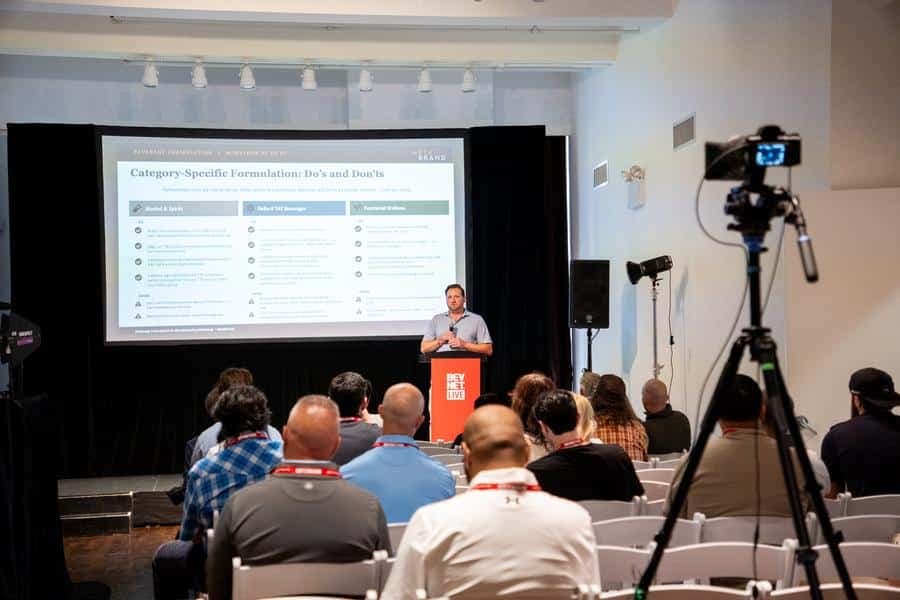
Nick Andlinger [02:40] I'm Nick. I'm the vice president of sales here at Metabrand, um, and I'm talking about intelligent formulation. Um, so most beverage failures don't happen because of bad ideas, they happen because of bad decisions early on in product development. Uh, today's goal is to help founders avoid expensive mistakes before they invest heavily in formulation, packaging, inventory. And production whether you're building an alcohol brand, a THC product, or a functional wellness product, the process fundamentals are remarkably similar. Um, the earlier you solve the problems, the cheaper they are. Um, so the first piece is how to build a formulation brief that works. The brief is the foundation of everything. Most founders spend months discussing flavors and branding before writing a proper brief. A weak brief creates endless revision cycles because nobody knows what success looks like. Formulator formulators aren't mind readers, they need constraints. Uh, so there's 7 critical pieces. Uh, first is the consumer target. Who drinks this? What is the consumption occasion? Why? You know, women 25 to 40 isn't a target. Busy professionals looking for a non-alcoholic social beverage after work is. Uh, flavor benchmarks. What should this look like, taste like, feel like? What are the nearest neighbor products in the market? Do you like them? Do you hate them? Why? Everybody interprets light citrus differently. Bring physical products, whether you're making them at home or it's a nearest neighbor product. Give them to your formulator. Uh, functional goals, start with outcomes. Then determine ingredients and dose levels that support those outcomes. Specify specific dosages. You know, 200 mg of cava means nothing without context. Is this 200 mg of cava extract? Is this 200 mg of cava lactones? These are completely different targets. Format decisions can versus glass, carbonated versus still, pasteurized versus a preservative system or Velcrone. There are differences that need to be taken into account in the formulation process for each of these methods. Your liquid has to be compliant with your end state container closure and processing method. If you have a heavy electrolyte product with high chlorides, you're going to need to do a can liner compatibility study. Maybe you're right for the Aul can, but if you want, you know, 12 ounce sleek, that can doesn't exist. You always have to match the liquid makeup with the container and your process step. Uh, the regulatory bucket, set your regulatory category and ingredient restrictions in advance. This happens to us all the time where we go through a project and all of a sudden the client asks, Hey, I'm non-GMO, right? Well, we didn't establish that from the beginning. Um, so you, you have to establish all of the parameters upfront, you know, as a product, kosher, natural, organic, uh, we need to define these in advance to avoid unnecessary reformulation and cost down the road. Create a launch date with a buffer. You know, ingredient lead times are almost never included into a launch strategy. Sometimes it takes 4 to 10 weeks to get your natural flavors or extracts made. Rarely is anything off the shelf these days. Uh, same thing with shipping. We just had a client whose vendor shipped a product through UPS and they lost it 2 times, delaying their CPAC run by weeks. Um, there, there are always things that are happening. Make sure you set your date accordingly. Uh, supply chain viability, cost of goods, set your parameters from day one. You know, everybody wants yuzu juice or Sheila's sheet, right? So the, these ingredients are expensive. Um, there are ways to, you know, cut costs early on to avoid, you know, reformulation down the road. You know, there's a reason why Sindrift now uses extracts. So you look at brand like Sanzo, you know, started out with targets of only NFC juice. They're now reformulating once they hit scale. Um, death by AI. We'll touch on this a little bit later on. Um, but it's important to note that, you know, cloud's a great tool to develop a concept and an ingredient list, but it cannot validate manufacturing feasibility, stability, supply chain costs, or regulatory compliance. A good brief eliminates ambiguity. Category-specific formulation do's and don'ts. One of the biggest mistakes founders make is assuming formulation principles transfer across categories. They don't. Uh, when you're looking at, you know, alcohol, your flavor components need to be tested in that alcohol environment as the, in, in the final product before you compare them to competitors or evaluate performance. Alcohol changes how flavors are perceived. A flavor that might taste perfect and balanced in water may taste weak or harsh in a 20% ABV spirit or a 12% ABV RTD. Um, the different ABVs and alcohol bases can suppress flavor notes and emphasize others. We find this specifically with chili or heat, where we might add this into a, you know, carbonated can and 4 days later that chili is undrinkable, um, because it is amplified with the alcohol and the, the CO2 in that container. Um, D9 THC. Know your audience and their tolerance. This is a point that we try to make to our, our, our founders and our clients on a regular basis. You know, is your product designed for on-premise or traditional distribution? You know, that 25 mg can might be perfect for the seasoned consumer, but no bar owner or restaurant's gonna want to serve that to a customer, not a chance. Um, and you're with THC specifically, and I'm going to make this point as we move through these slides, it is extremely important to validate your process step in your end-state container for both taste profile and potency before you lock formula before you go to pilot. You know, emulsions like to stick to stuff, you know, you'll have to make sure your can liner is, is compliant. Emulsions are also sensitive to certain pH ranges or ethanol levels and different flavor compounds, juice pectin, solids. You have to evaluate all of these in the formulation process because the last thing you want to do is go to a pilot and you're producing this in your single strength RTD and you have a 15% juice percentage and all the pectin and juice solids pull your emulsion out of solution. Um, these can all be solved in formulation. Some of the, the one I like to touch on in the avoid section is, you know, emulsion tech has gotten really good these days. You look at sources or Vertosa, these emulsions are super clean. Most low dose products don't need excessive bitter masking or buffering. The, the ingredients and the flavors and the sweetener system in there are doing a great job. Uh, we find that a lot of products in that low-dose category are overmassed, um, you know, over bitter blocked, and those blockers add unnecessary cost. Um, functional wellness, ingredient survivability is a big one here. Um, you know, we're, we're asked on a, on a regular basis of, you know, hey, can I put fiber in here? Can I put liposomal vitamins and protein and creatine? This is where that, that process step in your container is super important, uh, where, you know, we're dealing with a customer right now who, you know, went to run his pilot run and formulated elsewhere and he's got no fiber. It's like, well, I put in 5 g of fiber, how come it's not showing up in my test? Well, you use the wrong kind. It's not heat stable. These are things that your, your formulator can address, um, you know, from day one in this process. Um, you know, there's a difference between a clinical dose and a marketing dose. What exactly are you looking for in your product? Many founders choose ingredients because they sound great on a label but don't survive processing. Choose your regulatory category before you create your functional ingredient stack. Process. Um, so typically there are 5 stages as you move through formulation. Um, I'm always going to reference the brief. That's the most important piece, um, as that's going to set the stage for each iteration round in each stage in this process. Um, you know, kitchen and home recipes help establish the taste profile benchmarks. So the nearest neighbor products, I did mention that, but it's extremely important that you bring these to your formulator to start. Um, nutritional parameters must match taste profile expectations. We hear on a daily basis that, hey, I want my product to taste like a lani, but I don't want to use scralose or artificial sweeteners. Sucralose is 600 times sweeter than sugar. Well, monk fruit is maybe half that. Sucralose doesn't have a lingering taste profile or a coating in your mouth that monk fruit does. You can't achieve the same sweetness level and drinkability. And you, you have to make sure your, your expectations are set accordingly. Um, define what you dislike and not what you like. Two bench iterations. Uh, the first sample set is rarely the final sample. Sometimes things are approved in the first round, but that is extremely rare. Um, expect learning. Um, you know, once, once a base has been established and you're, you're roughly 80 to 90% of the way there. Request a live development session. We do this with the vast majority of our of our customers. It allows you, the founder, to experience how your product is built in real time. You get to see, you know, the lab technicians building it ingredient by ingredient, and you get to taste everything. It allows for immediate refinement. You know, that's the time to sample those secondary or tertiary flavor notes or you wanna do a botanical vertical of mint, shiso and basil to figure out what that, you know, tertiary note is, or you wanna do a sweetness variation of a 256, 8%, uh, the, the in-person session is the time to do all of those. Um. Tasting samples is fun, but compiling actionable feedback is extremely difficult, especially if you're not, you know, a seasoned beverage developer or entrepreneur, um, you know. I don't like it or it's too bitter. That's not useful or actionable feedback. We need to dive into the why, you know, if it's too bitter, is this an over steeped tannic bitter, or is this a sharp quinine bitter? What exactly are you tasting? Try your samples multiple times. Drink them warm, drink them cold, drink them over ice. Try with food. Try first thing in the morning. To develop that actionable feedback and be sure to always do the full can test. It's really hard to. Get that taste profile down if you're only tasting little 2 ounce cups. Uh, formula lock. This is where many founders struggle. Once you lock a formula, treat it like a contract. Every change afterward impacts packaging, nutritional panels, supplement panels, stability, and cost. Um, we need you, you have to define everything into that lock stage, make sure you've tasted it with your process step in your endst container as close as possible, so when you lock, you're really ready to go. Um, and the last step is the reference sample. This is the gold standard. This is proving your formula lock, your, your, that locked formula is being recreated, and this bench sample is where you bring to pilot, uh, because your pilot run is not where you decide if you like the flavor or not. You're doing that at formula lock, and that reference sample is for the further proving the lock. Working with functional and active ingredients, this is where excitement often outruns science. Can I put adaptogens in my drink? Can I use cava? Can I use mushrooms? Can we put creatine and protein in there? Maybe. But we need to understand efficacy, stability, and compliance first. You know, is this a supplement or is this a food? You have different claims. You can add different amounts of certain ingredients. We need to determine all of this up front from a stability standpoint, you know, again, process step, an NSAI container, does it survive heat? Does it survive? Does it have certain pH ranges that will degrade the potency of that specific ingredient? All of these need to be solved in that formulation step. You know, can suppliers consistently deliver? Does anyone remember the early days of CBD? We used to get random powders shipped to us with potency written on little baggies, you know, that still exists, not to that extent, but you know with some of these newer functional ingredients, you know, it's you've got a guy who's got Sheila sheet. Cool. You know, is that Sheila sheet self-affirmed grass? Is it grass? Can you use it? There are all these regulatory aspects that have to be taken into account. Um, back to the regulatory. There's, you know, there's a difference between, you know, supports relaxation and treats anxiety, you know, NFP versus SFP. If you can't validate the ingredient, don't build a brand around it. How to evaluate a formulation partner. Your formulation partner should help commercialize your product, not just make your samples. You need to be able to lean on the lab team to help you navigate stability, regulatory taste profile, all of the things needed. So when you've locked that formula, you know you're ready to go to pilot. Um, the key questions to ask that, you know, we hear on a regular basis are, do you have experience in my category? Um, you know, proof of, of commercialization? Can you give me some brands that have made it in this, you know, the hard game that the beverage industry is? Um, you know, who owns IP? You know, do, do I own it? Do you own it? Who owns the ingredients? Do you have a supply agreement? You know, how does this work? Because Um, because your formula is an asset, you know, if you don't own it, you're just building someone else's business, you know, walk away if you hear we co-own the formula or shelf stability and shelf life are the same thing. They're not, you know, iteration samples expire within a week. In most cases for an acidified product, if you're processed in a certain parameter in that container, that sample should last well over a week. It should last months. So the key is you need to choose a commercialization partner, not just a lab.
Craig Forton [18:45] Any questions?
Nick Andlinger [18:48] Any questions? Yes. Yeah. Great question. So we typically will, yeah. Yeah, just to repeat, you know how many samples is the founder receiving round to round and for a larger scale sampling. So typically we'll send 6 cans per SKU per round. When we have customers that are wanting to do a larger sample set, we can build 50, 100, 200, 300. Usually those larger sample sets are built in your printed can or in a labeled can where you'd provide that primary packaging or labels for us to fill them.
Craig Forton [19:45] If I can expound on who has the question. Oh, you didn't. OK. Um, one of the things that is important, Nick, if you don't mind me jumping into this, is getting feedback collectively. There is nothing more frustrating than getting on a call with the founders who have 6 partners. I think it's too sweet. I think I don't think it's sweet enough. So if you're, if you're going to get a big sampling set, try to corral all that into meaningful, actionable feedback. Nick mentioned, um. We have, we have a successful entrepreneur who's who's now in the business. Their first sample was Tastes like dishwater. Um, they had a very interesting ingredient, and you know, Nick and I are both sitting there going, we don't drink dishwater. I mean, I have no freaking idea what you mean, and we have to drag out, you know, one of those aspects of flavor. So try to get everyone's feedback corralled into actionable points, 1. Number 2, probably is don't try to fix all of it at once. Work on a flavor. The easiest things, and what we believe the easiest things are, are color. And sweetness, those are the ones that we can, we can really dial in at the tail end. But making sure that the sweetness profile that you're going for, making sure that the flavor profile, the efficacy profile, all of that needs to be really dialed in, and then we can get down to that last 1 or 2%. Does that help? OK. Great.
Nick Andlinger [21:11] right. Um kind of It depends. Um,
Craig Forton [21:20] the, the question was what kind of regulatory support, uh, does a formulator provide? Now that, so Nick, go ahead.
Nick Andlinger [21:27] Typically we're providing regulatory support around the ingredients and your NFP or your SFP as far as, you know, what should I be labeling on my primary display panel or what claims should I be making. Those are typically all handled by an FDA attorney.
Craig Forton [21:43] We'd encourage you if you have, so the world of TTB, if you've got an alcohol kind of product, TTB has very strict regulations. There's a formula filing, there's CA filings, there's all kinds of components. We actually use a third party because you want that transparency that we're not shoving something down the line that doesn't meet regulatory aspects. But if you're talking about FDA type stuff, Nick brings up a really good point. Do that before you set your, your, your, your first formula. If you, if you have an FDA claim you want to make. Now there are structure function claims and all kinds of other claims that you can and cannot make with beverages, especially on RDIs and things that are FDA regulated. Get that work done in advance because what happens inevitably. I we have completed formulas and someone goes, Hey, I thought I'd run this by an FDA attorney and I want to make these kinds of claims on there, and those claims are inconsistent with where we are. So if you want to get that done up front, they're really good guys in the industry. Get that up front and bring it to the table as part of the brief, and you will save at least 2 months of delays that would normally occur if you try to go backwards. Any other questions? What do you got? Hey, hey, Ashish, what do you got for a question? Who's our favorite client? Do I have any other clients in the room? Because if it's not, it's definitely ashish. Uh, Ashish has been a long client of ours. He's, um, I'm gonna put you on the spot. Started, we, we, we started with him. We've how many iterations of what do you want? Formula version 12 at this particular point. This is not a, I mean, this is not a marathon, guys. This, you're going to go through it. Get meaningful feedback. To me, meaningful feedback is someone who will pay for the product because your grandmother is only going to buy so much of this stuff, OK? So take the feedback that's meaningful, corral it. Decide what is good again. I don't like it. OK, well why don't you like it? It tastes terrible. Oh, what part of it tastes terrible? But if you, if you don't get it now, you're going to, you're going to make it and that's not going to work. So get it, get it early, get it up. As I said, I think we've done 12 iterations at least. Yeah, we've got to rework it and and that's one of the keys that I'll drop in on when I'm talking about the manufacturing side is I think they said it this morning, getting it right out of the box the first time never happens. You get close, but it's very rare that it does happen that any of the beverages that we've worked with in multiple iterations, even the guys that we don't produce like slate milk. I don't know if you guys have ever had the slate milk product. We developed slate milk early on with the Milk Boys. By the time we were done, it even had to change to get into manufacturing, and they've had to go through several iterations to get it to the point of where it is today. That's just part of the deal. That's just part of the process because there's an old saying in our business that's been used in multiple businesses, the fastest way to become a millionaire in the beverage business is to start with a billion dollars because you are going to be this is a cash consuming business, so make sure you have good access to it and make small decisions repeatedly make good small decisions until it's time to start making bigger decisions. You'll shake out all the issues. Sorry, Nick, I took a little bit more time. All good. OK. Any other, anybody else? Yes, please. So the question is how often when someone comes to us with a formula do we recommend actives or choose ingredients or suggest ingredients? Very good question, because there's a little liability in there. OK. We are very risk averse people. We have got folks that have come to us. I want 600 mg of caffeine. Yeah, not happening. I'm not putting that in a can or very questionable, and I will say this in complete honesty, it's a little embarrassing. We had a client come to us and ask us to make a product called Date Rape. OK, we're not making that. OK, that's, that's not a good. OK, come up with a better name. We're not doing that, but we will make suggestions based on what you're asking us. If you're asking us for say, Hey, I want to make a niacin claim, or I'm sorry, a vitamin C claim, but I don't want to use ascorbic acid, oh, OK, maybe we can use Ace Arola. OK, we'll make those types of items. We're not here to change your profile. But we're really here to try to understand what you're looking for and make some modifications that can help get you to that profile. Does that help us? One of the things where we're different and you know I see one of our good supporters in the back, so I've got to say this cautiously, we have a lot of ingredients available to us. We have a lot of things. We have a really good partner that we can go to actually to compound something. Hey, they want a combination of these two flavors, but we, we don't want to make two ingredients because the cogs will get killed. So we'll work with them to say I need a combination of persimmons and grapefruit. Let's see if we can hit that note. Those are, I think, were very different than maybe other other individuals in this particular industry because we've been doing it a very long time. Does that help anybody else got a question that we can jump on? OK, great. Thank you, Nick. We'll, we'll, we'll jump into the real fun stuff, manufacturing. OK, so you've got your great formula. You're all set to go. You've paid hundreds of thousands of dollars, really, you really haven't, um, and you think you got it. OK. Please, please, please. Don't go to production. We really, really encourage you, no matter who made the formula, get bench samples. We call them bench samples, reference samples. Take this formula, see if it can be made by somebody else other than your formula. Even if we make it, go hire somebody else and see if they can replicate it, because this is where we shake out things like, Hey, your protein is foaming, OK, because we're doing it under the GMP circumstances. That's the first place to start. Start with a bench sample, OK. That way it shakes out. You get a reference sample. Those are sometimes also used to do distributor introductions. Hey, here's what we're going to make. We make them all to GMP standards. Many times we'll do them in printed cans so they can take it a matter of fact, we have a couple of guys that are out running around with cans that we made and bench samples introducing their products. The next one is going to be. A small what we call pilot run. Now to you, the entrepreneur, we're going to talk about the first two things in these 2 slides are most important. These are marketing expenses. Do not think for one minute the cogs are going to work here, OK? Marketing. The goal is to shake it out, get it manufactured, get stability, make sure it's where it's supposed to be. Start getting distribution, get that feedback in. We had a really great client came to us. They were in this particular stage. We had finished their bench samples and they went right to production. We warned and said, Please, please don't go to production. No, no, no, we know what we're doing. We have our shit together. We know exactly what we're doing all from branding and marketing. Well, unfortunately they spelled strawberry wrong 3 times on 3 different parts of their product spelled differently in each of them. With, you know, 60,000 cans. Um, we had a, a tier one beverage company we were doing all their piloting for, ran 50,000 units each, and they put the wrong UPC codes on the labels. So we had to take them all out of the boxes, put new UPC codes on, stickers, put them all back in the boxes. Stuff like this happens. The best happens in the best of companies. Start small because you can always make more, OK. So once you've now shaken it out, now you're going to go into your full scale production, and we specialize again if you saw Brian this morning, our sweet spot is we are entrepreneur friendly, so we start with that zero case. Our tier higher end clients while they're about ready to graduate because that's our goal is to graduate you with the kindergarten through grad school of the beverage industry is to get you graduated out that's like 100,000 units per shift, OK. And that's an 8 hour shift. So that's where we work and we have separate lines to handle this. When you get into full scale now you're selling. So this is where you're going to work and you're going. You'll start seeing cogs start coming down because I hate to say this guys, this industry is nuts when it comes to cogs. You buy your first million cans. They're 17 cents apiece. You buy a can 1 million and 1, it's $16.98 for the next million. OK. The co-packers are the guys that are coming down. We know that in the business. That's why Brian and the other co-packers are looking for things that are shaken out, stable, good supply chain, good handle on packaging. They pop it on their lines. It runs like butter, and that's what they want, and that's where you benefit from it as well. Our goal is to get you there and then move you on to the next guys, OK. So how to find and evaluate somebody, OK. Talk to everybody. You're gonna get a lot of notes. Brian has already said it before. As um Nick mentioned, do you guys make with this stuff before? Have you ever made any of these? Yes, it it helps. If they haven't made it, I would think twice about it. Regulation, regulation, regulation. One of the things we're seeing in this is the the invasion of IPA breweries who no longer are selling IPAs but decided to get into co-packing, and cheap. Hey, we'll do it for 20 cents a can, OK. We spend over $200,000 a year on regulatory compliance between GMP, QA, making sure our system's right, validating, checking formulas, everything else, and a brewery doesn't. We got a call. Nick took the call at 11 o'clock at night. My cans are exploding on the shelf. What the hell did you do? Oh, I ran into this CAC or this brewery in Wisconsin, OK, didn't process the product correctly. So make sure that they've got experience in your category, especially if you get dynamics of your product proteins, lipids, emulsions, and these types of things, solids, all these things have to be taken into consideration. Have the conversation. MOQs. Everybody wants to run big co-packing jobs because they're nice and easy. The point is, you have the biggest thing that we see is you come to us and say I want to run 50,000. I need pricing for 50,000, 200,000, a million. Usually we'll say, How about we do the 50001st and we can talk about the next 50. If you ask for 50, you've got to run 50. Unfortunately, in this business, you come to us for 50 and the next thing you know you're around 25, so it puts us in a little bit of a quandary. We'll work with you on it, but make sure that you don't get ahead of yourselves, OK? Um, QC infrastructure we've already talked about. Um, communication is a tough one. Um, we see in our business the desire, and Nick mentioned it earlier, on timelines. Please do not, whether you're working with us or anybody else, don't make a commitment. Without us even knowing about it, because all of a sudden your commitment becomes our deliverable, and it may not be possible. Especially things like TTB regulatory, a FIS, new language for you, right? FIDs take time. Those come from supply. They don't come from us. They come from the guys making the flavors. OK? You've got to plan this out really, really well. Have those good lines of communication to just listen, it's a need. Here's what I need. Can you help us with that? I would encourage you all to start with that conversation rather than, hey, I committed to a launch in South Dakota and I need cans there by Tuesday of next week. Not much I can, I can do about that. That usually becomes a tenuous conversation. So Nick mentioned it. You've got to own your own formula because if you don't, somebody else owns your business. It's that simple. It's a, it's a really important point. Understand what you're responsible for and what they're responsible for. We have plenty of entrepreneurs that like to do their own material sourcing. We charge for it, of course they don't want to pay it. We understand. If you're going to do that, do it really well. We'll be happy to tell you what you need to do, what we need to do to be successful, because we have 3 guys right now on the line doing their own sourcing. We're still missing ingredients that were supposed to be here 2 months ago. OK. Stuff is a lot of times out of your control, and we want to make sure that that model works because what you don't want, where we might be very different than other copackers, is we don't assign line time. You don't pay for line time. We put you in a queue and when all your stuff's here, then we get you on the line. That helps you not have to buy line time and go, Oh my goodness, my, my flavor house dropped the ball. I can't run. And your co-packer says, Thank you very much for your deposit. Let me know when you want to run again. You don't have the capital to do that, so try to work with that flexibility. We want to make sure that the, the batching records are clear. Ask for batching records. I don't know if everyone just, do I, should I discover what, tell you what batching records are? Anybody want to know what batching records are? OK, um, in this case, it, it tells you what we, we did. They're inspect. These are the additions. These are the items. These are the lock codes that, that keeps, if your co-packer's not willing to show you what they're putting in the tank, you should very much question what's going into the tank. Because it's your product, OK? And you know, recalls not in our, our language, so make sure you get access to that. And then the last one is a difficult one, and, and that is confidentiality. Um, we do see a request for that, hey, I want you to do this project, but you can't take anything else like this. OK, well, your Copaki fee just went to $6 million. OK, it's not reasonable. It's not feasible, but what's really good is there are some very good flavor houses that do a very good job at protecting the flavors they're providing you. They give you a unique ID so nobody else can buy it. So if somebody's in our facility and looks over and sees a brand name, that they can't purchase it. So there are ways to keep your supply chain nice and tight. We encourage you to work with those suppliers that do that, OK. OK, we talked about the pilots, talked about some early stage, get into multi-tier, etc. Once again referencing Brian. Brian's been in that business. I've known Brian for as long as I've been in the business. You don't need co-packers all over the planet, but he is right. The East Coast covers about 65% of the US population that consumes these products, and if you've got to go to California, you run intermodal, right? Go on a truck, goes on a train, train goes to California. OK. Find a California co-packer when you really need it. The best part is you can always build more. Try to stay away from, I'm going to build 42 pallets because if you're in this morning's discussion, talked about launches and getting velocity, you know, Bill Sipper, I think, said you're going to sell, you're not going to sell anything for 3 months. That is some reality to that, and you remember you've built something that's a ticking bomb. It's got a best by date. It's got maybe an expiration date. Um, so you want to avoid that. Stay with cash management. Build small, sell big. And then start growing into your sales demand channel. By the time you're getting into national distribution, you're in a whole other world. You've got a whole another team. You have different operational expertise. You have different co-packers. They may be doing turnkey for you. They may be doing other things. But the issue is, I think it was said this morning, don't skip a stage. Don't skip a stage. If you've got a product that is just running. All right then, speed through the stage even faster. And when clients outgrow us, our task to them, because we have a great relationship with them, is try to find them their next home. Um, because that's, that's what we've done right in the industry, and that helps them ease that transition to the point where I'll go on site, one of our other manufacturing guys will go on site, we'll dial in on site with a new copacker to make sure there's a traditional, transitional handoff. That's critical, not typical in our business, but something we do a little differently than everybody else because we work with with folks in the early stage. OK, your compliance checklist, very important. If you're going to self-manage, documentation is unbelievable in this business. There's the big 5 allergens, non-GMO declarations, technical specifications. You either have to have operational expertise or outsource it, and what we tell our clients is, listen, the only thing that you, in our opinion, what you should be really working on. I sales. Operations doesn't generate revenue. Sales generates revenue. It's the lifeblood of your brand. Hence we do most of that work. We do a lot of that sourcing because we're pulling all that documentation. As a matter of fact, all of it's needed in the event that there is a recall. We actually need it for SQF audits. We need to make sure that there's complete traceability with everything that goes into your product because that's the brand promise, and that's how we guarantee your brand promise that you always deliver the same ingredient, the same product to your customers 100% of the time. Look for that and no matter where you go, make sure you understand what those documents are and make sure that your co-packer is getting them, OK. A spec sheets I talked about the batch sheets that date is on there, making sure that you've got your inspect your builds are all consistent so you have product continuity. One of the things that during production is really just a matter of verifying everything's been done up front. All the hard work is done up front. Going through production is literally a checklist. Right ingredients, right items, right lock codes, right amounts, right blending, right flavor, right color, right technical specifications. Put it in the can or put it in the bottle, whichever the container you're using. And Nick did mention that process, container, and formula must all be in unison, OK. So it's actually a bigger issue we can talk about independently. Do not skip micros. Nothing leaves our building mandatory. Every product that leaves our building goes through a micro test for pathogens and microbial aspects. Pathogens we certainly don't want anything going on in the industry with Listeria, with E. coli, with any of the pathogens. Everything must go out and to date we're very particular in our process authority work, so it's a hallmark of what we do. Same thing with we don't want to have APC growth. We don't want to have mold, yeast molds and those items. Has it happened before? Absolutely. We've had a client that brought a They were doing their own co-packing. They gave us a specification. The specification was on pasteurized honey at a particular usage level. Product comes in, Documentation comes in. We read the documentation. We look at everything's great, kind of find out it wasn't pasteurized. Secondary fermentation happened in the can because we didn't have the thermal process for that for that particular product and actually the specification sheets we had, they just copied and made new ones because they didn't match the product without telling us. This stuff does happen, OK? We caught it in that particular phase. A lot was held. End of discussion. OK, so micros are extremely important because you've got to make sure that your product goes out to your consumers and the last thing you want is I open this up. I think everyone's everyone's probably seen the The pouch, the like the juice box, guys, it opens up, it's like an octopus inside the thing from like a big mold slug, you know that's not a very good way to sell a beverage we can assure you that you're going to get some customer feedback on that one. So timelines, Nick touched a little bit on timelines. This is a little bit of a scale of a timeline that that could work. And it says add 30% to it. It's probably an understatement. Supply chains are all over the place. When we started this business 10 years ago, we would call up a vendor and say, Hey, you got X and I need 5 pounds of this. They'd be like, Yeah, we've got it in stock. We'll have it to you in a week. Great. Now it's a call and ask for the cherry, you know, warmf that they've got. Yeah, it's going to be prepaid, and then we're going to order the ingredients to make it and then we're going to make it and then it's going to go through QC and if it passes QC, we'll ship it to you. Well, how long is that going to take? I don't know. It's running about 6 weeks. Tough being entrepreneurial with that kind of leadership, but that's where we are right now, and that's, that's stuff you have to definitely take into consideration as you're, as you're building your product. So make sure that that is in there. Everything else is pretty tight. If you've got a good formula, got bench samples, we know it works. It means it can go into a tank. If it goes into a tank, it should repeat the process out. So run that through pilot production. So Yeah, you can get to, you can get to a good product within a 20 week time frame. Formulation takes 3 to 4 months depending upon that. We can come on behind that and get a little early stage on some of it, but set it accordingly and actually plan on something going wrong. The worst one for us was a client that we were running that the truck got stolen that had platinum on it and the labels for their product were in the same truck. Now not much we can do about that, and it's not like you can call the printer and they can whip them out in 10 minutes, so. You plan on plan on stuff happening and build a tolerance for it. So where's my AI slide? Did I miss my AI slide? I skipped the AI slide. Here we go. This is an interesting one for us. We get 10 a week, maybe somewhere in that ballpark, more 20 a week. I've generated. I've got this new concept of a product. I need manufacturing. I need quotes for the 1st 10,000 cases up to a million. I have an AI generated formula. When do I start? So this is an AI generated formula, by the way. This is if you want to create your own energy drinks right there, just do it hands down, no problem, right? I don't know how much Pannax ginseng should I put in, 0.01% or 0.05%? I don't know. Is there a difference? There's a huge difference. OK. And this is where AI isn't working yet. You are the brand owner. You have a taste profile. You have an impact profile. It's up to you to be able to take that. Nick said it. These are good places to start, but what's the method of preservation on this? Is this what is this, is this a preservative base? Is this a heat treated base, tunnel pasteurization? Is this an HTST kind of a process? This is where AI is falling short. It's really falling short. We've had folks send stuff to us that actually cannot be manufactured. The best one recently is I've got 25 g of protein. I want it carbonated, and I want it to have the same carbonation level as a Coke at 3.6 and it's tunnel pasteurized. Violates chemistry, violates physics. You can't change either of those because the can cannot withstand that kind of pressure. Can't the paste, pasteurizing the process with 25 g and that with the fiber will turn to a hockey puck, OK. This is where AI is falling short. If you're using AI as a tool, fantastic, but be ready to be able to make some trade-offs as to where that could be for your structure because you, we, we, we dance a line. And that line is Nick hears it all the time. I didn't go with you guys. You were too expensive. We are. We're not the most inexpensive guys in the street. I went with somebody else. I got the formula, they handed it to us, it can't even be manufactured. It has insolubles in it, has illegal ingredients, has things that don't have grass registrations. Unpasteurized juices, alcohol and, and, uh, caffeine. These are, you can't make this stuff. So when you're in that process, get in there early and understand where everything is and why it's there. Have have a purpose. We sometimes call it the brand promise, OK, but if you've got a good feeling, we can get those samples done. If the samples work, then you can run into production. We encourage, as I said, whether you do it with us or anybody else, get those in because it's the proof of concept. If it's wrong, no big deal. You can make more of it. OK. So I think I've covered pretty much, sorry, I skipped over that one. Um, what I want to do is, is there something I didn't cover, or let's, let's go ahead to open up anything. Anybody have any questions on manufacturing from this perspective? Or please tell me I didn't cover absolutely everything perfectly. That's not possible. Somebody has one question. Ashish, ask me a question about manufacturing. Great, great question, Ashish. How do we handle THC and making sure that the D9 is at the right level in the can? Brilliant question Ashish, OK? Sheish has a, a D9 brand. Uh, anybody else have a D9 brand? OK. Have you had any tests not go your way? Yes, we did, absolutely. It's critical and making sure in this case we use a technique to make sure that when you throw an emulsion and everybody knows how salad dressing works, and you shake it up, it works really great for about 2 hours, emulsions and water don't want to stay together, but keeping under a certain process of blending techniques and making sure we can bind things together, there are checks and balances the way that we run a particular. Line is we have a high bricks meter that we run to bricks. Our bricks are tied, for example, bricks is a measurement technically of solids. It's very commonly used to measure sweetness in there to make sure that if we stay within that bricks, we're going to be within our targets of our of our D9 dosing and manufacturing. So when you get your tests out, you're going to be within all the standards that you need for every state that you're operating in. Great question, Ashish. Please, Ah So if I can rephrase the question, as the industry changes and new things are coming to market, be it ingredients, be it maybe process, what are we doing to, what are we doing as a co-packer investing in the future to make sure that we can run these things? Great question, because our industry, the unfortunate thing with our industry, it runs on a Set of standards. For example, when we run, we only run ball ends made by ball manufacturing because our seaming specifications on cans must be pristine, and that's the way we guarantee it by running a set of standards that in our industry, there isn't a lot of diversity in that hot filled bottles. We love this question. I've got this bottle. It's Suja's got their juice in it. I want to do a hot fill product in that. The bottle can't handle that. That's that's a process that doesn't work. Our industry is driven by a set of standards, and we adapt to some of those standards. The exo can lid. I don't know if people know the reclosable exo lid. Yeah, you can use that. We can tool it. We've got tooling to run it. We can run it. The thing is 17 cents a piece versus the standard end, which is $0.3. That becomes a business question. We're seeing some things in the market with resealable twist-off seam cans looks promising without reversing the tooling. So we're always looking at those things that are coming out. The question becomes, in a cog centric business, Does that work in your advantage? We do have a really cool alcohol we're doing a project for an alcohol project that has got something that we haven't seen in the industry yet. I can't talk about it, of course. That's the teaser. We do the first production run for them end of this month. We do the first. It's going to be distributed in Florida. They've agreed. To let us put it on our website when we're done, but we're the guys that love this weird stuff. This is one that we're investing in to make pucks to run these things because it really is something we're really interested in. The guy's got a great concept. We'll adapt to what is necessary for that particular brand, but a lot of it comes down to the brand owner. If you're a nut job, we're not doing it, OK? If you're this business has some unique personalities in it, but if you've got a good brand proposition, funding is appropriate, you're dedicated to the brand, you show the passion, you've got legs on it, we'll get behind something like that. Does that answer the question sufficiently? Anybody else please. A retort. Who else has a retort project? Usually coffee is low acid, the world of low acid. We don't touch low acid because the rules are very, very different. However, You can do some work with a microthermics unit down at Microthermics in Georgia to test that. We would strongly recommend it. They're stupid expensive. OK. Talk to your flavor house, see if they have a microthermics unit. They will do an HTST, high temperature short time, that can mimic some of the things that go into a retort. There's also a couple of retort processors we've been working with to do these types of scale projects. We have 2 of them that have passed our test. Get with us after. We'll make recommendations for you to contact them. We don't do retort projects because they're just the world the FDA splits that over here, puts low acid, you know, coffee, plant-based. They put that all over here, dairy, we stay over on this side over here. We don't want to kill people. That's if you don't do that right, that's a problem, so we like to stay over here
Nick Andlinger [50:43] just to jump in there.
Craig Forton [50:50] Yeah, there is some low acid that we'll work with. There are things that we try and we can't work with. Low acid is very expensive to formulate because you hit it on the point. Tastes great, runs through retort, tastes terrible. So now we've got to go back and make it taste terrible on the front end to then make it taste good on the back end, and that is a laborious, expensive process. Anybody else? Fantastic. Thank you so much for coming. Uh, if you need anything, grab Nick or me. We're going to be here for the next 2 days. Appreciate it.
Related Videos
The State of Cannabevs: Strategy on Deadline
With federal regulations about to put this fast-growing industry into a time-out, we look through the lens of brands, distributors, and lobbyists for potential futures for this fast-growing segment.
AI and Online Retail: Brand Building Meets Agentic Commerce
In a special tactical presentation, sales, marketing, and tech experts share a concrete playbook for making your brand legible to AI agents — without gutting what makes it human.
Retailer Profile: Launching and Maturing with Whole Foods
A rare founder–buyer conversation on what makes a pitch resonate, how brands can build productive retailer relationships, and what growth actually looks like once you’re on shelf.
Exit Interview: How Dirty Shirley Cleaned Up
Longtime beverage marketing veteran Adam Kost discusses his lean startup, proof-of-concept strategy, the key insight that gave Dirty Shirley the oxygen it needed to grow.
Disruption at Scale: A Conversation with Athletic Brewing CEO Bill Shufelt
Athletic’s rise has reshuffled the deck of beverage categories. Shufelt shares how he's navigated explosive growth and what he’s learned about raising capital, brand positioning and category creation.