Search across the BevNET CPG Media network including BevNET, Nosh, Brewbound, Taste Radio, Nombase and CPG Jobs.
Sponsored Workshop: aTULC Cans from VulCan - Meeting Beverages Where They Are
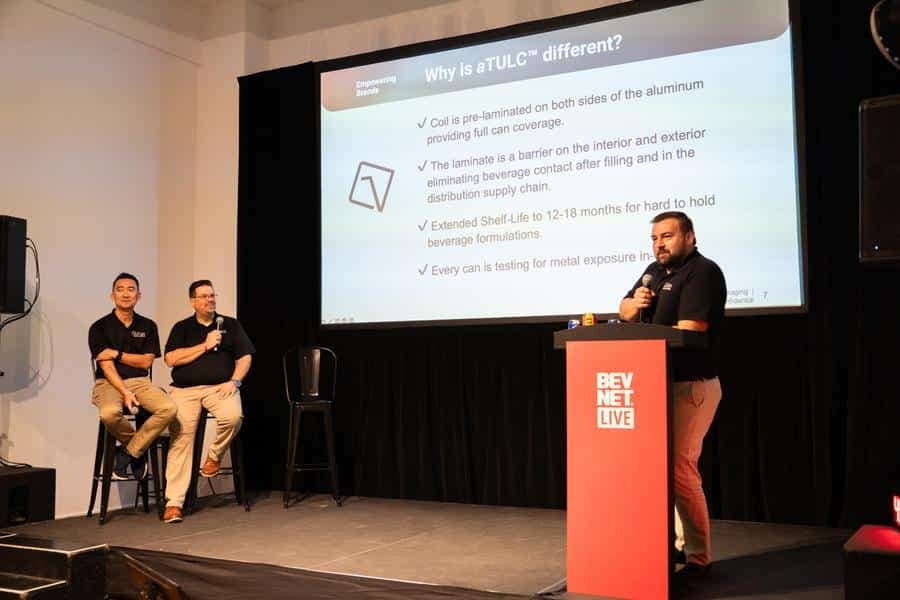
An introduction to aTULC can technology—pre-laminated aluminum cans engineered to deliver zero-metal contact. This creates a stable, uniform liner that is BPA-free and PFAS-free, while supporting extended shelf life. The Co-Founders of VulCan will share insights into the technical capabilities and commercial applications of aTULC, helping emerging beverage brands formulate and scale even their most challenging products.
Dana Abernathy, Technical Director & Co-Founder, VulCan
Scott Fore, Commercial Director & Co-Founder, VulCan
Alvin Widitora, Managing Director & Co-Founder, VulCan
Transcript
Note: Transcripts are automatically generated and may contain inaccuracies and spelling errors.
Speaker 1 [00:27] Uh, well, good morning. Um, welcome. Uh I appreciate your, uh, early morning support for the three of us. We're actually based in California. Um, and so this is uh a little bit earlier, uh, uh, timing for us than most, but, um, nevertheless, appreciate you guys coming in. Um, my name is Alvin Widitora. I'm one of the co-founders of, uh, VulCan Packaging. Um I'm also the managing director, so responsible for operations and, uh, the overall uh business. Uh, with me today is uh our Scott, uh, Fore, uh, who's head of commercial as well as uh Dana Abernathy. And today we're going to be talking about uh our company as it relates to the aTULC technology, OK. Um, and so, To start, um, a bit of a background and introduction about ourselves, we've been, uh, collectively in the industry now for the better part, combined about 70 years. So between us, new product development, operations, I've been making cans for the better part of a quarter century. I may not look like it, but um I've been making cans for 25 years. I think Tim McLaughlin in the audience can actually attest to that. Um, Scott and Dana have, uh, experience in, um, uh, brands, commercial, uh, activities, uh, relationships, um, uh, at some of the big multinational companies and, in fact, uh, um, in the world. So, uh, together, we bring a level of expertise to the business, um, and, uh, I think you'll see that, you'll see how that bears out relative to what, how we're presenting this technology, and what it could do relative to a value proposition or merging brands, in addition to uh larger multinationals for that matter. So With regards to aTULC, um, and, um, I'm just going to assume that familiarity with aTULC right now is essentially very limited here in the US. And the reason for that is because while the technology has actually been commercialized in Asia, particularly out of Japan for the better part of two decades, we're the only ones here in North America, actually, I could say with the Western Hemisphere that utilizes this technology. Um, and so from a can making perspective, Um, you'll see some of our samples there in the back table. The cans themselves don't look and feel any different. OK? It's what's inside the can and our method of production that differentiates us from the legacy or what we call legacy technologies, OK? And that really drives the value proposition for Brands, as brand owners, producers, co-packers, with respect to risk mitigation, and overall cost profile, beyond just buying the can, right? And so, um, what we're able to do beyond just the supply of the can itself is enhanced performance. bring a level of risk reduction to your brands as well. And then ultimately, What we're able to do from a service standpoint in terms of uh bringing to market some of these ideas at a faster pace, we're not, we're not talking, you know, months or weeks, in some cases, we've been able to do development in terms of graphics in a matter of days, OK? And so, To give you a sense of what aTULC is, I'll give you a video here and you can kind of see the difference between a traditional can and our aTULC can.
Speaker 2 [04:02] and this is a 12 ounce BPANI or epoxy can. At first glance they're similar, but let's take a closer look. aTULC, BPANI and epoxy refer to different types of liners that are applied to aluminum cans. These liners are essential because they protect your brand from coming into direct contact with and reacting to the raw aluminum canba. During production, BPA and I and Epoxy liners are sprayed into the cans at incredibly high speeds. As you can imagine, this method is effective but leaves room for inconsistencies in coverage. On the other hand, aTULC utilizes a pre-coated aluminum sheet. The liner is rolled onto the aluminum prior to production, resulting in a thicker, more consistent barrier on the can. Here's why that matters. Liner consistency and thickness directly relate to quality. A more robust liner helps limit corrosivity, extend shelf life, and preserve flavor.
Speaker 1 [04:54] So as you can see, there's marked difference relative to the actual finished product or the can itself, as well as, and we're going to demonstrate for you earlier, uh for, for you later, the method of production uh of the can itself. Um, a little bit of background on the technology, as alluded to earlier, this technology has been around and developed and pioneered in Japan for the better part of two decades. And so it's been tried and proven relative to its consistency and its overall performance. Um, the background actually behind this, believe it or not, was more so around food applications. And, and so if you kind of think about Um, beyond beverage, I know everybody here is primarily focused on beverage, but with food in particular, you have a myriad of options in terms of liners. We're talking about hundreds if not thousands, OK? And so, A liner for chicken noodle soup is different than for green beans, is different than for pet food. And so this concept of a singular liner technology was conceptualized in order to simplify that. OK, as a standardized liner. And so, the application actually was developed initially around steel, and it translated over to aluminum, in terms of a two-piece aluminum, what we call DWI technology. And so, um, I wanted to make sure that there's emphasis on the fact that the technology is not just, you know, an ascent in nature, but more so has been around and developed and we continue to develop and make improvements on that under license, under IP continuing to go forward in the years to come. So with that said, I think Dana, you wanna talk about some of the technical aspects?
Speaker 3 [06:45] Absolutely. Thank you, Alvin. So, as we saw in the video, traditional cans are manufactured using wet coating systems or spray line technology. aTULC is different. So our PET laminate is applied directly to the coil before it arrives at our facility. This means it can be applied more uniform and robust, as well as we can remove several of the manufacturing steps you would see in traditional can manufacturing. Ultimately, the result of that is a more consistent liner, a better beverage protection, and a more environmentally sustainably produced can.
Speaker 4 [07:20] Hey Dana. Why don't we ask, has anyone been to a can plant? Have you seen a traditional can plant? OK, great. Perfect.
Speaker 3 [07:33] Sorry about that. So if you think about our can print, we have laminate aluminum coming into our facility. What you will see in this video is much like traditional can manufacturing. We produce a cup, we draw it through the body, we decorate the can, and we go through a necker, and then we inspect it. We're inspecting it for dimensional integrity, for print quality, and for metal exposure. We're testing 100% of the cans that go through our facility for metal exposure. What you're not going to see in this video is any of the upstream acid wash, the water rinse, or any of the inside spray pieces. So those who have been in a facility that manufactures cans, this will be a net different production than you're used to from a cleanliness perspective because we've removed a lot of the manufacturing aspects that produce the VOCs that produce and require oils and lubricants. We've pulled them out of our manufacturing process.
Speaker 4 [08:27] Dana, what's the process called? When we're using the PET as the lubrication, yeah,
Speaker 3 [08:34] it's, it's a dry forming process, which just means it's waterless in nature. So we're not using lubes, we're not using oils, and we're not having to come back and clean. So here's a video of our production down in Austin, Texas. There's a little how it's made of the beverage can manufacturing and shipping out of our facility directly there in Austin, Texas.
Speaker 4 [10:48] And is that a normal size footprint for a can plant?
Speaker 3 [10:51] No. One of the benefits of the aTULC technology is you can remove about 40% of the equipment required in the can manufacturing process. So our line is about 60% or 50% of what you would typically see in a can manufacturing plant for a direct manufacturing. And then there's auxiliary equipment we don't need either because we're not using water and we're not producing sludge. We don't have to have wastewater treatment and some of the auxiliary systems that are required in traditional can manufacturing.
Speaker 4 [11:19] Where's our plant located?
Speaker 3 [11:21] Austin,
Speaker 4 [11:21] Texas. We're at inside the city limits, correct?
Speaker 3 [11:24] Yeah, you would think nobody would intentionally choose to produce a can manufacturing plant within the city limits of Austin, but due to the nature of the technology, both from a water and an air permitting perspective, we are still able to run and manufacture and even expand because of how easy we are on the environment. And so when you look at the big differentiator in the product, it's the barrier protection. Our coating of the aluminum via lamination is done on the interior and exterior before it arrives to our facility, and that ultimately becomes the product contact surface. This means that your beverage is never touching aluminum. It is never touching aluminum. Right, because we, unlike any other facility, any other can technology, are able to 100% nondestructively test metal exposure in line. So instead of doing the traditional method of some mill style sampling where we're pulling cans every once in a while and using enamel testing to validate if there is metal exposure, we are, we are testing 100% of the cans that go through our system and kicking out any level of metal exposure that is found that is net different than any other can technology. We're able to do that because of the robustness of our liner. So the liner solves 3 things. One is the consistency. When we're laminating on the aluminum, it's putting it directly on the full coverage directly on the aluminum. Also, our PET liner is both PAS and BPA free. And lastly, as we talked about the dry forming process. We don't have to have an introduction of any of the water or the harsh chemicals associated typically with can making, and this allows us to have an extremely consistent liner. It allows us to have improved beverage protection, and again we are producing a more sustainable package for our customers. And here's why it matters when you look at the actual interaction with beverages. The largest cause of can failures is the interaction between the package and the beverage. On the package side, from spray liners, it could be the coating chemistry, it could be the film thickness, it could be the metal exposure. On the beverage side, you could have stuff like really low pHs, high alcohols, increased chloride loads. There's a myriad of beverages out there that aren't designed to be compatible with traditional can making. And that's where our PET liner de-risks the product that you're putting into that package. And so here's a real life test study of an RTD with salt comparing the isotonic levels of inside spray on spray line cans to our aTULC can. And with an accelerated testing you can see there's an interaction between the beverage and the package, and these are real metal samples from those cans. And those that interaction can result in failures, and that failure can be from a sensory failure where we're changing the color or the taste of that product all the way up to can failure where we're causing leakage and damage within the supply chain or out in the market. None of that you want to experience. And so the aTULC technology de-risks the product by having the highest level of protection on that can itself.
Speaker 4 [14:47] Dana is the protection on just on the inside?
Speaker 3 [14:50] No, that's one of the great things about it. So we talked about the dry forming process, which is that it's coated on the interior and the exterior. The primary reason for that is to remove the lubricants and the oils, but there's secondary benefits. One, We are protecting the can from inside out as well as outside in. If you have leakers in the market, you have pallets that get damaged, we are not going to see corrosivity caused from the outside in on the can, and you're able to save product in the distribution. In addition, we'll talk about this a little bit because the exterior liner becomes our ultimate print surface, we can use the existing inks, but the exterior print surface has a lower surface energy. This means we don't have to do the same level of predictive expansion when you put ink on aluminum. And so we are able to get trappings as tight as digital print, because when we set the ink down, it does not move.
Speaker 4 [15:43] Yeah, we have some samples in the back. And of course, you can take a look at them, you'll see no trappings in between any of the colors. It's color on color, which is a great opportunity.
Speaker 3 [15:52] Perfect. Scott, I'm gonna hand it over to you talk a little bit more about the commercial side.
Speaker 4 [15:56] Appreciate it. OK, so on our side of the street from the commercial, what we're doing is we're focusing on hard to hold beverages, OK? Um, we have a saying, it's nice to have or need to have. So our focus and our outreach to customers is targeted more so to brands that need to have this liner to help them with their beverage in a, in the supply chain. So that's what we're focusing on. We focus with low and high pH, so low acids, high acid, um, high chloride levels, um, RTDs with high alcohol, um, those are our targets for us. And then even non-alcoholics, things that are very sensitive to nature, um, very sensitive to metal contact, these are great targets for us to, to work with. Also, Archaeans. Even with the PET on the inside and the outside have been tested for retort, so Dana's done a great job doing the qualification on that. And so we can handle high temperatures for pasteurization and retort, so we can go into milk, coffee, dairy, all across the board. Um, a big opportunity for us as we hit commercial and, and again, next week, there's a big uh trade show in Austin for the Hemp Beverage Alliance. Um, The liner itself is not promoting efficacy loss in THC and cannabis. The cannabinoids do not attach to the PET on the side walls, so the beverage is keeping the efficacy in the can. So it's a great outcome for us as we approach. So hopefully that, that all gets settled here in the in the Senate and the Congress here shortly. All right, so as stated a little bit above, um, we target alkaline waters, hydration beverages, tea, coffee, uh, spirit RTDs are a major part of what we work in, of course, hydration. We work hydration brands. One of the brands that we brought today has a chloride level over 1200 of chlorides. Wouldn't normally put that into a DWI. Um, we have some that are approaching 3500 in chloride base that are being tested. These opportunities give them 12 months to 18 months on the shelf for a can warranty. We do third party beverage testing on that so we don't do it in-house so the customer can see that validation. So you can see all the list of the brands that we're going up. What you, we do some localized beer. Most of the beer that we do are sours, things that are that need the, the product, uh, need the AO brand. Commercialization, faster. Dana initiated and talked a little bit about this. Um, we're blessed to have vertical integration at the plant for our artwork process. All the equipment is there on site. So what we do is we receive your artwork, it comes in, we do digital rasterization on it, color matching. We have our own ink system with the Toyo Ink system. We also can work with INX, um, but we do all of that in-house, and then we have the capabilities of producing. A straight wall can with a proof we print directly onto the same PET substrate and attach that to the can. So if we have an engaged customer on the artwork, we're turning artwork in days. We literally last week turned artwork onto a can in 4 days with a proof, and on Monday the can is going into production. That's how quick and that's offset printing with 8 colors, not digital. We burn plates on site. Um, so that helps us, uh, not only if we have any kind of issues with the plates, we can stop production quickly and reburn plates. We don't have overage from having to charge the customer for 3 or 4 plates from outsourcing, so all of it's on site. We have a very low entry level for artwork, and if you engage with me, I can share some of the pricing with you. Um, so printing the, the cans, it's an 8 color process. We typically try to work with 6 and we use the extra 2 for extra bumps on black or white or red, uh, or a large base color. Um. Customer supplies the art. We have qualified tactile. We also do glossy and matte, so we have full capability in the range. And again, lightning fast pilot cans. Again, Dana brought up a little bit about the predictive space for the surface energy. I encourage you to take a look at that. That's the one thing that brings people in when we take a look at it, and especially from an emerging brand, from a shelf difference, being able to get a product to the shelf quickly. And to stand out when it pops due to that is, it's amazing. It's a great opportunity from a commercialization.
Speaker 3 [20:56] We're extremely proud of the level of decoration we're able to get on these cans, but we have also put in the effort to qualify digital printers across the country. So we have um. Several digital printers we work with right now that are able to service some of the smaller size beverage that is looking to grow eventually into the truck truckload. So while we're extremely proud of the capabilities and artwork capabilities should not be a reason to not use the offset printing, we still have the ability to service smaller customers using the digital print ecosystem that currently exists.
Speaker 4 [21:32] Thank you, Dana. So value. When a brand owner approaches the opportunity to speak to a buyer and they're only talking about their beverage, they can also include the ATO can into their pitch. Why? And it's part, it's part of not only the branding and the way that it'll stand out, but there's a level of trust that they can give into that pitch to the retailer that the product is going to be very stable in the can. That helps for the supply chain. We're also able to be agile and meet those needs for agility when a customer comes to us and says, I need something quick. There's been an opportunity. It helps us create that value. And then we're going to talk a little bit about sustainability and drive a little bit more of what Dana was talking about with the drive form process on our ESG. I'll share a little bit about that. So in a traditional can plant, a lot of water gets used. Dana, how much water gets used per can?
Speaker 3 [22:35] It's about 12 ounces of the water is used in the rinse process per can, yeah,
Speaker 4 [22:39] and we're not doing that, so you can see. Our plant itself maxes out at 400 million on 12 and 16 ounce standards, so just basing it off of the 300 million, we're saving nearly 12 million gallons of water a year. It's incredible. Um, CO2 1620, and of course the metric tons of solid waste 240. It's amazing that we're inside the city limits and being able to do so. Um, that's a great message for a young brand. It's also a great message for a multinational brand. They use that a lot in their messaging if they have an overall company ESG statement. This supports their statement as they go and build out innovation into their.
Speaker 3 [23:23] One of the things I want to touch on is because a lot of times when people hear that it's a PET liner, they think about the recyclability aspect of it. The PET liner falls under many of the traditional chemical chemistry liners you'd hear from a polyester perspective. And so we are applying, while we're laminating, we're applying it once it's drawn, it's between 10 and 6 microns, not that much different than where a spray liner would be. And so these recycle in the same nature as spray line cans. So there's not a recycling difference of. Can when you compare it to spray line
Speaker 4 [23:56] cans, that's Class 3, right?
Speaker 1 [23:58] It's Class 3 from our facility, but it goes into the normal UBC used beverage can supply chain that ultimately goes back to the mills within days of collection to get remelted and back into canned stock yet again. So this is not different than what traditional cans would actually undergo.
Speaker 4 [24:18] Thank you. All right, so Alvin, just gonna go through a little bit of recap for us, will you? Yeah,
Speaker 1 [24:25] I mean, you know, just sitting in on a couple of the presentations from earlier, from yesterday, um, you know, and, um, you know, what my takeaway is, is that there are a lot of ideas out there in space, and what we are, uh, suggesting here through A talk is, it is not limiting to the entrepreneur or to the developer of a brand or a beverage. OK, to be in aluminum cans. We think aluminum cans are the best single-use package. In the world, OK, just because we're can guys as well. That being said, um, you know, there are certainly limitations and, and risks that are associated with traditional DWI and, and as Scott mentioned earlier, our point is to not displace the universe of DWI. Um, it's to offer a specialized and unique alternative to the existing legacy technology that allows your brand to actually grow very, at a very reduced risk. OK, and allows you to scale. As well. OK. And so when you kind of look at it, I always, and from an operator standpoint, I always tell people I can put this probably if, if any place is zoned in down in Manhattan for light industrial manufacturing, I could put a plant there because I don't need, um, you know, half the electricity load, I'm a third of the VOCs and I'm waterless. Um, and so when we go to, you know, when we look at places that Uh, you know, are currently in, in drought, even with places like Texas, right? Um, where, you know, I could go to a municipality and say, hey, I need 250,000 gallons a day to run my plant, and I'm going to just take that water and dump it back into the stream. It, it, it's, it's, it's kind of limiting in terms of our ability to grow here. Um, at least with, uh, traditional DWI technology. And so when you kind of look at the various elements and the various aspects and attributes, and all of the things that we can do from a value standpoint using ATO, um, one of the things is that the biggest thing and the biggest takeaway for me in the, in these last couple of days here and here is that We are eliminating some of those barriers to development, you know, especially with regards to nascent brands and entrepreneurs that really want to push the edge and the limits of development in their products, and you can do so safely in an aluminum beverage can. OK. So, um, you know, that being said, I, I think I'll open it up to, to some questions, if you guys have any questions, and we're happy to answer them.
Speaker 3 [27:13] Yeah, I'll take that one. So the question was, can you speak a little bit more to the shelf life aspect and, and what's kind of leading to that? And so when you look at the failures in typical beverages, it's due to an interaction. So there's, there's an entire genre of beverages that as soon as you put them in a can, they start to spoil. So traditional beer, right? So this liner is not going to be able to prevent that, but that's the nature of the product itself. What this technology is able to improve is the compatibility between beverages that are shelf stable and the package itself. So there's two things going on for it. One is the liner itself. It doesn't have the same porosity. It's extremely inert, so it won't adulterate the beverage directly. And two is the complete coverage of the interior of the can. So you're not doing the metal exposure. Aluminum is a catalyst for a bunch of different reactions. If you look, look at a specific one like wine, right. Wine uses SO2 in their winemaking process very often. When it contacts aluminum, it catalyzes the formation of H2S, which is rotten egg smell. And so wine historically has not been a great beverage to put in an aluminum beverage package. This technology changes that because we are able to 1 guarantee on the coil that we're covering it, and 2 in our process measure the metal exposure of 100% of the products going through it. We are ensuring that that wine or that product that goes ultimately into a can is not contacting the aluminum.
Speaker 1 [28:56] On a compatible end, I mean, for us there's really no plans to make it. Yeah, so the question is on ends, whether or not there is any pathway towards an AOC style end. Um, at this moment, no. And, and I think the, the big difference for us in terms of ends and the CAN body itself is, um, the encoding system is a lot more robust than what you would see with CANs, right? Because the similarly to how our laminate is applied, it's basically applied on the flat, it's more consistent, it's more robust, and so, You don't see as many product failures relative to contact of the end as you do on the canned body itself.
Speaker 5 [29:41] have good confidence
Speaker 1 [29:44] Absolutely,
Speaker 5 [29:45] yeah, yeah, yeah. They should be able to retain the same. Integrity Well, you're not.
Speaker 3 [30:01] The one, the thing I will add that I think is a gap in a lot of the discussions around end making is when you're talking about canned bodies in the spray coating systems, they're even talking about different levels, right? You have the beer soda level all the way to isotonic. You do have various film thicknesses that you're also applying to ends, but I don't think it's talked about nearly as much. And so making sure you are sourcing a robust end that has a A thick liner application to start with is going to benefit again. The application technology is more similar to our product in that it's applied at the coil level, but thickness also
Speaker 4 [30:39] matters. Yeah, we have customers, so as part of our commercial intake we do third party beverage testing. Um, so we, we use a company out of St. Louis called Brim Engineering, and so our customers, we supply the cans, we can supply ends, and we, in, in the commercial process, we're talking to the customer about their intention for ends. It's part of the conversation. It comes up because we don't produce them. Um, so we talked to them about it and we have, I, I'll use one as an example, hydration, major hydration brand that even goes to the level of purchasing, um, retort level ends. So not only is it thick coating, but there's also the extra. Um, coating around the rim and the curl. So one other quick note, in the process from a commercial point, if you're a brand and you're going to a co-packer or a formulator, we supply samples and we, we always make sure that the cans are going to run on the line and our flange is universal, so it'll work with any end. Across the board. So and we make sure that we're working with all the manufacturers to do it. So we work from a slow speeds up to 1500 to 2000 cans per minute with no issues. Any other questions?
Speaker 5 [31:59] Please printer. One of the biggest things we see with brands that require tunnel pasteurization. Uh, can you talk a little bit about how, uh, the coding aspects of it. Additional steps that they need to know, do we need to tell you this is they're going to go. We've seen a fair amount of discoloration, failure modeling, shading, etc. Water.
Speaker 4 [32:25] Yeah, I think we can discuss it from a direct print point. We have a high level of confidence. There's no issues with that whatsoever. We're doing retort
Speaker 1 [32:33] level. I mean, we're taking, we're taking our stuff all the way up to 265 on a continuous rotary.
Speaker 4 [32:47] Hi. High level, yeah. And so our outer coatings are Sherman Williams, our OBs, yeah, so. Very high level. Dana, you've done some additional testing with OVs with Sherwin Williams, correct, for retort?
Speaker 3 [33:06] Yeah, so when you're going to retort, it's a level of past pasteurization, so you want to make sure you have the, you know, pigment stabilization in the inks and so if you are doing that, it's worth having a discussion with us to make sure we're using proper inks that can take it up to the 265, but the pasteurization, even the high temp pasteurization should not be an issue for the general inks we're blending within our system.
Speaker 4 [33:31] Any other questions? All right, we want to thank you very much for coming today. We appreciate your time and your attention. Thank you so much.
Related Videos
The State of Cannabevs: Strategy on Deadline
With federal regulations about to put this fast-growing industry into a time-out, we look through the lens of brands, distributors, and lobbyists for potential futures for this fast-growing segment.
AI and Online Retail: Brand Building Meets Agentic Commerce
In a special tactical presentation, sales, marketing, and tech experts share a concrete playbook for making your brand legible to AI agents — without gutting what makes it human.
Retailer Profile: Launching and Maturing with Whole Foods
A rare founder–buyer conversation on what makes a pitch resonate, how brands can build productive retailer relationships, and what growth actually looks like once you’re on shelf.
Exit Interview: How Dirty Shirley Cleaned Up
Longtime beverage marketing veteran Adam Kost discusses his lean startup, proof-of-concept strategy, the key insight that gave Dirty Shirley the oxygen it needed to grow.
Disruption at Scale: A Conversation with Athletic Brewing CEO Bill Shufelt
Athletic’s rise has reshuffled the deck of beverage categories. Shufelt shares how he's navigated explosive growth and what he’s learned about raising capital, brand positioning and category creation.