Search across the BevNET CPG Media network including BevNET, Nosh, Brewbound, Taste Radio, Nombase and CPG Jobs.
New Beverage Showdown Finals, Part 2
Transcript
Note: Transcripts are automatically generated and may contain inaccuracies and spelling errors.
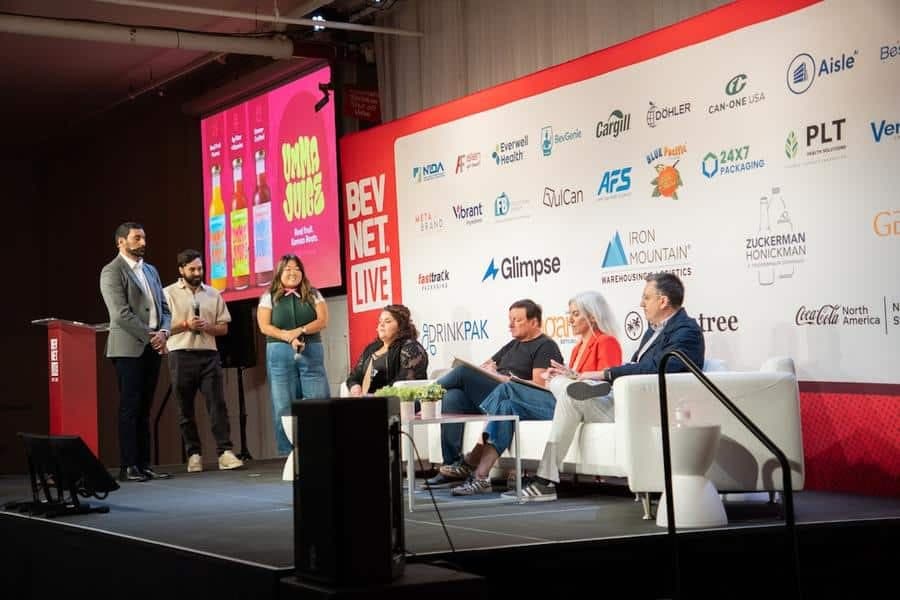
Speaker 1 [00:27] We're gonna kick things off with Umma Juice, founders, Angie and Mark Max, come on up to the stage. Hello. Good to see you. Good to see you. You know the deal. Clicker, please keep an eye on your timer.
Speaker 2 [00:45] So Umma Juice started from a memory of my mom peeling fruit for us every day for every occasion. When I became a mom, I wanted to reflect that same care, but in a way that fit our fast-paced lifestyle. So I went to the grocery store. I was looking for something that could nourish and delight us as a family, but nothing met the moment, so we created it. Umma Juice is real fruit with Korean roots. I'm Angie, mother, daughter of Korean immigrants, a former consulting leader at PWC, and prior to that, I worked for over a decade in maternal and child health globally. What that, what that taught us early is what we feed the people we love is more than just food, it's nourishment and traditions passed down. For generations,
Mark [01:29] and I'm Mark. I've spent 15 years in finance and analytics working with early stage companies, helping them with their forecasting and analytics and supporting some CPG brands like Vibe Organics. By being, oh yeah, um, together we launched Umma Juice in September 2025.
Speaker 2 [01:56] And what we learned early through validation in the market is that juice lost people and they want back in. So we created a juice not just for adults with a functional edge or kids with minimal nutritional value. It's something that we can all enjoy together as a family or as people. It's more than a niche, it's a movement. We have 3 flavors inspired by the fruits that I used growing up, Jeju salmon punch, inspired by the Heo divers off Jeju Island. We have mango, pineapple, pear with uh excellent source of vitamin C and E. And then we have K-pop Medley inspired by the big Korean cultural wave, but also my mom, who you'll see on every bottle. That's persimmon peach blueberry with postbios from kimchi and Subox splash, which Sobc means watermelon Koreaon with sweet potato and raspberry. It's got electrolytes and magnesium
Mark [02:53] on top of our unique flavors. Some of our differentiators include organic fruit purees that you can see at the bottom of every bottle, 4 g of fiber, including 3 g of prebiotics, and 60% less sugar than your average juice. Additionally, we are in the process of non-GMO project verified on all three SKUs.
Speaker 2 [03:15] And we're meeting our consumers where they are, whether it's at cultural festivities, events and activations, and donating products to places near retailers, because we know that sampling leads to purchases. We've sampled over 7000 people in total so far since launch, 5000 over one weekend during the big game weekend at Ghirardelli Square, and also as an official beverage partner to Laneige during their big juice pop product launch.
Mark [03:43] The strategy from here is disciplined. We're growing through more demand over more doors. Locking in our velocities before we scale at Wheatsville Co op, where CEE launched their brand, we're selling 13 units per SKU per week in our second month, earning us an additional front of store placement. As we speak, we're currently launching in all 10 central markets across Texas, as well as part of the NAKE program, which has landed us stores in neighboring states. Um, additionally, we're available on Misfits Market nationally. Um. You know, depending on channel, our SRP is between 399 and 499. In all of our retailers, we are averaging 20% month over month growth in velocities driven by our aggressive demo and customer activation strategy, where 85% of sampling leads to purchase.
Speaker 2 [04:39] My Oma moved quietly and with care so that we could move boldly with our juice, retailers, bottles and events. We're Umma Juice and we're bringing juice back to your home.
Speaker 1 [04:55] Please hang out, uh, keep your microphones. The judges might have some questions for you. I'm just gonna slide over Mark, just so I can, oh, there we go. Thank you very much. Uh, John, let's start with you. Um, you know, it was interesting about 10 years ago we saw. A new juice category emerge release segment in cold press juice. Is the timing right for a new kind of juice like Umma Juice?
Speaker 4 [05:16] I mean, I think it's, it's definitely interesting timing in the sense that right now there's really, there just aren't that many companies focused on innovating in juice. So in effect, it's like the white space, right? Um, and I think, you know, this liquid is. Really solid. It's familiar, but also unique. I think, you know, the sugar profile of it, it's like really spot on timely. Probably my only, you know, just feedback, you know, for you guys to think about is I feel like the Korean roots part of it and the the name of the individual SKUs is a little bit of like, it's the only thing that makes me stop and think. Whereas like, I, I don't think like the consumer really needs to stop and think about this. So I think figuring out how to like make the SKU names a little more clear and maybe put the, you know, don't lose the Korean roots story. Just maybe don't make it something that when I'm opening a cooler door, I'm like, huh, I don't know what this is next, you know, but I mean, really great liquid, um, you know, really like what you guys are doing.
Speaker 1 [06:18] Yeah. Samantha, what do you think of the positioning of function for the whole family? I think function for the whole family is a fantastic place for you to market your brand. It's, um, it gives a great blend of traditional, so you're bringing in your heritage, you're bringing in your background, um, if you've tried this out in the fridge, it actually. Has a super vintage snap, like Snapple pop to the top when you open it, so you're bringing in that history, that vintage, but with the functional blend to it, you do have that modern twist on it with the naming convention you do have that modern twist. I think that's something that is applicable to an entire family because of the different age groups between parents and children. I would say to kind of play off of what you were saying. Um, with that contradiction, it can get, it's borderline polarizing with confusing, so it's very traditional with the story, but then you have something like K-pop. So I think the liquid's delicious, the packaging is great, but just a little bit of fine tuning. The wording of it to blend it just a little bit. You're 90% there. It just needs a little bit of a wording adjustment.
Speaker 2 [07:27] That's exactly what we're trying to work through as well to just honor our heritage but also make it kind of more palpable for a broader audience. So thank you.
Speaker 1 [07:35] Yeah, Dan, there's a mom crafted approach to Umma Juice that seems like it would appeal to a lot of parents. Is that the right path? Is that the right pathway for a brand like this?
Speaker 4 [07:45] Yeah, I think the one thing I have written down on my Handy clipboard here is, um, is that the brand is lovely, like it's, it's a lovely brand. I, I think, I think, um, and, and so it fits families, it fits kids. I, what I'd love to see is, is just a little bit more breakthrough on the brand, right? So like it, it is, um, it's a brand that you'd say is like, what would you list the brand? Sure. You know, will it, will it move and will, will it will appear on the shelf, you know, will fit in the set? Sure. Does it come off the shelf? Uh, that's the piece that I wanna, would, would, would wanna look at. I, I think this idea of the, I would say that, that, that there's a Korean subtlety to it, that maybe you want to dial up. I mean, I like the, the, you know, Especially around K-pop and like the the opportunity right now and culture of what that takes is like there may be an opportunity to dial that up further to grab the differentiation, but, but don't put it there for like for for put it their sake, you know. I think what people said so far and John said is that you know the juice category itself is it doesn't. Need innovation, you know, because everything has kind of moved off of juice in function and juice as a carrier for function. And so there's something about the purity of juice that's really, you know, that's really nice and that a lovely brand actually fits very well in, but you just want to make sure that it has just a, you know, a dial out more edge. I love the flavors of the, of the brands as well, or the flavor of the product as well.
Speaker 1 [09:13] Yeah, yeah, Lynn, you get the last word, but I'd like to ask you about the glass packaging. There was a lot of discussion among the semi-final judges about the glass packaging. I just want to get your thoughts on it. Well,
Speaker 5 [09:22] and the glass packaging again, I think. I, I, from what the judges said yesterday, I would echo that in some ways it's great because there is, you know, it's sturdy, it is retro, um, but if we're selling to families, having everything single serve and non-transferable is hard, and I think that's where I, I wish the brand was either like very family or very Korean mainstream, like, and, and I don't know where the, the, the bridge is between those two because if I'm. Going to buy this for my kids and, you know, and, and stock it in my house. I almost want less functionality and want it to be more of a juice, and it does taste delicious and the brand is great and I think just being a modern juice with a better, you know, better macros and less sugar and more interesting flavors is a great idea. And I also think leaning into the Korean heritage is great, but it almost feels like that would be a, have a, have a different target audience.
Speaker 1 [10:20] All right, outstanding. Well done, Angie. Thank you so much. Really appreciate it. Thank you so much. All right, on to our next finalists, we have Justin Bohannon and McKenna Bohannon, come on up. Hello microphone and microphone. You got your clicker and please keep an eye on your timer. Hi y'all, I'm McKenna out of Austin, Texas. I'm a COO and co-founder of LYFLO, and I'm Justin Bohannon. I did a lot of speaking yesterday, so let's go ahead and get into our presentation. All right. Most of our consumers know that they need to drink more water and have more protein in their diet. Uh, the problem is, is that shakes are often heavy and bars are often dry. Um, so they don't really want to do that, right? And so who wants us? Who likes to buy our product? Bikers, hikers, walkers, gym bros, gym girls, and millions and millions of moms and dads who love pickleball. Uh, also, young athletes, people looking to enjoy a refreshing, better for you beverage. I was that consumer, uh, when my baby boy was born, I started breastfeeding and I was looking for hydration and protein and vitamins to set him up for success and myself, um, and lo and behold, I couldn't find that drink or that product, um, so we ended up creating something. So meet LYFLO. We have two flavors, and I want to talk a little bit about these flavors. Both of our proteins have 10 g of protein, that's 7 g of whey, and 3 g of collagen peptide. Science says 2.5 g of collagen peptide a day improves your hair and nails. That's why we have that. Uh, one of the first tasks that I like to do is adjust the labeling so that now you will be able to identify a little more clearly the zero sugar brand and the sugar brand because I see there's two different types of demographics. You have one demographic of people who want to lose weight but also increase. Of protein with the emergence of peptides like semaglutide and Ozempic, there's a need with smaller stomach stomachs to have an enjoyable, refreshing drink. And then there's also a demographic of people who like to work out but also maintain their weight or even gain their weight, but in a refreshing way. LYFLO aims to be right in between the people who want a protein, but not 30 g of protein, and who want hydration with functionality. So what makes LYFLO different? We have the benefits of a protein shake, but we have the hydration and vitamins of a sports drink, and it's clearly just refreshing. The result isn't a shake, it isn't a sports drink, but the protein water that drinks like a refreshing beverage. So LYFLO really sits at the intersection of protein and hydration. And right now, LYFLO is selling on websites only DTC at 375. But we do hope to get onto TikTok shop and Amazon shop. Also, our big goal is to get into retailers that kind of fit our niche. Uh, we're looking for academy, we're looking for sporting goods stores, nutrition shops, kinda like vitamin shop. Also, I've noticed that there's a big stigma against protein water. I think when you think of protein water, you think chalky, you think disgusting, I'm sorry. Uh, so, um, our goal is to implement a sips on lip strategy. It's a field marketing strategy where we'll have samplings where you get the drink on people's lips so that they can see it actually tastes really, really good and we can break through that stigma because we believe that once you try it, you'll buy it. If you buy it, you'll rebuy it. So we have a new occasion for protein. LYFLO is a drink that you can have as a post-workout. Um, you can go on a nutrition, um, walk, even everyday wellness. LYFLO is a protein that flows with you, and LYFLO has been around only for about 90 days, so we're really young and very much in the beginning, and we recognize that. Um, We have 2 flavors and we're currently working on a couple more flavors and Thank you. You can hang out here, OK. We have some questions for you. I'm just gonna slide. Thank you so much. You can come in a little bit closer. There you go. OK. Uh, you know, Samantha, last year's or in December, the winner of the New Beverage Showdown was a brand called Projo, which sat at the intersection of protein and coffee. LYFLO's, that's in the intersection of protein and, and, uh, hydration. What do you think of that, uh, concept? I personally think it's great. I think the concept, I do think that it is a need state. I have a teenage son who I'm constantly getting after to drink water and to have protein, but obviously since I'm his mom, everything I say is not cool. But if it were to come in a prepackaged, very cool looking bottle, I would not have a problem as a parent giving that to my child, and I think that. It would give, um, it's a great kind of all in one solution. That being said, I do think that when it comes to the design on your can, it does read to me a little. Everything all at once, so it does have, it's this and it's this and it's this and it's this. While it may have it, I think that that's a question that you may need to ask as a brand. Does it need to be on the can, or is that something that you just say when you're having your demonstrations, when you're talking to the different brands, because protein water in itself, I think that's, that's your full stop, that that is the concept that's that really is going to be your key piece and. Um, that way it allows the consumer to decide if it is for their workout or if it is for another environment without necessarily pigeon pigeonholing yourself into just being a workout drink. It actually will open you up more if you take more off of your can. Thank you. You're welcome. Dan, uh, Justin McKenna led off by saying that consumers want protein beverages, but just not another protein shake. Would you agree with that?
Speaker 4 [16:39] Yeah, well, that was fun, and, and, and I, I think true. I think the, um, and, and also the, the taste profile of protein beverages overall, you know, um, especially as you get clearer and clearer, don't taste very good. It tastes very good. I was sorry about the gong because I'm really interested in these two other flavors, but I think the, the, uh, the, the, the difference I think of the can, the package probably needs just a bit of work. I mean, if you're gonna be hydration plus protein, say hydration plus protein right on the top. Don't just say protein, because I think you're leading off, you're actually like leading. And part of the story behind that because you've got there is a lot of ingredient loading here, you know, you've got 3 or 4 ingredients ingredients stacked on top of each other and so you want to make sure like what, what is the primary purpose for it. There were kind of two ways to go on this thing, you know, and your insight actually on on Ozempic users or semaglutide users or GLP-1 users that are looking for a refreshing drink. I, I actually think that's probably something that's big enough and developable enough. But narrow enough to get after with a with a strong positioning story at retail that could be really, really useful. And then you broaden from there that was, you know, part of the path that I saw from the from the presentation here but overall that was great. Thank you. Thank you very much,
Speaker 1 [17:57] Lynn. What are your thoughts on the macros and the ingredients themselves? There was some discussion yesterday about how much protein do you really need, but in a brand like LYFLO, do you think it's the right amount? Do you You in terms of the ingredients themselves,
Speaker 5 [18:09] well, I think the product itself is great. It is delicious. It doesn't taste chalky. You get the coconut, you know, loud and clear. I actually want to just also build on what you were saying. I don't think it should be called protein water. I think it should be called protein hydration if that's the intersection of what you are. So I think the macros are good, but I don't think the macros are good. For the gym because I see what people are wanting in the gym like a lot like for, you know, you can't compare 10 g of protein to the 42 that the others have and so I think leaning more into the hydration and, and more into, you know, the story about just wanting to be hydrated and getting some protein and other things as part of that hydration. Uh, the other thing that was a little. Not confusing, but the packaging and the usage don't make sense. Like a can at the gym would be hard. A can while hiking would be hard once it's open. So I don't know if you'd go to, but sitting at your desk or while you're nursing or more as a refreshment, cans make more sense. So really understanding who you're for and when you're for, um, and I think LYFLO doesn't say like. Jim, yeah, yeah, it says like this is for your life, so I think leaning into that will make the proposition so much clearer and have the macros make sense,
Speaker 1 [19:32] and I appreciate that because we don't really want to be a meal replacement. We do want to position ourselves with hydration next to all the other sports drinks as it's hydration. With added protein. So, well,
Speaker 5 [19:43] even next to the coconut waters there's a better coconut water. So what you, what are you improving and what, what are you replacing for the consumer? I think this is a better coconut water as opposed to a better sports drink. Yeah,
Speaker 1 [19:56] thank you. Thank you, John. You get the last word on life
Speaker 4 [19:58] flow. Yeah, I guess the only thing I would add is that I feel like I would, and I know you're just testing D2C, but I would just pick a sweetness level. I think having different skews with different like. Sweetener blends or whatever is it it's just going to be confusing and you know, I thought the, the no added sugar one like it, it tasted pretty good. So I mean I feel like focusing on that rather than the person who like doesn't care and wants some sugar like I don't know or maybe try somewhere in between but um yeah I mean I think the liquid solid and would definitely uh just try to pick a direction on that. So
Speaker 1 [20:32] yeah, I appreciate that. All right, great feedback, great job. Well done, Justin. Well done, Kenna. Thank you so much. I'll. All right, our final finalist is Amna Mettman from Brause. Hello. How are you? Good to see you again. A microphone.
Speaker 5 [20:54] Thank you. Quicker. perfect. Please keep an eye on your timer. And Ray, this time you said it right. It's Brause, which is actually an old German word for carbonated drink. Um, and I've mentioned yesterday that these drinks have been around in Germany and Northern Europe for centuries, and now we're bringing them to the US market. Brause is actually 100% a US based company. We pride ourselves in sourcing everything, including our cans, ingredients, everything, the packaging in the United States, um. It's interesting. Yesterday, after the conversation, I think the best part about this exercise, and I'm going to pivot a little bit away from the presentation, is the feedback that we received, and there were two pieces of feedback. I want to talk a little bit about the SKUs themselves and our go to market route, but I also want to address the feedback, two pieces the German relevance and then also the minimalist design that we have. So let's talk first. About the drinks, so we've got 3 skews, 2 of them are malt-based, and that's what makes us German. Malt-based beverages aren't really a thing here yet, but they're emerging, and we see them really everywhere at this point coming up, especially in the craft beverage aisle. Our apple and malt, a craft beverage, is a combination of Bavarian wheat malt and non-fermented, no alcohol. Not alcoholized at all, but as a whole food ingredient, and we pair those with organic apples and organic dates and what comes out is this almost like an apple wheat beer that foams also just like a beer and it's delicious and very refreshing. The other skew is the date and malt, and interestingly enough this one almost has a cult following. So if you do anything today, I'd really love and I encourage you to try this. This drink is almost like a lightly sweet stout or a Guinness again, zero alcohol, but we pair roasted barley and again the Bavarian wheat mold with organic dates, and what comes out is this roasted coffee chocolatey caramelized finish, and it is really a treat, and we're extremely proud of that drink. Now I want to talk a little bit about our positioning in the market. I spoke yesterday about the fact that I believe that the non-alcoholic category is eventually going to evolve into the craft beverage category, and this is what we're trying to usher in. We similar to meatless meats that were a huge thing 10 years ago and see where they are today, we think these categories need to evolve and need to go back to being. Authentic and that's what we're trying to do. We're also super clean. There's a huge market for functional drinks out there. That is not at all what we're focused on. We don't want you to have to do your homework when you open a can of Brause and you know what is in there, but really we want to be very clean, 2 to 5 ingredients, no added sugars. We let the apples and the dates do the trick there. And then this is the part where I want to focus on the German heritage here. I mentioned that malt-based beverages are omnipresent in northern Europe, but what is German about this is actually something that is, it's the industrial design here. If you think about German, you think about cars more than, more often than not, and we, I still think. We make the best cars in the world, and what you get there if you think about a BMW or a Porsche or an Audi is a very sleek design from the outside, very industrial, very sleek, but when you open up the car, when you open up the car itself, you have the most powerful motor inside, the most powerful engine. And that is the same experience that we're trying to replicate with our drinks. It is very sleek, which means it fits into a variety of different settings. And what we're doing here is the educational piece is super important. What are German craft beverages? So we're parallel tracking. We're on track to be in a 1000. Doors by the end of Q3, those are mostly retailers, but we're also in premium hotels like the Armaniri, the Ritz-Carlton. We do partnerships with Land Rover. We are in front of the consumers that we're targeting, and that's how we can educate the United States about these drinks. Thank you.
Speaker 1 [25:09] Excellent, well done. Slide up here. Uh, we'll start with Dan. You know, clearly there's demand for premium soda. What we heard from Amna is clean, simple, and craft is the future. What are your thoughts?
Speaker 4 [25:22] Yeah, I think, I think, um, the insights are there. I think the um German craft soda is probably more descriptive, you know, I, I saw in your presentation this craft beverage versus craft soda. I think it drinks like a craft beverage more than it drinks like a craft soda. The way you are actually describing it. I mean you sounded like a brewer, which, which was beautiful, right? You know, and the, and about the intricacies of the brand, you know, and the intricacies of the taste, um, which I, I think in some ways have to be captured somewhere on the package and, and I, you know, I think, I think the, the, I mean the front of the package is beautiful, I mean it's beautifully simple, um, and, um, and so there's a, there's a, there's a place for that, but I think the product description of like what you, what your taste expectations need to be, um, I think, um. Uh, it could be dialed up that that's just goes in the back of the can. The, the product itself tastes delicious. I mean, uh, you know, this idea of like a category creator, you know, I'm gonna go back to like Eastern Europe, kvas, kind of that like, you know, that, that kind of maltiness and that, um. I, I think there's an opportunity to kind of bring that, and so there is a category creation piece of that. In order to do that, you're gonna have to have this kind of process for, for of discovery, but also, you know, a really simple explanation. It's like the, it's like the, the, the, the primary coffee that we just, you know, just tasted with cacao. It's like you don't necessarily want to get involved in the ingredients, but you do want to say that it's a breakthrough or there's something new that you're adding to the category, which I think is all included in this can,
Speaker 1 [26:48] yeah. Yeah, Lynn, I want to stay on the branding and designs for a minute. What are your thoughts on the label hierarchy and how this is portrayed on the shelf? Yeah, I
Speaker 5 [26:57] need to stop going after Dan because you keep saying everything I want to say.
Speaker 4 [27:02] Hide my clipboard or hide your clipboard, I guess I
Speaker 5 [27:04] should say. So I think the minimalist design is interesting. I wish the brand name were bigger and the flavor names were smaller so I understood like. What the brand was first and I think the link to German engineering and sleek on the outside but you know powerful on the inside or complex on the inside is a good one, but it is missing some taste cues for me and it doesn't necessarily have to change the design, but like Dan, when you start talking about oh this is like a stout, this is like an ale, this is like a pilsner, all of a. And I thought, oh, I'm not drinking a sparkling cider, so queuing or a sparkling apple juice. If you close your eyes and you're just an average consumer, you may not understand the difference, but if you tell me I'm drinking a crisp apple pilsner or something that brings it back to the beer occasion and the craft occasion and the craft beverage occasion, it feels more elevated, so. Heightening the taste scus, I think would be super helpful. Do you want to address that? Look like Yeah, I think the educational part is actually the most important, and that's why we try to parallel track with the premium food service to actually really finance our ability to go out in the market and talk exactly about the SKUs and what they are and do the educational piece. It has to be super active, and we're evolving the packaging. This is the 2nd iteration based on actually some feedback that I got from John and we're continuing to evolve.
Speaker 1 [28:31] A probably pretty good feedback that you got from John, but you know taste is everything. Taste is king. So what are your thoughts on the taste of the two products that you tried? Yeah, I mean,
Speaker 4 [28:39] I think it's a really unique again like you've taken two familiar flavors, and I guess I say this is an American without the heritage side of it, but you know, two familiar flavors that are popular and combine them into one product that's now different and You know, I think, I don't know, every time I hear you describe the liquid, I'm like, yeah, this, this is awesome, you know, and I think, you know, the slide that you left up here, um, you know, this sleek, simple industrial sensory overload, it's, it's an interesting dilemma that you have and that you have all this great stuff and a great story, but to compete with the sensory overload of all the products that are like protein, zero sugar, you know, it's just sort of like. You know, how do you straddle both where the consumer's like, Oh, I get it. I know this is different and unique. Without doing all that stuff, and I think that, you know, it's the classic thing of like if this were, you know, super easy to figure out, it might not be worth doing anyway. So I think, you know, you've just got to figure out the path to get there and maintain, you know, this aesthetic that you have. Um, you know, I love the just cleanliness of it, but again, I wish more of that story came out, but I'm also not advocating that you start screaming on the package, so not super helpful, but
Speaker 5 [29:57] No, it actually is, and I think that's the exact that's what we're talking. My husband and I talk about this all the time, but we think what we can do there is really educate. We are very founder-led. Every, you know, in-store demo, everything that we do is all my husband and I, and I think being able to tell the story, it's going to take longer than a lot of the poppy drinks. That are out there and immediately tell you what they are, but we're, we also believe in, you know, time in the market versus market timing. We think it's going to take a long time, but that's why it's also going to prevail because we do spend most of our time on the educational piece.
Speaker 1 [30:29] It's a marathon on a sprint, right? Yes, yes. Samantha, final thoughts on Braussa. The good part is that the liquid's there. The liquid's there. The liquid is delicious, and sometimes, or usually that's the hardest part, is getting it to have that proper flavor profile. I think there is still work to be done on the packaging. We've said it several different ways, several different styles, but I, I very much so resonate with that because as a Merchant as somebody who this would potentially get in front of. When I look at the first item, it says craft soda, and I straightaway say, oh, that's not me, that's going to go to the grocery buyer. But then another item in your portfolio, I said, Well, hmm, now that has malt in the description, it's not clear who that would belong to and unfortunately in those cases it usually means it won't belong to either merchant. You'll you'll unfortunately maybe fall into this black hole between different merchants of it's not mine, it's not mine. So I think that just continue to work on the wording of it. I like that you have a very strong plan to have the education piece. I think the education's going to be very important to show how it is truly a soda, if that's the strategy definer that you're going to end up with. All right, outstanding feedback. Amno. Very well done. Thank you so much. And a round of applause for all of our 6 finalists. Amazing job, Dave. Very well done.
Related Videos
The State of Cannabevs: Strategy on Deadline
With federal regulations about to put this fast-growing industry into a time-out, we look through the lens of brands, distributors, and lobbyists for potential futures for this fast-growing segment.
AI and Online Retail: Brand Building Meets Agentic Commerce
In a special tactical presentation, sales, marketing, and tech experts share a concrete playbook for making your brand legible to AI agents — without gutting what makes it human.
Retailer Profile: Launching and Maturing with Whole Foods
A rare founder–buyer conversation on what makes a pitch resonate, how brands can build productive retailer relationships, and what growth actually looks like once you’re on shelf.
Exit Interview: How Dirty Shirley Cleaned Up
Longtime beverage marketing veteran Adam Kost discusses his lean startup, proof-of-concept strategy, the key insight that gave Dirty Shirley the oxygen it needed to grow.
Disruption at Scale: A Conversation with Athletic Brewing CEO Bill Shufelt
Athletic’s rise has reshuffled the deck of beverage categories. Shufelt shares how he's navigated explosive growth and what he’s learned about raising capital, brand positioning and category creation.