
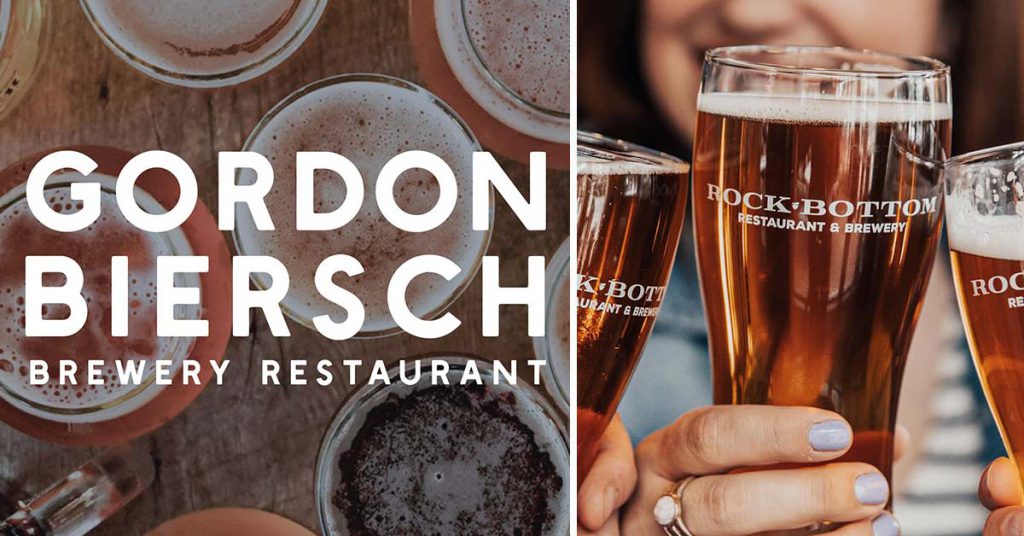
One of the latest signs that craft beer has entered a new era: Patrons of storied brewpub chains Gordon Biersch and Rock Bottom can now order domestic lagers produced by the world’s largest breweries.
The brewpubs shared news of the menu changes on social media in December and January to little reaction from followers. Kelly Operations Group, which acquired both chains from SPB Holdings in late 2024, announced the menu additions in a late February press release.
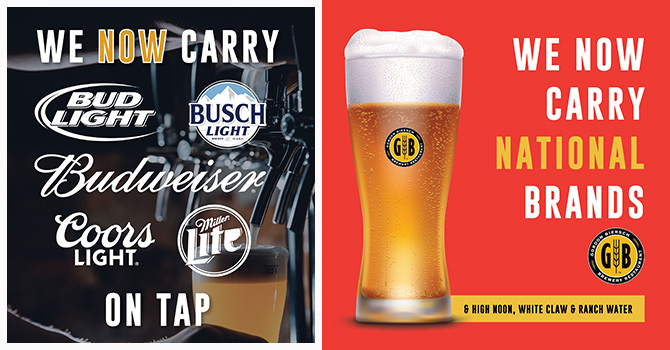
“As part of the transition, Kelly Operations Group has made several key updates to the menu and specials, reflecting their focus on bringing both new and classic flavors to customers across the nation,” the company wrote. “Notable changes include the addition of domestic and import beer on tap including Coors Light, Modelo, Michelob Ultra and more, to expand the offerings to appeal to all beer enthusiasts.”
Both Rock Bottom and Gordon Biersch will continue brewing “signature house brews,” which will be on special alongside counterparts from Anheuser-Busch InBev, Molson Coors and Constellation Brands, a Kelly spokesperson told Brewbound. Price promotions include draft beers for $2 on Tuesdays and $3 on Thursdays, according to the release.
The move to include beers produced by the country’s largest beer manufacturers marks “a significant shift,” Chris Cramer, co-founder and CEO of Karl Strauss Brewing, told Brewbound.
“Rock Bottom and Gordon Biersch were foundational to the U.S. craft beer movement – not just in introducing people to craft beer but in training a whole generation of brewers,” Cramer said. “Their move to bring in mass domestics and imports signals a strategic pivot.”
Southern California-based Karl Strauss operates nine brewpubs in the region and sells its beer and other craft brands to off- and on-premise retailers via Karl Strauss Distributing. The brand, which was founded in 1989, has ridden out various craft beer industry waves, giving Cramer a sharp perspective on the brewpub segment and its significance to craft overall.
“Our point of view: A brewpub isn’t just a restaurant that sells beer, it’s a place that creates beer,” he said. “It’s where people connect with the craft in a tangible way – being closer to the brewing process, engaging with brewers, and experiencing something they can’t get anywhere else.
“Moving toward a more mass-market lineup risks stripping away that identity,” Cramer continued. “And maybe that identity just isn’t important to them anymore.”
Brewpubs, which the Brewers Association (BA) defines as breweries that sell at least 75% of their volume on their own premises and operate restaurants, have maintained a relatively stable share of craft volume since 2016, when they produced 1.3 million barrels.
In 2023, the most recent year for which BA data is available, brewpubs accounted for 8.4% of overall craft production volume. That year, the country’s 3,502 brewpubs collectively produced 1.66 million barrels of beer.
Due to their restaurant component, brewpubs face challenges that other craft breweries may not. With 165 brewpubs opening and 145 shutting their doors, brewpubs’ openings and closings inched closer to parity in 2023 than they have since 2010, when 63 opened and 51 closed, according to the BA.
2018 was a highwater mark for brewpubs, when 461 opened and 99 closed. Openings have dropped off in the years since.
In 2016, Rock Bottom’s 29 locations produced 30,081 barrels of beer, according to BA production data. Twenty-seven Gordon Biersch locations produced a combined 19,050 barrels. That year, the combined brewpub chains’ output would have made them the 63th largest regional producer in the country by volume, according to BA data.
Just as stay-home orders forced the closure of the on-premise channel at the outset of the COVID-19 pandemic in March 2020, Craftworks Holdings – the former parent company of Rock Bottom and Gordon Biersch – operated 23 Rock Bottom and 10 Gordon Biersch locations.
In May 2020, a judge approved the sale of Craftworks to its lender Fortress Credit LLC, which folded the group under its subsidiary SPB Hospitality. SPB sold Rock Bottom and Gordon Biersch, along with several other restaurant chains, to the Kelly Operations Group in December 2024.
Today, Rock Bottom’s website lists 11 locations across California, Colorado, Florida, Illinois, Maryland and Massachusetts. Gordon Biersch’s website names two standalone brewpubs (Louisville, Kentucky, and Myrtle Beach, South Carolina) and nine airport locations across the U.S. and Taiwan.
The additional beer offerings arrive at Rock Bottom and Gordon Biersch at a time when “brewpubs are cool again,” Maine-based Sebago Brewing co-founder Kai Adams said last week during a panel discussion at the New England Craft Brew Summit in Portland.
As drinkers began to embrace more bare-bones taprooms (breweries that sell at least 75% of their beer on their own premises, but do not offer food service, per a definition set up when the BA separated taprooms in their own class in 2019), brewpubs may have lost some swagger. But that has returned, as some breweries turn to food service to boost revenue.
“The taprooms came in 2012 and that made us look a little dinosaur-y,” Adams quipped. “But now everyone wants to know about food service, and we’ve just been able to do it.”
Adams shared that Sebago, which operates four locations in Maine, has seen its revenue return to pre-pandemic levels.
As other breweries turn to brewpubs for inspiration to survive a challenging period for the industry, two of its oldest brewpubs are embracing mass produced beer.
On a careers page maintained by SPB Hospitality, only one head brewer position was open across all restaurant concepts, at the Rock Bottom in Orland Park, Illinois. A Kelly spokesperson did not answer Brewbound’s question about the menu changes’ impact on brewing staff.
Cramer questioned what the embrace of mass domestics means for the chains’ craft ambitions in the future.
“It’s not necessarily a death knell, but it does seem like a departure from the community-driven ethos that made these places – and craft brewers – legendary,” he said. “Will they still invest in brewing innovation? Will they maintain the quality and connection to craft that built their reputations? Or is this a step toward a more conventional restaurant model?”