
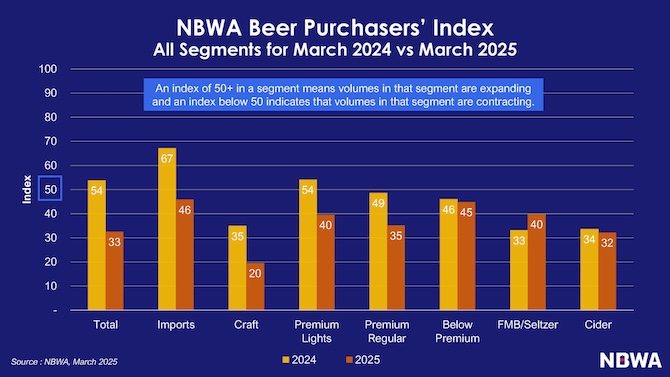
Distributor sentiment for the beer category continued to fall this month, according to the latest Beer Purchasers’ Index (BPI) from the National Beer Wholesalers Association (NBWA).
Beer recorded a March BPI reading of 33, two points below February’s reading of 35 and 15 points below January’s reading of 48. Readings above 50 indicate expansion, or increased beer ordering, while readings below 50 indicate contraction.
March’s BPI reading was 19 points below March 2024, when beer posted its highest March reading since 2021 (54).
At-risk inventory – products within 30 days of going out of code – had a reading of 50, three points below February and three points above March 2024.
The state of the import beer market certainly had an impact on total beer, with the segment falling into contraction for the first time since April 2020, posting a reading of 46. The segment’s March BPI was 21 points below its March 2024 reading (67) and nine points below February 2025 (55).
Distributors’ falling sentiment for beer imports comes ahead of 25% tariffs on goods imported to the U.S. from Canada and Mexico, which are now scheduled to go into effect on April 2. which President Donald Trump has dubbed the day “Liberation Day.”
Trump’s efforts to enact promised tariffs have been delayed several times. Most recently, tariffs were paused the same day they were set to go into effect on March 4, after agreements were made between the three affected countries – dubbed the United States-Mexico-Canada Agreement (USMCA).
Mexico has a dominating share of beer imports in the U.S. January import beer volume from Mexico (nearly 87.8 million gallons, or more than 28.3 million barrels) was 10x the volume from No. 2 importer the Netherlands (8.9 million gallons, or more than 2.8 million barrels), according to the Beer Institute.
Constellation Brands’ portfolio makes up the majority of Mexican import volume, including brands Modelo, Corona, Pacifico and Victoria. The company is required to produce its products in Mexico due to a consent decree after it acquired Grupo Modelo brand rights in the U.S. from Anheuser-Busch InBev more than a decade ago.
Constellation has been hesitant to share how much tariffs could impact its business. During the company’s Gold Network Summit earlier this month, Constellation beer division president and EVP Jim Sabia said: “Consistent with what we have said before, we will continue to evaluate the levers at our disposal around inventory, cost and pricing. These are going to have implications for our suppliers, distributors, retailers and our consumers that also need to be factored in. So please don’t let this take away from any energy you felt last night and the excitement of what you’re going to see and hear today from our teams and the evolution of our successful playbook.”
Teamsters president Sean O’Brien recently called on the Trump administration to deploy “targeted tariffs” on Mexican beer imports, citing lower labor costs for production in Mexico.
Bernstein analyst Nadine Sarwat estimated earlier this year that Constellation could see a 33% hit to group operating income with no incremental pricing, or a 23% hit to group operating income with 5% incremental pricing.”
In addition to imports, all other beer segments were in contraction in March:
- Craft (20), three points above February (17) and 15 points below March 2024 (35);
- Premium light (40), one point below February (41) and 14 points below March 2024 (54);
- Premium regular (35), one point below February (36) and 14 points below March 2024 (49);
- Below premium (45), two points below February (43) and one point below March 2024 (46);
- Flavored malt beverages/hard seltzer (40), four points above February (36) and seven points above March 2024 (33);
- Hard cider (32), seven points above February 2025 (25) and two points below March 2024 (34).