
Calicraft Brewing is on pace to grow 80% in 2025, after 30% growth in 2024. The Walnut Creek, California-based craft brewery has been able to buck national craft trends by cleaning up production, making key hires and refocusing its portfolio.
Now, the company plans to expand that growth into ready-to-drink cocktails (RTDs), launching in 2026.
The addition follows Calicraft’s 2024 acquisition of Heretic Brewery and Distillery in Fairfield, California. Calicraft has maintained some of Heretic’s portfolio, including its line of high ABV RTDs. While the company plans to go in “a different direction” with its own RTDs, leadership learned a great deal from selling Heretic’s offerings in the last year that they plan to apply to the new venture, Calicraft founder and CEO Blaine Landberg said.
While Heretic’s RTD offerings are “high booze, high sugar” and are “a better bang for your buck” compared to similar leading RTD brands, Calicraft’s version will feature offerings between 7.5% to 10% ABV, made with “real” and “all natural” ingredients,” “organic where possible,” Landberg shared. The company is finalizing plans for three different flavors, each using craft ingredients such as grenadine and passionfruit-orange-guava (POG) juice made in house.
“What acquiring Heretic did was really made us pay attention to the other categories, because now you’re in it,” Landberg said. “Understanding how you could pivot and continue to stay strong in beer, while understanding that there is a glut of it. And then take what you’ve learned over the years from creating interesting craft products and start to execute them into categories that maybe you haven’t thought about.”
Through selling Heretic’s spirit- and malt-based offerings, Calicraft learned about the “expansiveness that the consumer has right now” and “what the retailers are listening to,” Landberg said.
“We hadn’t really taken a look at that segment to say, ‘Is there an opportunity, and do we have a voice? And is it something that we want to do?’” he said.
What Heretic found out was there are “not a lot of small players” in RTDs, and “four to five companies, max, have all the shelf space.” Calicraft is positioned to take advantage, using its knowledge of creating high quality craft products with its existing distribution system to “make a difference right now,” compared to other small players.
“Seeing the growth in that [RTD] segment, understanding that there is something here that we believe that would allow us to have a unique voice in that segment, and we could start regionally and locally, and we’re with a huge distributor that was all on board with it, it’s like, ‘All right, let’s go,’” Landberg said.
Calicraft has dabbled in similar beyond beer offerings before, making a “spritzer,” or sparkling fruit wine, as an answer to the hard seltzer boom. However, consumers didn’t quite understand the offering, until it was reimagined and marketed as a hard cider, Landberg said.
“We’re taking all these things that we’ve learned over the years, like, how do you work with wine grapes and how do we stabilize these things, then all these things we’ve learned over the years of how to make fresh beverages in this fruited category,” Landberg said.
“We’re uniquely positioned with all the weird ass, fucking, stupid shit we’ve done over the years – and most of it was weird, most of it was stupid, most of didn’t work, but it tasted good. Now, we have the ability to communicate that more simply to a customer.”
Beer is not to be forgotten. Calicraft is still prioritizing its craft beer portfolio, which will slim down over the course of the next year, particularly across 6-packs.
“We all just went after hazy, hazy, hazy, hazy, hazy, because we had to, that’s what the customer wanted,” Landberg said. “And then we also came out with a bazillion brands and all different colors, and nothing made sense. And all of a sudden, it gets [to be] decision paralysis as a customer.
“If I have a difficult time making a decision and I own a fucking brewery, how the hell am I going to be able to communicate that to a customer?” he continued.
Landberg refers to the herd-culling as “killing our zombies.” The company’s attention will refocus on West Coast IPAs first, including Westside IPA, its No. 3 brand in NIQ-tracked off-premise channels; hazy IPAs second, such as Karl the Fog, its second-largest brand in NIQ channels; and light beer third.
“The simpler we could be – West Coast, hazy, light – we do it in 16 oz. cans, that is it,” Landberg said.
“Now, all of a sudden, retail is starting to understand what you’re doing, now you could press promote, now your distributor knows how to execute your brand, because you’re being very specific about where you want it, who you want it next to.”
Calicraft’s top four brands in NIQ-tracked channels have recorded dollar sales gains year-to-date through June 14:
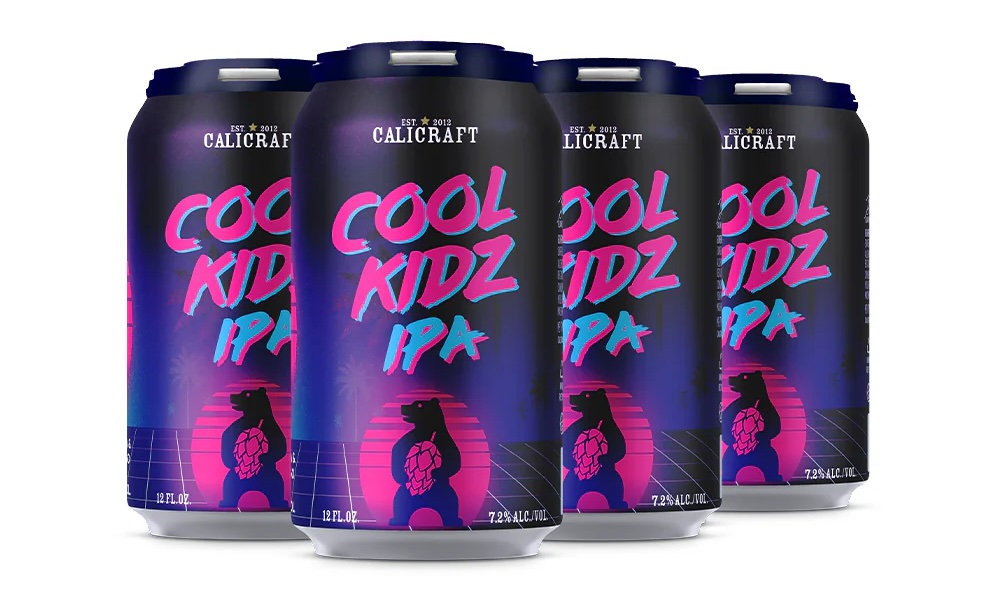
- No. 1 Calicraft Cool Kidz IPA (dollar sales +1%, volume +0.8%);
- No. 2 Karl the Fog (dollar sales +0.8%, volume +3.3%);
- No. 3 Westside IPA, up exponentially as it laps its May 2024 launch;
- And No. 4 Oak Town Brown Ale (dollar sales +15.7%, volume +17.9%).
Its fifth-largest brand, Cali Coast Kolsch – one of its oldest offerings – isn’t faring as well, with dollar sales down 31.8% and volume 36.4% YTD. Those results are why the company’s third priority is light beer, and more specifically “rethinking what we’re doing with light beer.”
“Because we’re in California, and the retailers we have, it’s fucking [Constellation Brands’] Modelo [and] Pacifico, baby,” Landberg said. “We could come with the greatest light beer, you know what? They tell us, ‘Great, sell the shit out of it [in] your taproom.’”
Calicraft’s total off-premise business – excluding hard cider brand Bloom – is up double-digits YTD in NIQ-tracked channels (dollar sales +24%, volume +28.8%).
Helping spearhead executing Calicraft’s new plans at retail is director of sales John Spicer, who joined the company in August 2024. Spicer previously led national accounts at Mighty Swell, Lagunitas and Anchor, and spent nearly four years in sales at Molson Coors.
“That’s made a tremendous difference for us in terms of our focus,” Landberg said. “He really came in and looked at our organization and said, ‘Hey, we got to focus on chain business.’”
Results are already beginning to show, with sales up 75% in Safeway and 56% at Raley’s, Landberg said.
Another recent hire is helping streamline production. In late April, Calicraft hired Ramon Tamayo as head brewer. Tamayo previously oversaw New Belgium’s now-shuttered San Francisco taproom brewery and advised Open Beer, an art-centric lager brand New Belgium backed. He also had tenures at Anchor and Russian River.
Tamayo’s hiring has been “transformative” to the brewery, Landberg said.
“His mentality, in terms of how he runs a team, is very leadership-forward and training-forward and mentorship-forward,” he said. “Even beyond the technical side of how he brews beer and how he understands how to make it. When you’re talking about somebody coming into an organization, they also really need to understand kind of the ethos that you’re trying to create and the vision that you’re trying to do with your beverages, and this is where Ramon’s fantastic.”
Tamayo has also helped make the brewery more efficient, decreasing production loss from about 25%, to less than 10%, saving about 150 to 200 barrels a month.
“He’s brought more than just a vision and a personality and a technicality, he’s also brought our ability to make this a more viable business as we move forward,” Landberg said.

The hiring move has also allowed Calicraft’s director of marketing and sales, and original brewmaster, Thomas Vo, to turn some of his creativity toward cocktails at Calicraft’s new location in downtown Walnut Creek, slated to open later this year.
The 3,000 sq. ft. indoor/outdoor space will still serve about 20 beers on tap, but will be cocktail-focused, with Vo leading a drink program that will highlight local ingredients and unique combinations, Landberg said.
Also joining Calicraft’s own-premise lineup is a new taproom near the campus of the University of California – Davis, which is home to one of the most esteemed brewing education programs in the country. The 8,000 sq. ft. indoor/outdoor space will be the anchor of a new development on “one of the busiest corners in Davis, near some of the university’s athletic facilities. The area was previously known as a large social spot, housing the now-closed Davis Graduate bar, or “The Grad.”
Additionally, Calicraft is opening a new R&D brewery and taproom at its Walnut Creek homebase. The company’s original facility was recently sold and torn down, with a new building going in its place. When construction is done – slated for mid-2026 – Calicraft will have a new 10,000 sq. ft. brewery space.
In the meantime, Calicraft has created an outdoor beer garden next door that opened in April. The outdoor space, which also houses a 40 ft. shipping container and a cold box, has recorded a 15% to 20% bump in sales compared to the taproom’s 2024 performance, Landberg said.