
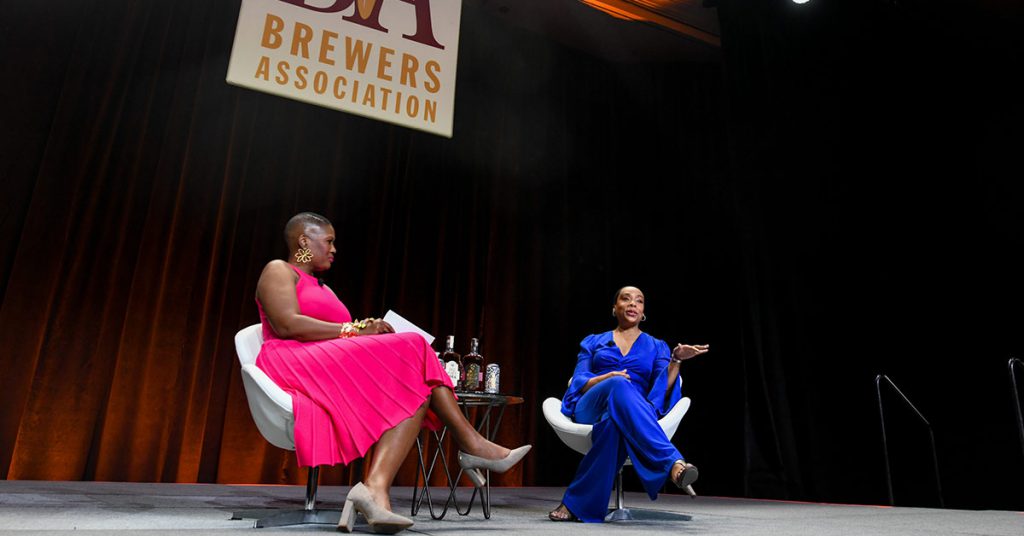
Uncle Nearest Distillery founder and CEO Fawn Weaver disregarded the advice of the spirits industry’s old heads on the way to building a billion-dollar brand, she shared during her fireside chat with Crowns and Hops Brewing co-founder and CEO Beny Ashburn on the opening day of the 2024 Craft Brewers Conference (CBC) in Las Vegas.
“Literally every single thing that everyone told me, ‘This is what you do not do,’ we did,” Weaver said.
The path less traveled for Weaver included launching in control states when others suggested that she start in open states; expanding distribution nationwide within two years when others told her to try to focus on her home state for five to seven years before expanding; and leaning into awards instead of a brand story, when others told her that no one cares about awards.
“No person of color has ever succeeded [in the industry],” she said. “No woman at the top has ever been at the top. So why would I listen to what has always worked?”
Five years later, Weaver is lauded for her success in building the Uncle Nearest brand. The road to more than 1,100 awards for a brand that celebrates the story of the first known African-American master distiller is about being authentic and representing women and people of color in a predominantly white male dominated business, Weaver shared.
“I realized that if I could break through every ceiling, every barrier in this white male industry, that everybody else can do it in every other industry,” she said. “So I wasn’t representing hope for the spirits industry; I was representing women and people of color, period.”
When Uncle Nearest launched in 2017, Weaver’s women-led team was met with indifference and silence from supplier companies, retailers and distributors who wouldn’t return their calls. Weaver leaned on her husband, a Sony Pictures executive, to get through to decision makers.
When her husband reached out, those decision makers either took his call immediately or returned it by the end of the day. The decision makers had two questions for Weaver’s husband: Do you play golf? And do you drink beer?
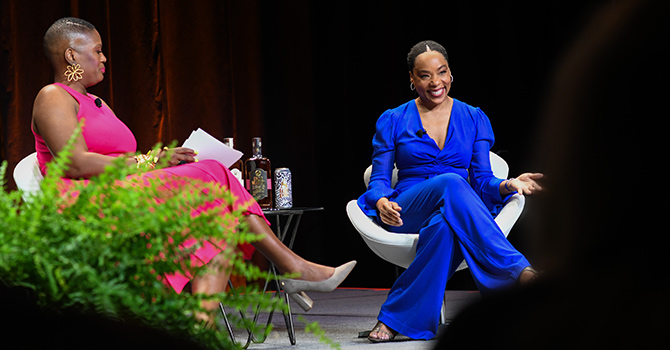
Weaver said this allowed her to fly below the radar, which informed her strategy behind landing news stories in Uncle Nearest’s early days. In those stories, she wasn’t referred to as founder and CEO, but the chief historian, because “that’s something America could swallow at that time.”
Her true role as the driving force behind Uncle Nearest didn’t become public until 2019. And even then, the fact that the company was women-led and Black-owned didn’t come out until 2020.
“Why?” she said. “Because the juice can speak for itself. And if all ego is cast aside – don’t care what my color is, don’t care what my gender is – and if all of that wasn’t put aside so the juice spoke for itself, I would not be sitting here right now.”
The juice attracted consumers but the story kept them engaged, Weaver continued.
Through its growth period, Uncle Nearest has remained independent and resisted investment from strategics and private equity, including a $2 billion offer for the company, Weaver claimed. Instead, the company has relied on investment from 170 individual investors.
To build the brand, Weaver shared that she needed $230 million.
“What beer brand needs to do that?” she asked.
The decision to lean on individual investors has created 170 brand ambassadors who act as “an extension of myself,” Weaver said. And they have helped secure multiple national accounts.
Over the last year, Uncle Nearest has turned into an acquirer. In October 2023, the company acquired cognac maker Domaine Saint Martin. The company appears poised for more deal making, as Weaver teased an acquisition of a craft spirit brand – one that attempted to stay small but ultimately will be sold to Uncle Nearest once due diligence is completed in the coming weeks.
“With craft distillers, there’s always been this pride in staying small,” she said. “The company that I’m acquiring – phenomenal company that was trying to stay small. The problem is you stay small too long, you will die or you will have to be acquired, and you will be acquired at a loss because you never had a goal or a dream to be bigger.”
Weaver hinted that tequila may be in her company’s future, adding that if you see her in Jalisco, Mexico, “know that I’m putting down roots.”
Several times throughout the discussion, Weaver challenged the notion that brands should remain small. She added that there’s a piece of the craft beverage movement “that is so hung up on ego” and a desire to do everything themselves.
“There isn’t that much pride in doing your own accounting,” she said. “There is nothing great about aspiring to be small. It’s hard to be big when little’s got you.”
The commentary highlighted a striking difference between the trajectory of craft distillers and craft brewers, with the majority of the 9,683 small brewers producing fewer than 1,000 barrels of beer annually. The BA has championed those small and independently owned craft beer makers, while excluding those who have been acquired by a larger bev-alc producer from its ranks.
Weaver also shared that Uncle Nearest is trying to lift up other BIPOC companies along the way Last week, the company hosted 130 BIPOC founders, who were afforded the opportunity to pitch “all of the gatekeepers” in the industry, from distributors to retailers to investors.
“If we can make it to the top, we’re bringing everybody with us,” Weaver said.
Throughout the speech, Weaver preached being authentic in both business and self. The philosophy has helped Shelbyville, Tennessee-headquartered Uncle Nearest become the seventh most-visited distillery in the world and its guests cut across political lines.
“I don’t change who we are and what we do in order to suit the large population, but the larger population feels comfortable with this brand because I made sure from Day One everybody was included,” she said.
“We don’t have to agree on everything as a matter of fact, we sure as hell don’t have to agree on politics,” she continued. “Like the fact that people would just discount other people as consumers because of their political beliefs is insane and suicide in business.”
Weaver concluded that success doesn’t make the work easier.
“The higher you go up, the thinner the atmosphere, the more difficult it is for you to breathe,” she said. “If you’re looking to get to this moment of easy, drop out now. If you’re going to the next level for purpose, then nobody can knock you off that mountain that you’re climbing.”