
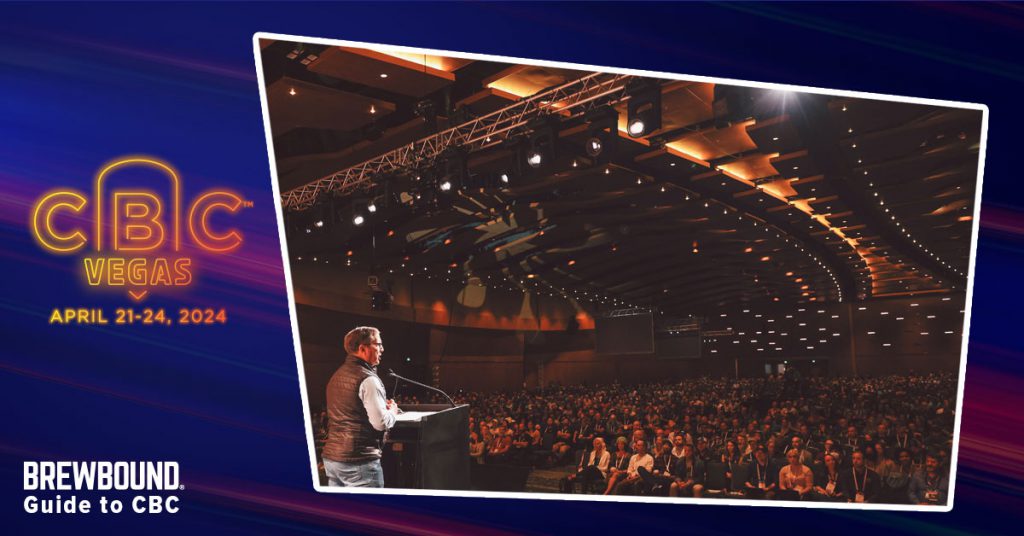
Ahead of the 2024 Craft Brewers Conference (CBC), which officially kicks off today (Monday, April 22), Brewers Association (BA) president and CEO Bob Pease shared his thoughts on the largest gathering of craft brewers, the turbulent times the trade group’s members are facing, the organization’s own changes and conversations he and Dr. J Jackson-Beckham have taken part in regards to the 2023 event.
Below are Pease’s responses to Brewbound’s questions.
Brewbound: Official or unofficial, what do you believe the theme of this year’s CBC will be?
Pease: Internally, our unofficial theme is finding growth. That can be applied in various ways, not just market growth, but business growth, leadership growth, learning lessons on growth from other industries, and more. I think you’ll see that reflected in our General Session presentations and seminar lineup. We want to make sure CBC attendees take away actionable ideas to implement when they get back to their businesses.
It is harder than ever to run a successful brewery business in a complex beverage environment. The seminars and tradeshow are aimed to help find the growth pockets and efficiencies that will help attendees run profitable businesses.
It’s no secret that the market is rough now for a lot of craft brewers. We’ve seen increased closures, bankruptcies, auctions. What’s your message to your members at this point?
Pease: While there are challenges in the industry, there are many successes and opportunities that exist. No one will run a better business by worrying about financial uncertainty, so our message to our members is that we’re here to share insights, tools, and resources to help them understand and navigate this market while listening to them on what we should be doing next to best help them thrive.
There are bright spots, and they lie in the fact that Americans still love visiting their local brewery, meaning taproom and brewpub numbers have held up better than distribution. While demand isn’t necessarily growing, this isn’t a bubble bursting, and many craft brewers still have strong brands, particularly in their local markets. That offers opportunities for extensions as well, and many brewers are seeing more opportunities in beverage or other product areas.
How can the BA better help those breweries?
Pease: That answer is going to change over time; what we’re doing today shouldn’t be what we’re doing in a year or two years as our members’ businesses evolve. That’s a place we want to hear from our brewery members. There are some things we can’t change (e.g., we can’t negotiate with your landlord when the lease is due), but we can understand those challenges and put resources in place to make sure breweries know what the issues and challenges are and have networks and resources that help them respond.
The Brewers Association will continue to support our brewery members in several ways, including advocacy, education, resources, programs, networking opportunities, market research and marketing.
In recent years, our governmental affairs efforts have seen major wins and broken down barriers for the industry (e.g., changing state legislation, franchise laws, etc.). This has been some of the most impactful work that the BA has done, and we will continue the important work we do in D.C. to help craft breweries nationwide.
The BA is a big tent party at this point. Your members vary widely in size and needs. How is the BA ensuring that it is meeting its members’ needs at this critical juncture?
Pease: We are grateful for the diversity of our membership. While we currently have a robust library of resources and programs and offer value through in-person experiences, we rely on our members to share their feedback so that we can serve them the best we can.
We have continued to recognize emerging business models and have diversified to meet those needs. Our board created the taproom breweries membership class around six years ago, and a more recent example of how we are meeting members’ needs is through the recent changes to our bylaws to include contract brewery members as voting members.
Ultimately, at the BA, meeting member needs starts with hearing from all those members. That’s why it’s so important for breweries to engage to have their voice heard and why so much of what we do builds in member input from committees and more. Look at what we were doing five or 10 years ago, and I think you’ll see the evolution of our resources and programs based on the changing nature of small and independent breweries and our membership more broadly.
As we all know, many of the business conditions for beverage alcohol are negotiated at the state level so we’ve increased our government affairs support. One success that we are proud of is the franchise law reform that passed in Wyoming this year. That was a team effort that included the guild, the Brewers Association, and the state’s wholesalers at the table.
Federally, our members don’t have the bandwidth to have to think about labeling rules that we are working on now that won’t go into effect until late in the decade. Our members need the association to make sure the rules that are created are reasonable and fair for small brewers.
This will be the first CBC following the by-laws change that made contract brewers voting members. What should this group of brewers expect before they attend the voting members meeting? Why was this change important for the BA to make?
Pease: In February, the Brewers Association Board of Directors approved updates to both the voting member criteria in our bylaws and the craft brewer definition to include small contract brewers (where brewing is your primary business). This shift recognizes the changing landscape within the beer community, provides greater representation for this growing segment, and ensures that their voices and input are heard and included in forming the trade association’s priorities and resources.
Contract breweries are disproportionately minority groups, and changing the bylaws to give contract brewers full voting rights was important to diversify and expand the discussions in voting member meetings.
We encourage all contract brewing members to attend the voting members meeting at the Craft Brewers Conference as it will be a great opportunity to engage in important conversations with the Board of Directors and other Brewers Association staffers.
Craft is at an inflection point. A lot of the leaders who started the movement have moved on. The founder-as-star seems to have faded as well. Who do you see as being instrumental in writing craft’s next chapter?
Pease: Like any other industry, community members come and go, and we are equal parts thankful for those who have positively impacted our industry in the past and excited about the current and future talent that is and will continue to be instrumental in writing craft’s next chapter.
The BA just announced the annual Industry Award winners, and this year’s honorees are making huge ways in the industry. Read the full report here.
In addition, the BA’s Mentorship Program continues to grow year-over-year, with the latest cohort being the largest to date. We are confident these rising stars will have major impacts on the craft community.
The innovators of processes and styles will be instrumental in writing the next chapter. The brewers who help other brewers and become leaders in their communities will gain regional or national notoriety and influence many.
As the industry has grown, it will probably be harder to point to just a few individuals. Chapter writing is hard, and so the people who spend the time showing up and engaging most widely in the industry are likely to have the biggest influence.
I think there is a chapter that J. Nikol Jackson-Beckham, Ph.D, will write. Her work is helping lead the mentorship of hundreds of diverse folks to check out opportunities in the craft beer industry is paying off. We are in a big moment of creating an inclusive industry, and it will take many years.
The BA itself is in a transitional period. After sunsetting SAVOR in 2022, the organization has put Homebrew Con on ice. Additionally, long-time events coordinator Nancy Johnson is retiring. Events are such an important piece of the BA’s annual business. How is the BA approaching events moving forward?
Pease: Events remain an important part of our organization, and while we will miss Nancy, we have an outstanding events team that is well-trained and will continue to execute our events and competitions with excellence.
The goal of our events will always be to provide value for our members through events like the Craft Brewers Conference, and for the public through events like the Great American Beer Festival. Each year, we strive to provide an experience even better than the previous, and we rely on attendee feedback to evolve our events in meaningful ways.
Anyone who is involved in events knows that they must change over time and our events are evolving accordingly. That will be based on a combination of nuts-and-bolts event operations, as well as the needs of the industry and our members. Our events serve various purposes, from information gathering and promotion to problem-solving and community gathering. We’ll keep listening to our members on what specific needs they have and then work to make sure our events best solve those needs.
You and Dr. J met with Lady Justice to discuss concerns following CBC 2023, including host city selection, sessions failing to go through DEI checks and a perceived lack of support for small breweries. What can you share about that meeting and how the BA is approaching things differently in response?
Pease: Lady Justice is a very engaged member, and we met with them in February to discuss progress. We had a great meeting and covered a lot of topics. They have been very generous in publicly sharing information from the meeting, and their notes should be taken at face value. We plan to continue to check in with them to learn what the smallest brewers need from their trade association.
In one way, we’re not approaching things differently – which is to say that we are always changing and growing. As a trade association, we strive to engage in continuous improvement that is informed by best practices, available data, and feedback from our members and the broader brewing community. This applies to our DEI department and programs, which were established in 2017, and continue to evolve. Coming out of Nashville, we tightened up a number of our processes.
Read More: Brewbound’s Guide to the 2024 Craft Brewers Conference
Brewers Association Hopes to Turn Craft’s Luck at CBC in Las Vegas
Justin’s CBC Picks: State of the Industry, Fawn Weaver, Government Affairs and Chain Buyers
Jess’ CBC Picks: Innovation, Annual Business Plans and Beer Education
Zoe’s CBC Picks: Hard Cider, Brand Extensions and Business Smarts
Craft Brewers Conference Primer: A Pre-Conference Reading List
Brewbound Podcast: The Brewers Association’s Dr. J on Thrive, CBC and Vegas Musts