

Metal cans have regained the share of beer volume they lost in the prior year, according to the Beer Institute’s (BI) new packaging mix report.
Cans accounted for 64.1% of beer volume in 2023, marking a return to the same share they held in 2021 after a slight dip to 62.9% in 2022. The +1.2% share change for cans came from bottles, which declined from 28.1% in 2022 to 26.9% in 2023.
Draft’s share declined -0.1% year-over-year (YoY), to 8.9% in 2023, down from 9% in 2022.
“This year’s report covers three years’ worth of data and shows the recovery of draft beer since the pandemic in 2020,” the BI wrote. “Draft beer currently makes up 8.9% of beer volume, up 3.1 percentage points since 2020. However, draft beer remains below its 2019 level of 10.4%.”
The on-premise shutdowns of 2020 due to the COVID-19 pandemic caused a drastic shift in beer package formats. That year, draft’s share was nearly cut in half, dropping from 10.4% in 2019 to 5.8% in 2020, according to the BI. Draft began to rebound in 2021, increasing share to 8.3% and adding another +0.7% in 2022, to 9%.
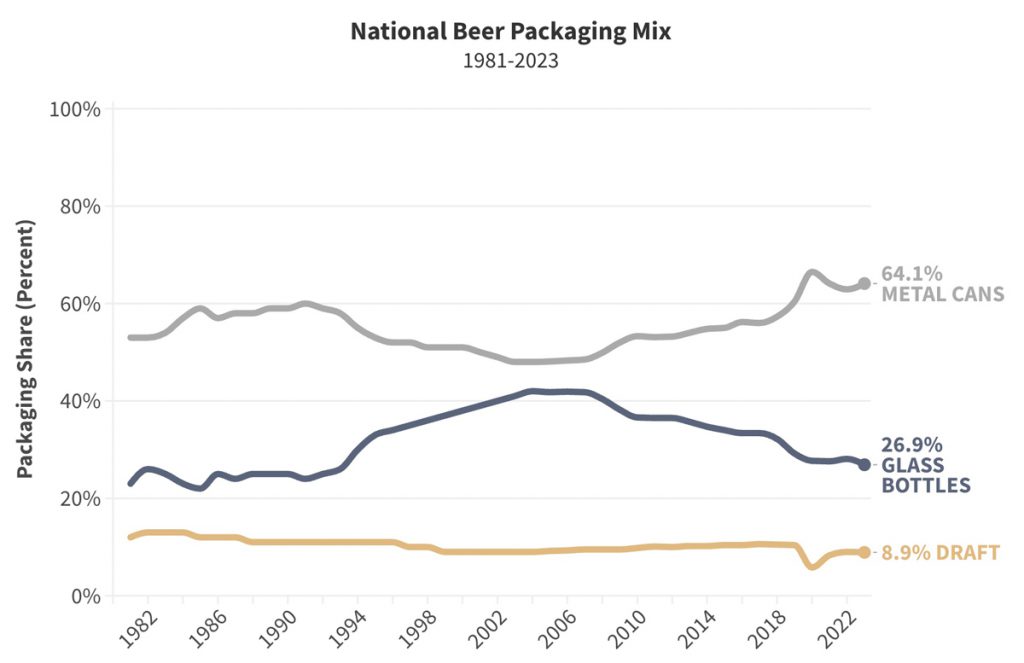
The BI began tracking beer package share in 1981, when cans accounted for 53% of volume, followed by bottles (23%), draft (12%) and refill bottles (12%), which have since disappeared from the landscape.
Throughout the BI’s 43 years of tracking, draft’s share has remained fairly steady. It peaked at 13% in 1984 and reached its nadir during the pandemic in 2020. Draft held double-digit share until 1999, when it dipped to 9% and it didn’t tick back up until 2011, when it reached 10.1%.
Share of beer in bottles and cans has been more volatile. Cans have always been the dominant package, but bottles gained share during the 1990s and 2000s with the rise of the first wave of craft beer.
Bottles began their share climb in 1994, when their share of beer jumped +4% YoY, to 30%. Glass bottles’ share peaked in 2004 at 42%. That year, cans accounted for 48% of volume – their lowest recorded share – and draft was 9%.
At the state level in 2023, cans hold the highest share in Arkansas at 75.3%, followed by West Virginia (74.1%), Vermont (73.9%), Montana (73.8%) and Iowa (73.7%).
Bottles were strongest in Maryland with a 35.9% share, followed by Connecticut (35.8%), New Jersey (35.4%), Rhode Island (34.7%) and Louisiana (33.5%).
Draft had its highest share in Washington, D.C., at 18.8% of total volume, followed by Minnesota (16%), Massachusetts (14.2%), Oregon (13.6%) and Maine (13.5%).
Package mix in the import segment differs from overall beer, with glass bottles accounting for the majority of volume at 55%, followed by cans (40%) and draft (5%).