
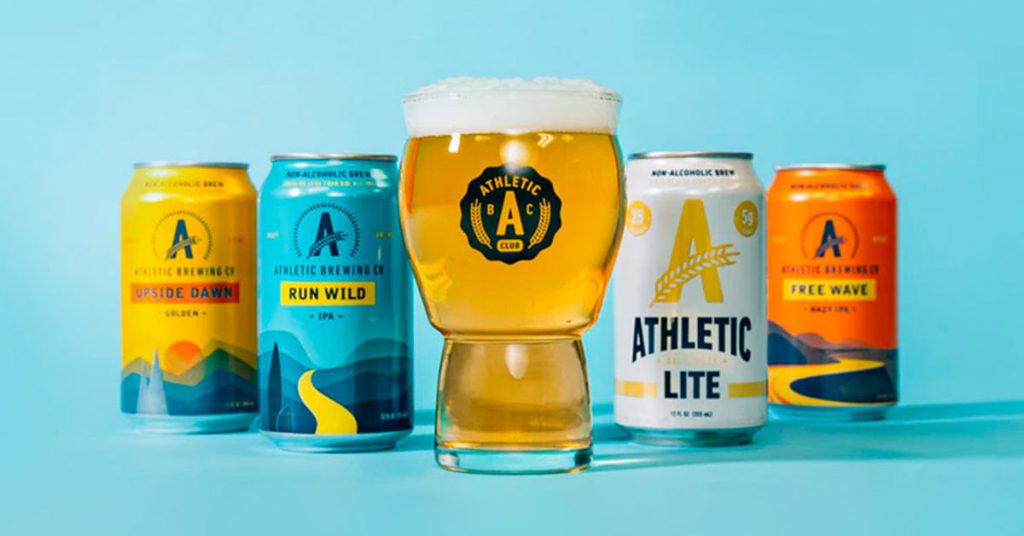
Seven of the top 25 craft growth brands in 2023 were non-alcoholic (NA) offerings, according to full-year NIQ data shared in Bump Williams Consulting’s 2023 craft review.
Five of those brands belong to dedicated NA brewer Athletic Brewing Company, including Run Wild IPA (No. 5 growth brand and No. 25 overall craft brand), Free Wave Hazy IPA (No. 10), Upside Dawn Golden (No. 12), Cerveza (No. 22), Athletic Lite (No. 25).
Athletic capped a big year as the No. 15 craft brand family in sales, which increased +80.6%, as volume measured in case sales increased +79.2%. Athletic was the No. 2 craft growth leader in 2023, increasing sales by more than $35.4 million, to $79.3 million, trailing only New Belgium Brewing, which increased sales +18.2%, to $514.8 million, adding more than $79.3 million in sales last year.
Of the top craft brand families, Athletic gained the most category weighted distribution (CWD) last year (+9.4%, to 27.4%). New Belgium was second (+3.7%, to 72.6%).
The other NA beers to make the cut as top growth brands in 2023 were Boston Beer’s Samuel Adams Just the Haze IPA (No. 15) and Lagunitas Hoppy Refresher assorted pack (No. 18).

On the other end of the ABV spectrum, New Belgium’s high ABV Voodoo Ranger Juice Force and Fruit Force offerings ranked as the top two craft growth brands in 2023. Off-premise sales of Juice Force in its second full-year reached nearly $116.7 million, while Fruit Force sales topped $45 million in its first full year.
Five other New Belgium-owned brands made the top craft growth brands list, including:
- No. 4 Voodoo Ranger Imperial IPA;
- No. 11 Bell’s assorted IPA pack;
- No. 14 Voodoo Ranger Hoppy pack;
- No. 17 Bell’s Hazy Hearted IPA;
- No. 20 Bell’s Two Hearted IPA.
Voodoo Ranger Imperial IPA closed 2023 as the No. 2 overall craft brand, growing sales +8.8%, to nearly $160 million. The brand trailed only Molson Coors-owned Blue Moon Belgian White, whose sales declined -3.1%, to $283.9 million.
New Belgium finished 2023 as the top craft brand family, with overall dollar sales increasing +18.2%, to $514.8 million.

Molson Coors Top Craft Vendor, But New Belgium Gaining
Fort Collins, Colorado-headquartered New Belgium also trailed Molson Coors as the top craft vendor. However, adding sibling brand Bell’s, whose data is kept separate from New Belgium, into New Belgium’s sales totals surpasses Molson Coors. Bell’s alone ranked as the eleventh largest craft vendor, with nearly $112.4 million in sales.
Of the remaining top 15 craft vendors, beyond Molson Coors and New Belgium, just five increased dollar sales in 2023. The top 15, in order of dollars sales, included:
- Molson Coors’ craft portfolio ($551.1 million, -7.7% dollar sales);
- New Belgium ($514.848 million, +18.2%);
- Anheuser-Busch InBev’s craft portfolio ($464.6 million, -1.5%);
- Sierra Nevada ($357 million, +4.3%);
- Boston Beer ($310.9 million, -4.3%);
- Tilray Brands ($211 million, -4.8%);
- Heineken/Lagunitas ($178.8 million, -7.5%);
- Gambrinus/Shiner ($135.59 million, -0.7%);
- Mahou-owned Founders ($125.9 million, +2.2%);
- Firestone Walker ($122.1 million, -2.9%);
- Bell’s Brewery ($112.4 million, +6.5%);
- Monster Beverage/CANarchy ($97.1 million, -5.6%);
- Artisanal Brewing Ventures ($92.3 million, +2.7%);
- Sapporo/Stone ($87.98 million, -1%);
- Athletic ($79.6 million, +81.4%).
Outside of New Belgium, the only top 15 craft vendors to increase both dollars and volume were Bell’s (+7.1% volume), ABV (+1.8%) and Athletic (+80.1%).

Sierra Nevada No. 2 Top Craft Brand Family, Blue Moon No. 3
Zeroing in on craft brand families, Sierra Nevada ranked second to New Belgium. Although Blue Moon Belgian White remains the top-selling craft brand, the Blue Moon family ranked as the third craft brand family in off-premise sales, with dollars declining -8.5% and shedding nearly -12% in volume.
The top 25 craft brand families shook out, in order of dollar sales:
- New Belgium ($514.8 million, +18.2% dollar sales, +12.5% volume);
- Sierra Nevada ($357 million, +4.3% dollars, -0.8% volume);
- Blue Moon ($347.2 million, -8.5% dollars, -11.9% volume);
- Samuel Adams ($259.2 million, -2.9% dollars, -7.2% volume);
- Lagunitas ($178.8 million, -7.5% dollars, -10.4% volume);
- Shiner ($131.56 million, -0.9% dollars, -4% volume);
- Founders ($125.9 million, +2.2% dollars, -0.6% volume);
- Molson Coors’ Leinenkugel’s ($119.97 million, flat dollars, -3.2% volume);
- Firestone Walker ($115.7 million, -5.1% dollars, -8.9% volume);
- Bell’s ($112.4 million, +6.5% dollars, +7.1% volume);
- A-B-owned Elysian ($103.1 million, -7.7% dollars, -10.2% volume);
- A-B-owned Kona ($99.5 million, +13% dollars, +10.8% volume);
- A-B owned Goose Island ($96 million, +4.8% dollars, -1.8% volume);
- Sapporo-owned Stone ($83.17 million, +3% dollars, +3% volume);
- Athletic ($79.3 million, +80.6% dollars, +79.2% volume);
- Deschutes ($68.07 million, -3.8% dollars, -9.8% volume);
- New Glarus ($59.2 million, +4.1% dollars, +3.1% volume);
- Monster-owned Cigar City ($58.6 million, -1.6% dollars, -4.6% volume);
- Tilray-owned SweetWater ($52.2 million, -4% dollars, -5.5% volume);
- Boston Beer-owned Dogfish Head ($51.1 million, -10.2% dollars, -11.5% volume);
- ABV-owned Victory ($45.6 million, +1.2% dollars, +1.3% volume);
- A-B-owned Wicked Weed ($40.67 million, +7.7% dollars, +4.9% volume);
- Tilray-owned 10 Barrel ($39.666 million, +7.4% dollars, +4.3% volume);
- Georgetown ($39.17 million, +12.8% dollars, +9.6% volume);
- ABV-owned Southern Tier ($37.9 million, +5.3 dollars, +10.1% volume).
Craft growth leaders for 2023 outside of New Belgium and Athletic include, in order, Sierra Nevada (+$14.6 million in sales), A-B’s Kona (+$11.48 million), Bell’s (+$6.9 million), Fiddlehead (+$4.93 million), Georgetown (+$4.45 million), A-B’s Goose Island (+$4.38 million), Hop WTR (+$3.64 million), and Tilray-owned Montauk (+3.36 million).
Blue Moon led 2023’s loss leaders, shedding nearly $32.3 million in sales). Other loss leaders included Lagunitas (-$14.43 million in dollar sales), Elysian (-$8.56 million), Samuel Adams (-$7.7 million), Tilray-owned Shock Top (-$7.57 million), Firestone Walker (-$6.25 million), Molson Coors-owned Terrapin (-$5.88 million), Dogfish Head (-$5.8 million), A-B-owned Karbach (-$5.1 million), and Molson Coors-owned Hop Valley ($5.1 million).
2023 ‘Mixed Bag’ Year for Craft
Bump Williams Consulting described 2023 as a “mixed bag” for the overall craft segment across channels. Craft sales in convenience increased +6.5%, while grocery (-1.4%) and liquor outlets (-5.6%) both declined, the firm noted, citing data from NIQ.
Overall, off-premise craft dollar sales edged close to flat, declining -0.3%, while volume dropped -3.8%, the firm noted, citing data from NIQ.
The declines of mainstream craft brands accelerated (-7.5%) in 2023 compared to 2022 (-4.9%), the firm reported. National (+5.8%) and regional (+2.6%) posted dollar sales growth. However, local craft continued to decline, -2.9% in 2023, following declines of -7.1% in 2022 and -4.7% in 2021.
Just two regions eked out craft dollar sales growth: the Mountain region (+0.1%) and New England (+0.4%). The biggest sales declines occurred in the West North Central region (-4%), East North Central (-3.3%) and the Pacific region (-2.4%).
The number of craft brands and SKUs declined -4.4% and -4.9%, respectively. There were 19,722 craft brands at the end of 2023, down from the 20,637 craft brands in 2022, and nearly on par with the 19,718 craft brands in 2021.
The number of SKUs dropped to 24,796, well below the 26,079 in 2022 and 25,238 in 2021.
The number of new craft brands and SKUs in 2023 declined -37% and -35.8%, respectively, compared to 2022. The 2,018 craft brands in 2023 was down from 3,202 in 2022 and 3,022 in 2021. The 2,632 craft SKUs in 2023 fell from 4,099 in 2022 and 3,776 in 2021.
Bump Williams noted that beer shelf space remained “stagnant, with existing space instead being re-allocated across segments.”
Imports, FMBs and non-alcoholic beer gained shelf space across all channels, while craft and cider singles gobbled up space in convenience.