
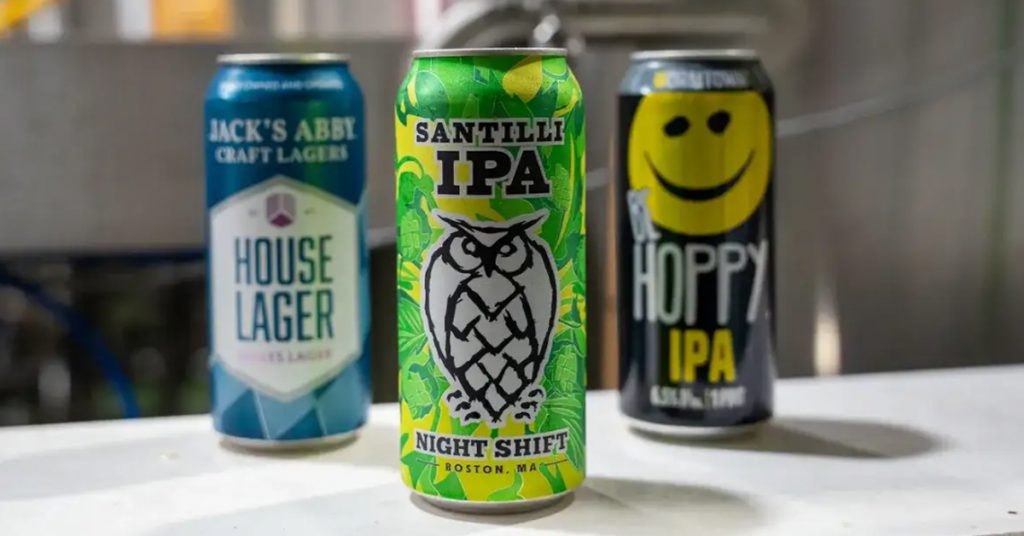
The formal union of Jack’s Abby and Night Shift Brewing had an air of inevitability. The Massachusetts craft breweries already had a contract brewing arrangement in place for more than two years, with Jack’s Abby producing the majority of the Everett-based brewery’s beer. And in June 2023, the company acquired Night Shift’s brewhouse in an auction.
On Monday, Jack’s Abby parent company Hendler Family Brewing Company (HFB) announced plans to acquire Night Shift, marking its second transaction of 2024 following the April acquisition of Wormtown Brewery in Worcester and giving it a full portfolio of Massachusetts craft brands.
Speaking to Brewbound, Night Shift co-founder Rob Burns and HFB co-owner Sam Hendler discussed the whys of the deal, how scale will change HFB’s business relationships and what’s next.
Here is an edited version of our conversation.
How long has this been in the works?
Rob: Sam and I have worked closely together for many years. We’ve always talked about ways to work together beyond the [Mass.] Brewers Guild.
The conversations got more serious at the beginning of this year. Like, ‘Hey, should we join forces? And what would that look like?’ And, ‘How can we make it happen?’ It obviously took some time to make sure it all made sense, and get to the finish line.
Sam, you already had a contract relationship with Night Shift, what did you see as the opportunity in acquiring the brand?
Sam: Getting more resources against all of these brands. The big picture here is these brands all on their own – Jack’s, Wormtown, Night Shift – would be struggling to have a full sales team and marketing team and human resources and accounting and all of these things that once you get to a certain size you need to have, and you need to do well. And if you don’t do it well, you’re not going to cut it at this point.
It’s too hard out there to get growth if you’re not firing in on all cylinders. And these brands individually can’t afford a full suite of those kinds of staff. But when you put them all together, you can have a really awesome sales staff, really awesome marketing staff, down to human resources and accounting, and that’s the key.
So we’re putting those pieces together and hopefully giving these brands a real shot at cutting through this environment and growing.
Rob: We’re all spending money on these similar roles. We can only afford maybe a half a person of this caliber of a sales director. How do we do this as a standalone company that’s just a small, independent company? It really makes sense to band together with somebody and really get some alignment, and hopefully the brand that we’ve worked so hard to create over the last 13 years can survive much longer than if we just stayed as a standalone company.
We looked at the landscape and like, ‘Hey, we should start being some of the first movers and finding the right partners sooner than later, and get ahead of this so that we can make sure that we land in a good spot.’ I’m really excited with who we’re ending up transitioning the company to.
Did you work with a firm or anybody through this process?
Rob: I did it myself. We did talk to other breweries, and that was our focus. We really wanted to go craft-on-craft approach, so we did have a selection of breweries to talk to, and we did get other interested offers, but really settled on Sam and his team as the best possible path for the future of Night Shift.
Plus, overall their vision and and really also how it would shake out for the entire Night Shift employee base.
Tell me about that vision, Sam. You’ve got a lot of scale now after two deals this year.
Sam: We’ve said for a while now, our path forward is through building up the production side of the business. Obviously, prior to this year, that was predominantly through contract brewing deals, Night Shift among those.
But we’ve seen the power that scale puts behind our business. Doing it on the production side really stabilized our company, and I don’t know that we’d be here without having made that pivot in 2020.
We are progressively getting farther into this, with a full integration of first Wormtown and now Night Shift, and Rob’s used the word survive a couple times here. And I think a lot of craft brewery owners can probably identify with the feeling of figuring out how to survive right now.
What we think we’re putting together at this point is a group of brands and a company all together that can actually thrive through this. And that’s the focus. Be able to throw resources at it, be able to cut through the clutter and noise that’s in the industry right now and be best in class and really thrive through it all.
What’s the distribution alignment look like?
Sam: Alignment broadly is fantastic. There are a few markets outside of Massachusetts where we will be misaligned. But from a volume standpoint, I believe it’s north of 90% as one.
You’re picking up three strong brands in the market in Santilli, Whirlpool and Night Lite. Tell me about the opportunity.
Sam: They’re large brands that pull, and we’re excited to have them in the portfolio. They make us much stronger with our largest wholesaler partners.
So we become the No. 1 supplier to our largest wholesaler [Sheehan Family Company’s Craft Massachusetts], which is a wonderful place to be, and the No. 2 to No. 5 supplier to a whole roster of wholesalers. And that means mindshare. And the onus comes back onto us. As long as we are getting that mindshare on, are we working well with our wholesalers to cash in on that mindshare and build our sales?
As far as spaces, you’re going to have a ton of spaces, Sam. What’s the challenge in managing all of that, and what’s the opportunity that you’ll have?
Sam: The challenge is clear. There’s a ton of people, a ton of individual operations, and we firmly believe that we can’t just make everything uniform. Each brand needs hospitality spaces that speak to those brands. There’s no plans to create one hospitality concept that we make uniform across the brands. So that’s a ton of work, and it’s a challenge.
The good news here is we have a core all together geographically, there’s maybe all in 40 miles between the farthest points of this company, from the Everett taproom to Worcester. So it is relatively tight geographically. It makes logistics relatively easy.
We’re excited to learn a lot from each other’s operations and bring best practices forward, but keeping our eye on it needs to be custom for each brand. The Night Shift taproom should not feel like the same exact experience as the Jack’s Abby here.
Is that the reason the other brands won’t be sold at the different taprooms?
Sam: From a consumer perspective, not that we’re looking to hide anything, but we want somebody who loves Night Shift to just go ahead and love Night Shift. And when they show up to a Night Shift taproom, they should get a bunch of Night Shift beers.
Putting House Lager and Be Hoppy on tap in a Night Shift taproom just feels confusing to me. The Night Shift taproom experience is all about Night Shift.

Having Night Shift’s Lovejoy location next to the TD Garden is going to be great for you with everything you’ve done with the Boston Celtics (Jacky’s Abby became the official craft beer of the Celtics in July 2020).
Sam: Lovejoy is fantastic for me, because Lovejoy is a really high volume place that speaks the Night Shift brand in everything it does. Again, we don’t see much opportunity in linking Jack’s and Night Shift from a marketing perspective. Where we see the opportunity to align is in resources and not in messaging, if that makes sense.
I really don’t, frankly, see any huge benefit to Night Shift’s place being right next to a place that Jack’s is doing a lot of Celtics business. Maybe there’s some fine operational efficiencies between the amount of time we’ll be going to roughly the same location. But it’s not like we’re going to be doing Celtics programming out of the Lovejoy taproom, because one is a Jack’s thing and the other is a Night Shift thing.
How many employees will you have after this?
Sam: In peak season, with the beer gardens running, we’ll be at 300 employees.
And I understand that you’re going to be keeping everybody.
Sam: Yeah, ownership is gonna be bowing out, but for the rest of the staff, the vast majority are coming.
Rob, do you have an idea of what’s next for you and your fellow co-founders Michael and Mike?
Rob: No, not really. I mean, we’ve lived and breathed craft beer for the last 13 years, and that’s all we’ve thought about day and night. So, we’re going to take a little time and figure out what’s next and see where it takes us.
Certainly, from a personal standpoint, we’ll probably start some company in the near future, but I don’t know what exactly. Got to spend some time and percolate a little bit. I also have four kids and two dogs, so I wouldn’t mind a little downtime, just getting to hang with the family.
Anything you want to add?
Rob: From the Night Shift standpoint, we’re excited about this path forward. We’re excited about keeping the brand strong in the marketplace. We’re big fans of the Jack’s Abby or Hendler Family Brewing Company. I’m still learning the new monikers.
Sam: We’re still learning it ourselves.
Rob: It’s a great thing that craft-on-craft is happening. It’s what the market, the industry needs. And if people can be willing to step aside and join forces, I think we can keep this category real lively and exciting for consumers for many years to come.
Sam, you’ve done two deals this year. Do you have an appetite for more in the future?
Sam: We have said no to way more than we have said yes to at this point. We are lucky to be in a position where we can be extremely selective and where opportunities arise to work with somebody that is really well-aligned and we believe in the brand and it fits in.
Could I see saying yes again? Sure, but it’s a rare fit, and not something that we’re seeking out right now.