

Editor’s Note: The below news items were initially reported in the Brewbound Insider Newsletter November 20-21. Not an Insider? Become one today to get earlier access to what’s going on in the industry.
Pike Brewing to Shutter Pike Place Pub, Fish Bar
Pike Brewing (Seattle, Washington) will close Pike Pub and Pike Fish Bar, both located at the city’s iconic Pike Place Market, it announced this week.
The locations’ final day of service will be November 30. All pints cost $4 until then, Pike shared.
The closure comes slightly more than two years after Pike moved its brewing operations to a new facility in Seattle’s SoDo neighborhood. That brewery does not have a taproom at the location.
Pike directed drinkers to seek its products at on- and off-premise retailers across the PNW and its taproom at Seattle Convention Center Summit.
Pike’s 2024 output declined 63% year-over-year (YoY), to 1,995 barrels of beer, according to data from the Brewers Association.
Molson Coors-Michelle St. Jacques Severance Details
Details of Molson Coors chief commercial officer Michelle St. Jacques’ separation from the company were laid out in a Form 8-K filing Thursday with the U.S. Securities and Exchange Commission.
St. Jacques will receive severance pay of $750,282 (minus withholding taxes) in a lump sum or installment payments through November 14, 2026. However, those payments are conditioned upon whether she accepts full-time employment, including if she goes to work for a competitor of Molson Coors, in which she would “forfeit any further severance pay and benefits, including any bonus payment.”
Molson Coors defines competitors in the agreement as “any other alcohol beverage manufacturer (including beer, wine, and spirits) or beer distributor (excluding any company-affiliated distributors), as determined by the company in its absolute discretion.”
St. Jacques remains eligible for a prorated bonus scheduled for March 2026, including a cash payment of $675,254 (minus taxes). She will also receive a cash payment for unvested restricted stock units and performance share units that she was granted in 2023 and were set to vest in February 2026.
The agreement includes payments for several other benefits, as well as confidentiality and non-disparagement agreements.
New on Shelves: Stem Zero Cider
Wilding Brands’ Stem Ciders launched Stem Zero, a line of zero-alcohol, 60-calorie ciders, earlier this week.
The cider is available in 4-packs of two flavors – Blueberry Lime and Apricot Haze. Variety 6-packs of those two flavors and Pear will launch in January. Stem Zero is made alcohol-free from the start, with fresh fruit and apple cider vinegar for prebiotics.
Wilding VP of Liquids Patrick Combs said: “We offered a limited run of Stem Zero at Acreage, our CO headquarters, and the response was amazing – it sold out quickly and had a great response from our distributor partners as well. We knew we had a winner, and we’re really excited to be expanding our NA offerings with delicious, zero alcohol ciders.”
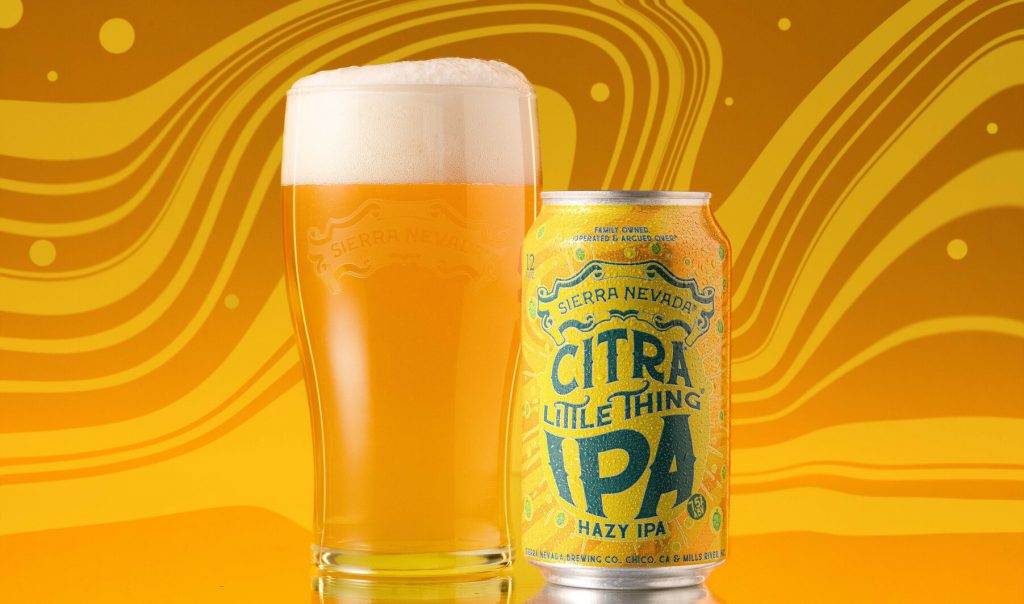
New On Shelves: Sierra Nevada Citra Little Thing
Citra Little Thing hazy IPA, Sierra Nevada’s next Hazy Little Thing limited-release rotator, will hit retail shelves in late November.
The 7.5% ABV IPA is sold in 12 oz. can 6-packs at a suggested price of $12.99, as well as draft.
Sierra Nevada chief brewer Brian Grossman said: “With Citra Little Thing we wanted to showcase everything that makes Citra special – its bright citrus, punchy aromatics, and unmistakable juiciness. We built the entire beer around that hop expression, then refined the haze and body to let Citra shine.”
Word on the Street: ‘Big Beer Companies Will Need to Acquire More Emerging Beyond Beer Brands to Offset Rising Structural Headwinds in Beer’
– Cowan analysts on the Wall Street Journal’s report that Anheuser-Busch InBev (A-B) is in talks to acquire BeatBox for a reported $700 million.
The financial services firm called BeatBox “a proven success in the beyond beer category,” with off-premise sales up 36% and on pace for $382 million in the last 52-week period.
Cowan wrote: “The news of a prospective acquisition differs from what we thought we heard from ABI about their capital allocation priorities in the U.S. when we wrote our Beyond Beer report in January. However, we think the brand will fit well in the ABI portfolio and further their efforts to reduce their exposure to mainstream beer declines.”
That fit is in part due to the vast majority of BeatBox’s volume distributed by A-B wholesalers, with room to grow at 56% ACV (all commodity volume).
Cowan added that BeatBox’s “valuation of 2.9x EV/LTM (enterprise value/last 12 months) sales seems reasonable in relation to multiples paid for similar beyond beer brands averaging 4x sales in recent years.”