
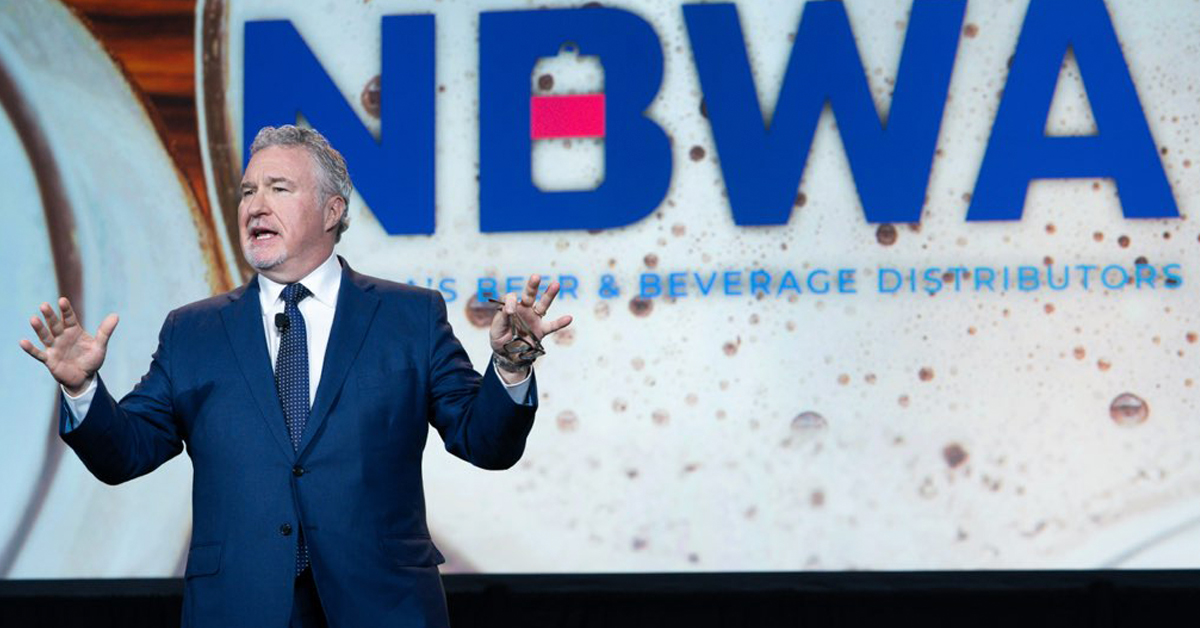
For both the beer industry and the larger political and social environment, “there are new rules to the game,” National Beer Wholesalers Association (NBWA) president and CEO Craig Purser said in his opening remarks of the trade group’s Annual Convention in San Diego.
In some cases, such as the hemp-derived THC beverage business – those new rules can change quickly. So Purser’s key word for NBWA members at this year’s event? “Durability.”
“In an industry that’s evolving at a whiplash pace, distributors are the steady, reliable engine that keeps things moving,” Purser said. “You persevere, you evolve and you succeed. To me, that is the definition of durability.
“And our partners know this,” he continued. “That’s why everyone in the beverage industry from wine and spirits, to NA [non-alcoholic] and beyond, wants on your trucks.”
During the 2023 NBWA Annual Convention in Las Vegas, Purser focused his opening remarks on the health of the beer category, and the industry “wake-up call” needed as beer wholesalers tackled a federal review of competition in beer, a conservative-driven boycott of Anheuser-Busch InBev’s Bud Light, and distributor contract terminations without cause, as well as beer’s continued inefficiencies in attracting younger legal-drinking-age consumers.
This year, Purser highlighted opportunities for NBWA members outside traditional beer, including celebrating PepsiCo announcing earlier this year that it would no longer distribute its bev-alc spinoff products through its own distribution arm, Blue Cloud.
Purser did not call out PepsiCo by name, but referenced “a major global food and beverage corporation” that “sought to distribute alcohol products through its company-owned distributors.”
“I’m not sure they expected such a massive coalition of stakeholders, including public health, regulators and legislators to pose policy questions about health concerns and responsible trade practices,” Purser said.
“When the dust settled, do you know where those products are?” he continued. “On beer trucks, with the people who are best equipped to sell them.”
Purser encouraged industry members to use the lessons learned from convergence products with hemp-derived THC beverages.
“Nobody should be surprised that the emerging hemp beverage industry is eyeing beer distributors as the best way to get to market,” Purser said.
The Farm Bill has been seen by many beverage manufacturers as an open door to launching hemp-derived THC products, including many bev-alc producers. Regulations for these products vary by state and are constantly evolving, as seen in California, which passed an emergency ban on hemp-derived products earlier this month that is in effect through March 25, 2025.
“In some states these products have been legislated and regulated,” Purser said. “Other states have banned their sale and distribution, and many states have remained silent on how these products should be bought and sold.
“Ask 10 state regulators about these products and you’ll get 11 answers,” he continued. “That reflects how uncertain the legal and marketplace framework is from a state-to-state standpoint.”
Despite the uncertainty around future regulations, Purser encouraged members to take on products, because the products are out there.
“It’s clear that hemp beverage producers want to go to market just like beer and other alcohol products,” Purser said. “But if these manufacturers are serious about that, they must support a system that delivers accountability and traceability. Because how can they sell intoxicating products in cans, next to beer or other alcohol without the public health and consumer protections of the three-tier system without trade practice laws, without fair dealing laws, and while making health claims?
“You all know that when there’s been a recall of one of the products you carry, you better believe you’re able to track every shelf and tap where that product needs to be pulled,” he continued. “Our partners understand this.”
Not to leave beer out of the conversation, Purser emphasized that the category is still important to consumers, and it is on distributors to continue to advocate for the category.
“Beer and beverage distribution is a business model that is the envy of other industries: It is durable,” Purser said. “But we all need to do our part to elevate beer amid ongoing challenges. That requires us to invest and think creatively, and those investments need to focus on identifying new beer occasions.
“We also must work to reinforce the advantages that beer has in the marketplace, including the on-premise market where many people discover new products,” he continued. “And brewers and distributors can’t give up on working together to elevate beer.”
Other priorities for the NBWA moving into 2025 include defending supplier contracts, combatting new health claims against alcohol, and extending “Main Street” tax reductions that are set to expire in 2025.
Additionally, the NBWA is continuing to voice opposition to the USPS Shipping Equity Act and efforts to grant the U.S. Postal Service alcohol shipping privileges. The bill has been introduced several times, with backing from other trade groups, including the Brewers Association.
“Make no mistake about it, using the postal service to deliver alcohol, when it can’t effectively verify age, or be held accountable by state and local regulators, is a bad idea,” Purser said. “And we will continue to oppose these harmful efforts, so that DTC [direct-to-consumer] does not become shorthand for ‘direct-to-children.’”