
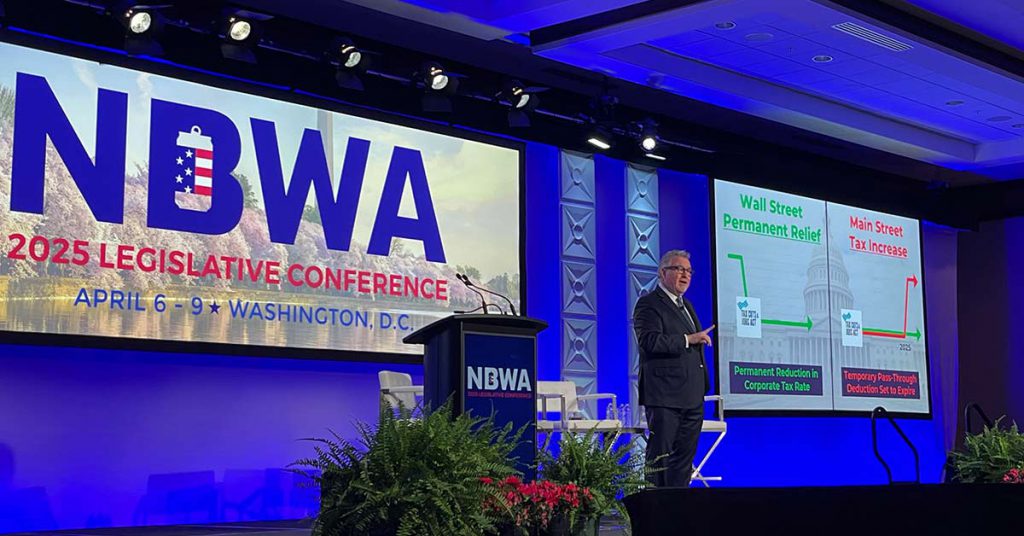
Beer distributors’ top priority in lobbying visits with congressional members during the National Beer Wholesalers Association (NBWA) legislative conference was to push for permanence for lowered tax rates put in place by the 2017 Tax Cuts and Jobs Act (TCJA).
The annual conference took place Sunday through Wednesday in Washington, D.C., amid the rollercoaster of the Trump Administration’s tumultuous tariff-driven trade war. President Donald Trump ordered a 90-day postponement on “reciprocal” tariffs on Wednesday afternoon, while increasing tariffs on China to 125%.
“Certainly tariffs are driving the news, but that’s not the primary focus of our meeting this week,” NBWA president and CEO Craig Purser told attendees Monday during the conference’s first general session. “NBWA is concerned about anything that could potentially raise prices for consumers.”
Nevertheless, NBWA leadership urged attendees to center tax permanence in conversations with lawmakers and their staff members.
“This is our chance to remind our representatives that beer distributors are local businesses that drive significant economic activity and provide solid career opportunities,” NBWA board chairwoman Rebecca Maisel said.
“If you’re only able to make one point in your meetings on the Hill tomorrow, it should be – say it with me – stay with me: Don’t raise taxes on our Main Street businesses like beer distributors,” she continued.
Owners of S corporations (S corps) – typically corporations with fewer than 100 shareholders, which many distributors are – were temporarily granted the ability to deduct up to 20% of qualifying business income under the 199A exemption. Additional expiring deductions include bonus depreciation, research and development (R&D) and business interest deduction, according to Bloomberg.
“The expiration of these provisions would result in a significant tax increase for you and your business, so when you advocate for the extension of the current tax policy, you’re not asking for a tax cut,” Purser told attendees. “All you’re asking for is for Congress to not raise your taxes, particularly when Wall Street businesses receive permanent relief.”
C corporations – which Purser referred to as Wall Street businesses – pay tax at the corporate level, which S corps do not, and were permanently granted a flat 21% tax rate in the 2017 law.
If the 199A and other exemptions are not extended, S corps are facing a tax rate as high as 43.4%, Rep. Jason Smith (R-MO) told attendees during his address. Smith serves as the chairman of the House Ways and Means Committee.
“We need certainty for small businesses to know what their tax rates are going to be,” Smith said. “Is their tax rate going to be 43.4% next year? Or is it going to be 23.4%? Because, as you all know, your businesses all over America, you’re making decisions now for tax year next year.”
Before being named chair of the House Ways and Means Committee in 2023, Smith co-sponsored legislation to make the 199A exemption permanent and repeal the estate tax, which he called the “death tax” and taxes funds and property passed down after death.
Before the TCJA was passed, estates greater than $5.49 million were taxed. The threshold doubled to $11.18 million in 2018, and has increased annually since, to $13.99 million in 2025.
“This would be such a punishment to family farms, family small businesses, family businesses, period, and so we have to address that,” Smith said to applause. “I am still from the advocacy of I’d like to get the death tax completely gone with not even exemption.”