
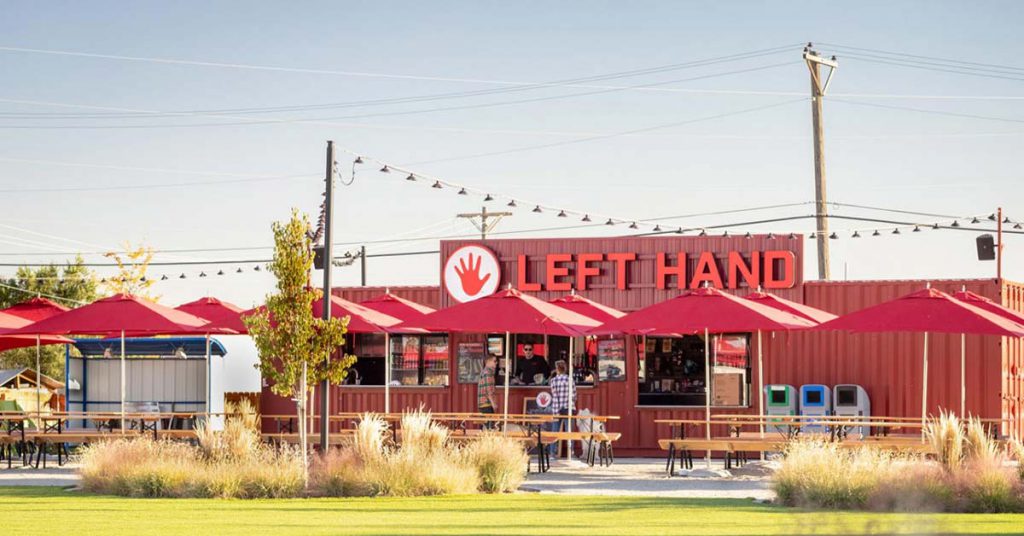
Left Hand Brewing co-founder Eric Wallace has assessed today’s challenging landscape for craft brewers and believes his Longmont, Colorado-based company may have a solution.
“As we look around, we see bad numbers coming out of the [Brewers Association], bad numbers coming out of all of the different organizations that track the numbers, and we see the stories of closings and breweries retrenching from distribution and focusing more on the hospitality side,” he told Brewbound.
“As we sit here with a bunch of real estate that we own and control, and a brewery that’s built for speed that can turn out quite a bit of beer – we’ve got great processes, we’ve got a great team here – we should more overtly put a call out to try to consolidate some breweries that are in bad lease situations, or whatever they happen to be in terms of where their pressures are: come over,” Wallace continued.
“We can make your beer more efficiently here. You can keep your brand, assuming that it has a reason to be in the market. You can keep your brand in the market and maintain its relevance, and try to leverage some of the other relationships that we’ve got out there, because we’re in 45 states, and let’s see if bringing in a couple of partners puts us on the path to be able to be multi-generational.”
Left Hand has been under those same pressures, but has been feeling them more acutely.
About four and a half years ago, twin problems hit Left Hand almost simultaneously: a sizable cashout for early investors, which depleted the brewery’s savings, and the COVID-19 pandemic, which upended the entire craft beer industry by shutting down the on-premise and canceling live events.
A possible fix could be to seek acquisition by a large corporation, but such a deal would be anathema to Wallace.
“We’ve always been pretty focused on what an independently operating brewery, or company in general, can do as an independent versus what it can do as non-independent,” he told Brewbound. “To me, generally, there’s a very large gulf between them, so we’re trying to find the path that allows us to stay independent.”
Wallace said maintaining Left Hand’s independence allows the company to continue its philanthropic work and uphold its commitments to its community and its employees, who participate in an employee stock ownership plan (ESOP).
The situation requires intertwined solutions. Inspired by the publicly owned non-profit that controls the National Football League’s Green Bay Packers, Left Hand launched an investment round on crowdfunding platform WeFunder.
The campaign hit its first goal, raising $490,481 from 205 investors, who purchased shares of common stock in the company at $36.28 per share.
One of Left Hand’s next goals for the round is to use $1.1 million of the estimated $2.37 million it hopes to raise to acquire another brewery or build a multi-brand platform.
“Our thought was ‘Let’s let people know, let’s get it out there, let’s raise some cash,’” Wallace said. “That’ll give us the flexibility to help bring somebody else into the fold, and depending on the size of the company, there could be room for a few.”
Left Hand’s brewery is capable of producing 100,000 barrels of beer annually, but the company’s output is “not near that right now,” Wallace said.
“We can bring people in and try to get close to 100,000 barrels and that would be good for anybody that’s participating because at that level, this plant can sing,” he added.
Wallace and co-founder Dick Doore, both U.S. Air Force veterans, founded Left Hand in 1993 after trips to Europe inspired them to start homebrewing. The brewery’s output peaked in 2015 at 82,858 barrels, ranking it the 39th largest craft brewery in the U.S. by volume, according to the Brewers Association.
But in the near-decade since, Left Hand has shed volume, similar to many other craft breweries founded around the same time. The brewery produced 28,313 barrels of beer in 2023, according to the May/June issue of the BA’s New Brewer magazine. Volume this year is also down, Wallace said.
“We’re in the majority right now, definitely just trying to hang on to the shelf placements out there, which we’re getting,” he said. “We’re having some good hits there in terms of chain placements, which is important to our distributors, so that we can stay in distribution. We’re effectively a national brand, but the distributors are shedding SKUs like crazy.”
Left Hand distributes to nearly all 50 states (Alaska, Hawaii, Louisiana, Mississippi, North Dakota and West Virginia excluded) via a network of 76 distributors, according to its website.
Contract brewing makes up about 15% of Left Hand’s volume, and the facility and its land, which Left Hand owns, is ideal for fellow Colorado breweries seeking production assistance. Longmont’s location, about 40 miles north of Denver where several interstate highways meet, also makes it attractive, Wallace said.
Left Hand currently contract brews for hard tea and hard kombucha maker Jiant, Present CBD Seltzer and other beer brands, as well as produces wash for Foundry Whiskey, according to the WeFunder. The brewery is licensed as an organic producer by the U.S. Food and Drug Administration.
Contract brewing relationships are important, and the practice has become a valuable way for breweries to extract revenue from otherwise idle tanks. But Left Hand is seeking marriages of breweries, in part as a way to help brands unwind their own excess capacity.
“The U.S. is about overbuilt by double,” Wallace said. “So the industry is running at something like 50% of capacity. Obviously, some capacity has got to work its way out of the market in order for things to get back to being healthy.”
The safety-in-numbers philosophy has been gaining traction in recent years, especially as Anheuser-Busch InBev (A-B), Molson Coors and Constellation Brands have begun to exit craft in part or entirely.
Last year, 45.5% of the 8.1 million barrels that the top 10 largest craft brewers produced came from brewing platforms or companies that bolted on other brands. Those include Boston Beer (Samuel Adams and Dogfish Head), Duvel USA (Firestone Walker, Boulevard, Brewery Ommegang), Gambrinus (Shiner, Trumer), Tilray (SweetWater, Green Flash, Alpine, Montauk, 10 Barrel, Blue Point, Breckenridge, Red Hook, ShockTop, Widmer Brothers), Artisanal Brewing Ventures (Victory, Southern Tier, Sixpoint) and Monster (Oskar Blues, Cigar City, Deep Ellum, Squatters, Wasatch, Perrin).
In the case of Tilray, many of those brands are with their third owner and are now back in the BA-defined craft realm, after their founders sold them to A-B in the last decade. Tilray scooped up four more craft brands (Atwater, Hop Valley, Revolver, Terrapin) from Molson Coors earlier this month.
The blockbuster acquisitions of the mid-2010s that turned craft brewery founders into multi-millionaires are long gone. In some cases, those acquired brands are shadows of their former selves, such as Ballast Point, which Constellation Brands acquired for $1 billion in 2015 and sold to Kings and Convicts for $41.1 million four years later.
“There’s no guarantee on any path that people have chosen, but the people that benefited from these big, big sales are wealthy, and did their communities benefit in the end? Did their employees benefit in the end?” Wallace said. “Some of them landed well, some of them probably left the industry. I think a lot of people are leaving the industry right now.
“But we have people that really want to be part of, part of this industry,” he continued. “And I want to support the crew. We’ve got dozens and dozens of employees that count on us to try to find a path and to make their ESOP ownership in the company worth something in the long run.”
For Wallace, it’s about assembling a family of like-minded brands that will stay close to their founders’ missions. The company is “in conversations with multiple organizations,” but hasn’t finalized anything yet, a spokesperson told Brewbound.
“This is not a buy and flip,” he said. “We’re not going to sell to vulture capital. We’re not looking to sell to private equity. We’re looking to keep it independent and keep it in the hands of the community and our employees, and find a path so that you can access the capital that you need without having to sell your soul.”