
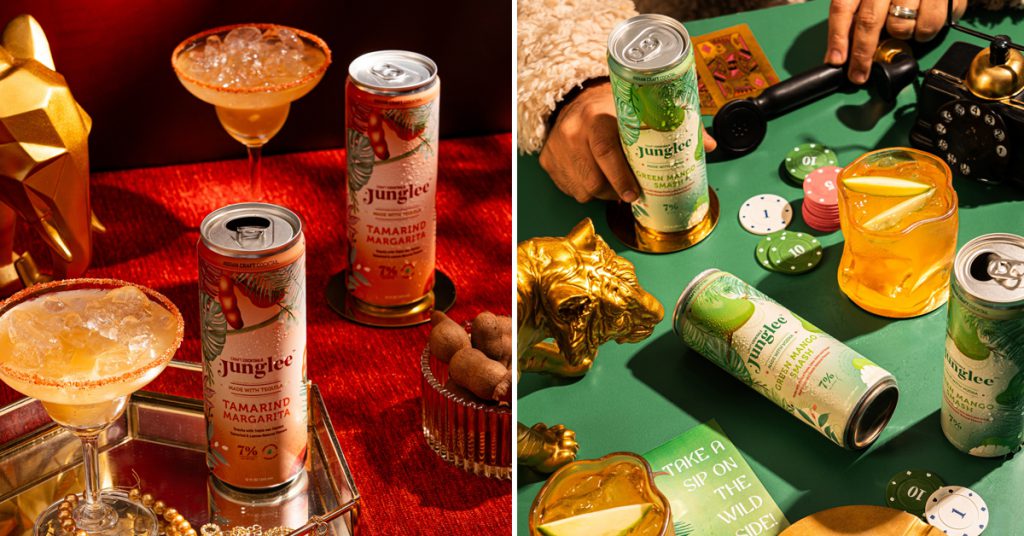
It’s not often that the genesis for a canned cocktail is a home-cooked dinner. But for friends Vishal Patel and Parit Pathak, the idea for their ready-to-drink (RTD) cocktail brand, Junglee, came from their mothers’ cooking.
Inspired by the South Asian flavors of their homes and the canned cocktails consumed among their peers, the college buddies set out to build their own brand, leveraging unique flavors and a cultural perspective to differentiate on a packed shelf.
Launched in 2022, the 7% ABV “Indian craft cocktails” come in three flavors: Tamarind Margarita, Green Mango Smash and Indian Spiced Lemonade. Cocktails are spiced with cumin and ginger, frequent ingredients in Indian cooking. The authentic connection to Indian ingredients and flavors is a major part of the brand’s story, but the founders have learned along the way how to balance a cultural product with the constraints and demands of the market.
“If we go back and we look at how we would actually plan our go-to market – we would have done it very differently,” Pathak said.
The Lowest Hanging Fruit
After starting off in their home markets of New York, New Jersey and Connecticut, the founders quickly realized that their initial plan to reach consumers was flawed. In those states, spirits sales are excluded from grocery channels, bodegas, as well as the Indian restaurants and markets where Indian communities shop – venues the founders assumed would be the lowest hanging fruit of their target demographic.
With backgrounds in finance, Patel and Pithak pivoted by bringing former bev-alc execs onto their board and spent a year gathering data, leading the brand to a new target market.
“We started understanding where we needed to find that customer, which was in those areas where it’s a little bit more urban, where there’s high disposable income, where people want to try something new and are culturally curious,” Pathak said. “And those pockets started opening up for us.”
Honing The Cultural Messaging
But the Junglee founders still had to learn how exactly to target the “culturally curious,” and on a startup budget. Other RTD founders like Phreshly have also navigated how to harness the founders’ cultural roots into a branding strategy.
Using a marketing AI tool called Limbik, the Junglee team repeatedly focused on testing consumer behavior and demographics with different variables of text and messaging before spending marketing dollars.
Initially, the brand downplayed some of its messaging. “[We] were staying away from being overly cultured,” Pathak said.
But the test results showed otherwise: consumers embraced language around “curiosity” when paired with messages highlighting “authentic, vibrant, bold, cultural Indian flavors, food and color.”
The team also brought that messaging to samplings, bringing in DJs and colorful merch, adding a “Bollywood” touch, Pathak added. Those activations were paired with efforts to merchandise the RTDs on the floor where the packaging, adorned with Indian design motifs, would sit among more premium products.
This sales strategy was also necessary to fight any pre-conceived notions about Indian flavors.
“There is a gap,” Patel said. “I think these foods are not widely known and India is looked at with prejudice that equates the food only with something spicy.”
Hiring sampling agencies working for various brands didn’t work to convince customers otherwise – now the company has a dedicated team of sales ambassadors. The operations platform Piñata has allowed the company to further leverage those ambassadors who submit data on floor placement, competitors, and which consumers are buying products.
“Usually people go to the direct-to-consumer (DTC) angle to find out information and talk directly to the customer,” Pathak said. “But this is an ambassador play, where we get these details that we can’t even find out from a DTC perspective that really help us understand if we’re operating correctly from a store level perspective.”
Regional, Non-Alc Play
The founders are focused now on replicating store-level profitability and continuing to increase organic velocity. The company sold 2,700 cases in New Jersey its first year, and last year hit 6,000. They launched in Connecticut six months ago, while pausing work with distributor Breakthru Beverage in Pennsylvania and Delaware to focus on current territories.
That playbook isn’t new: penetrating regionally has been the strategy of independent success stories in RTDs, such as Surfside’s conquest of the Northeast. But Junglee’s strategy also aligns with tequila cocktail brands like VMC, which has been unabashedly Mexican in its name (short for Viva Mexico Cabrones), imagery and flavors, while capitalizing on tequila’s success in RTDs.
But the founders also see their roots as an entryway into another growth category, and plan to build off the Ayurvedic knowledge of the diaspora to launch a non-alc cocktail line sometime this year.