
Chicago-based Funkytown Brewery’s mission is to bring more people into craft beer. Now it’s creating a physical space to be the homestead of that mission.
Funkytown has made a deal to acquire a building near the United Center that the Black-owned craft brewery plans to transform into a taproom and beer garden.
The location is on the West Side of Chicago, which is set to become a new community hotspot thanks to The 1901 Project, a $7 billion privately funded project meant to transform the underdeveloped area into an economic and community hub.
The United Center is home to the Chicago Bulls NBA team and the Blackhawks NHL team, drawing millions of visitors every year, but the surrounding area has notoriously lacked other attractions since the 1968 riots that followed the assassination of Martin Luther King Jr. The 1901 Project includes the building of a new music hall, a community park and green space, and a retail and lodging area.
Funkytown first sent a letter of intent to purchase the vacant building over the summer, but almost had their dreams snatched when the 1901 Project was announced publicly and other interested parties attempted to outbid the craft brewery. However, previous offers fell through, and Funkytown is set to close on the property by the end of the year.
To help fund the project, Funkytown has opened a seed funding round with the goal of raising $5 million. The building itself will cost the company about $2.85 million. Should the funding come through, Funkytown plans to open the taproom by late fall 2025.
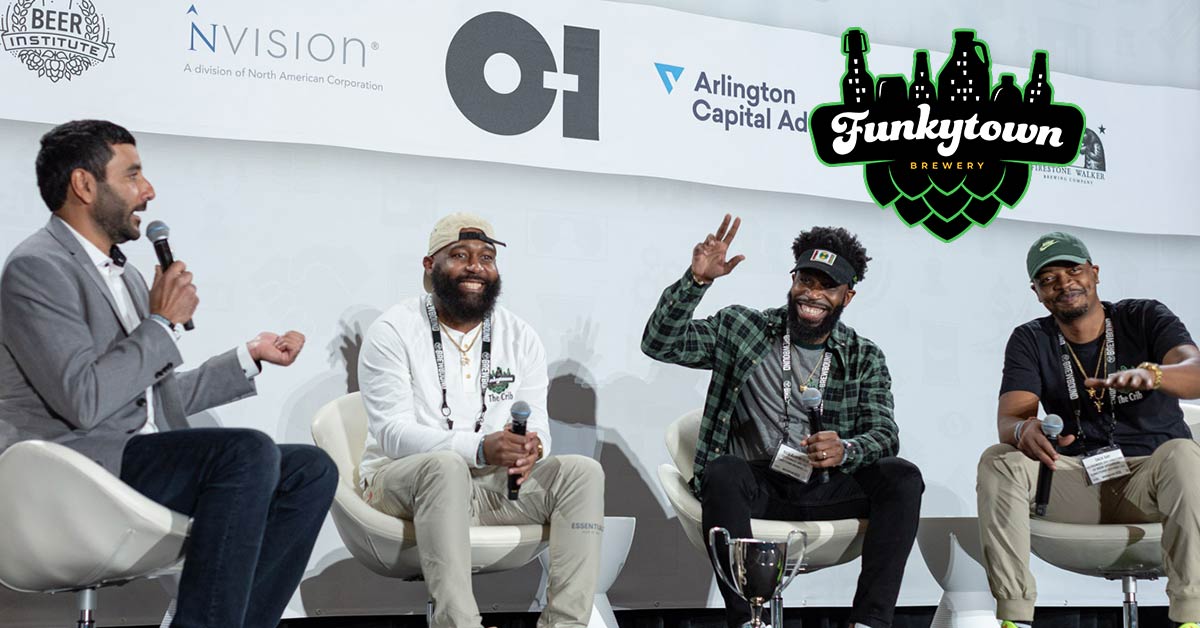
Funkytown co-founders Rich Bloomfield, Zach Day and Greg Williams spoke to Brewbound about the location and their vision for their first brick-and-mortar space. They emphasized the rare opportunity to make their mark on an area at such early stages of development, excited about the potential.
Day likened the future of the United Center area to Chicago’s Fulton Market, the former meat packing district that was transformed by a group of restaurant owners into a bustling neighborhood and hub of some of the city’s trendiest businesses.
“When I say this is like a on[c]e in a lifetime opportunity, it’s because we have the opportunity to do the same thing,” Day said. “If there’s people out there that want to get involved with this particular raise, then it is – what Rich has liked to call it – the Fulton Market before Fulton Market. It’s definitely an opportunity to get in early and have an experience of property within a booming area and a booming community that’s going to get $7 billion in development around it.”
The building itself is also poised to set Funkytown up for success and avoids “all of the common mistakes that brewery owners get into when they find a space,” according to the trio.
The location is a 9,000 sq. ft. building located on a 21,000 sq. ft. site, allowing for “room for growth and expansion,” Bloomfield said. The additional outdoor space allows for a beer garden, while the building has a second floor that can be used as an event space, as well as room for a full-size kitchen. It is also located within steps of public transportation.
Funkytown plans to install a 20-barrel brewing system to produce beer onsite, as well as self distribute from the location. Day estimates onsite production could max out between 5,000 and 7,500 barrels.
“Breweries get in a space and it’s like, ‘Oh man, this square footage is going to be just enough for me to do what I need to do,’ and then all of a sudden, a year later or even less than that, you find yourself cramped for space, can’t grow, you can’t put any more tanks in,” Day said. “We definitely wanted to make sure that we located a spot that gave us that flexibility and didn’t pigeonhole us into doing something that we were going to regret down the road.
“That’s why we want to own it too,” he added. “Different breweries, some of the mistakes that they made is not owning the building and just leasing the building, so when that 10-year lease comes up for renewal … and your business happens to be doing really good or really profitable, then you give the leverage to the owner of the building to price you out.”
Funkytown produces its beers in Chicago and Milwaukee through Pilot Project, the brewery incubator Funkytown launched from in 2021. The partnership has allowed Funkytown to expand distribution of its beers into nearby markets, and given consumers an opportunity to try beers on-premise at Pilot Project’s taprooms. While the partnership will still exist, the new location allows Funkytown to take some operations into its own hands, as well as have a space where it can showcase create brand personality.
The desire for a unique Funkytown space is also why the company has intentionally not hermit-crabbed an existing brewery space or former brewery.
“We want to customize it to give you the full Funkytown experience,” Williams said. “And there’s a reason why those breweries went out of business – could have been location, the size – a lot of factors that we didn’t want to worry about.”
“You don’t want people to come to a spot that was not yours before and then say, ‘Oh yeah, this was the old big West Coast brewery;’ No, this is Funkytown,” Day added.
Funkytown also hopes to make the space feel and look different from other breweries, with “natural light, color, local art” and a more “contemporary” feel, Bloomfield said.
Funkytown was built on the idea of doing something differently. The brewery’s founders are childhood friends who fell in love with craft beer and homebrewing, and wanted to create a brand that connected with historically underrepresented consumers in the industry, including women and people of color.
For the past three years, Funkytown has been focused on guerilla marketing, getting the word out about their brand through tasting events and the founders personally meeting with potential consumers.
The company has also drawn attention at industry competitions, winning the Brewbound Pitch Slam in December 2021 and the Samuel Adams Brewing the American Dream Brewing & Business Experienceship in late 2023. Day also received the Michael James Jackson Foundation’s Sir Geoff Palmer Award for Brewing in 2022.
Funkytown produced 1,146 barrels of beer in 2023, a +32% increase year-over-year, according to the Brewers Association. The company has expanded into several chain retail accounts and is now available at all major Chicago sports venues, including Wrigley Field, Soldier Field and the United Center.
“We’re really primed for real growth already, without any outside investment,” Bloomfield said. “[This round] is really about finally getting this next step, scaling out [and] having additional resources at our fingertips so we can truly bring the full Funkytown vision to life.”
“We’ve always been a grassroots type of business, but now we need to see the water for us to grow,” Day added.