
The beer category’s current bogeymen aren’t what’s plaguing Constellation Brands, leaders explained during Deutsche Bank’s dbAccess Global Consumer Conference last week.
The company’s share of 21- to 25-year-old consumers “is twice what the industry average is,” CEO Bill Newlands told Stephen Powers, Deutsche Bank managing director and head of U.S. consumer packaged goods research.
Plus, “there’s just no evidence” that GLP-1 drugs, which curb cravings for food and alcohol and have caused consternation for other food and beverage brands, have had “a big impact,” Newlands said.
Cannabis, whose specter has loomed large over beer for years, also seems to be immaterial to Constellation.
“If you look at the markets where cannabis has been legal for a long time, again, you see no real differentiation of what alcohol did before or after,” Newlands said.
So, what’s worrying the largest importer of Mexican beer to the U.S.? There are two prongs behind the company’s uncharacteristically slowing trends, the first being macroeconomic pressures affecting all consumers, connected in part to “concern about inflation” due to a rollercoaster of trade policy threatening to drive up prices.
The other is that many Hispanic shoppers, who make up the bulk Constellation’s consumer base, have cut back on shopping trips and other activities amid heightened concerns about immigration raids and arrests.
“There’s a lot of concern about the whole immigration question,” Newlands said. “That gets doubled down if you’ve had someone in your immediate family or friends who’ve had that issue attached to them at all. And where it’s playing itself out is in behaviors that are sort of anti our business, which is they’re going out to eat less – 75% of Hispanic consumers are going to restaurants less. There’s less social occasions.”
Year-to-date (YTD) through May 18, dollar sales of Constellation’s beer portfolio (Modelo, Corona, Pacifico and Victoria) have declined 0.4%, to $3.02 billion at off-premise retailers (MULO+C) tracked by market research firm Circana. Volume, measured in case sales, has declined 2.3%.
Those trends have accelerated in the four-week period ending May 18 (L4W), with dollar sales declining 1.3% and volume down 3.4%.
Those trends are in stark contrast to how Constellation finished 2024, with dollar sales and volume growing 5.8% and 4.5%, respectively, in Circana-tracked off-premise retailers.
Despite declining sales, Constellation is the category’s largest share gainer YTD at +0.42 sharepoints, nearly double that of the next largest share gainer (Mark Anthony Brands at +0.23 sharepoints).
How does Constellation plan to shake its current malaise? First, the company plans to maintain its aggressive advertising strategy.
“The brand health continues to be fantastically strong on all three,” CFO Garth Hankinson said of Modelo, Corona and Pacifico. “We’ve got a great base to build on, which gives us the confidence to continue to invest.”
Modelo and Corona rank No. 1 and No. 2 in “share of voice” in the beer category, Newlands said. The company focuses on advertising during live sporting events, which are “very, very effective,” but is beginning to invest more in digital marketing to leverage the medium’s ability to target “individual consumers a bit more precisely,” which Constellation is “very, very happy with,” Hankinson added.
Other levers Constellation is pulling include lowering the price of Modelo Oro, the brand’s challenger to Michelob Ultra. Dropping price positions Oro to compete with premium lights, a less competitive segment than super premiums, Newlands said.
Constellation also varies price by offering smaller size packages of Modelo and Corona, which are both available in 7 oz. bottles and the latter is available in 8 oz. cans.
“We’re finding ways to put price points in place so that the consumers are very loyal to us, irrespective of how much money they may have to spend at a particular point in time, we have a product available to them,” Newlands said.
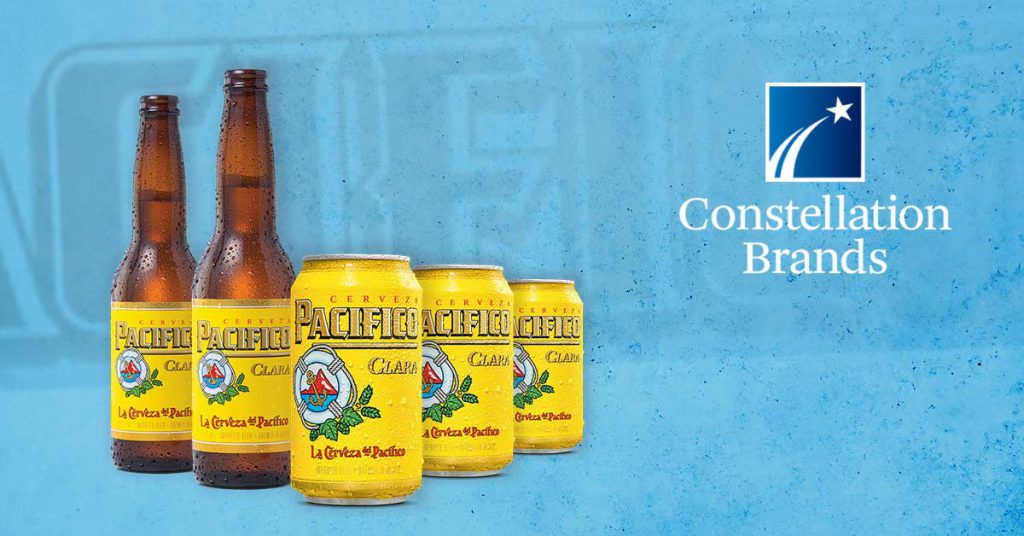
Pacifico, which is younger than its siblings in both brand age and consumer age, remains a bright spot for the company. It is the 13th-largest brand in the beer category and increased dollar sales 18.2%, to $162.9 million YTD in MULO+C stores, according to Circana.
Constellation is now weighing “how much more gas do we put on the Pacifico fire,” Newlands said and likened the brand to “a baby Modelo” that “started heavily in the West.” California is a key market for both brands. Modelo is the No. 1 beer in the Golden State and has twice the market share there than it does elsewhere. Pacifico is the No. 2 beer in Southern California behind Modelo, and the state now accounts for half of Pacifico’s sales as it develops other markets.
Other opportunities for Constellation include expanding shelf space commensurate with dollar sales. Modelo has 30% to 50% less space than Bud Light, despite outselling it, Newlands said. Constellation has gained more sway in category management in recent years.
“It wasn’t that long ago that we had less influence with those critical large retailers,” Newlands said. “Today, we have influence, either as a category captain or as a validator in over 80% of accounts, so we have more of a say in the equation.”
A point in the company’s favor with its distribution partners is its streamlined portfolio, relative to its competitors.
“With 160-ish SKUs, we’re very efficient for a wholesaler that wants effectiveness and efficiency in their delivery systems,” Newlands said.
Constellation’s then-150 SKUs generated net sales of $54 million per SKU, beer division president Jim Sabia shared during the company’s 2024 Gold Network Summit. By comparison at the time, Anheuser-Busch InBev’s 100 brand families had 1,500 SKUs with sales of $10 million per SKU, and Molson Coors had 50 brand families with 750 SKUs generating $11 million per SKU.
Constellation’s slim portfolio affords the company a level of trust with its wholesalers that may be hard to come by in a challenged beer market.
“What we have said to them is, ‘We’re only going to bring you things that have been validated and tested,’” Newlands told Powers. “We’re not going to throw anything against the wall that we don’t believe is going to be valuable and that we haven’t both tested and plan to support. They like that answer.”