
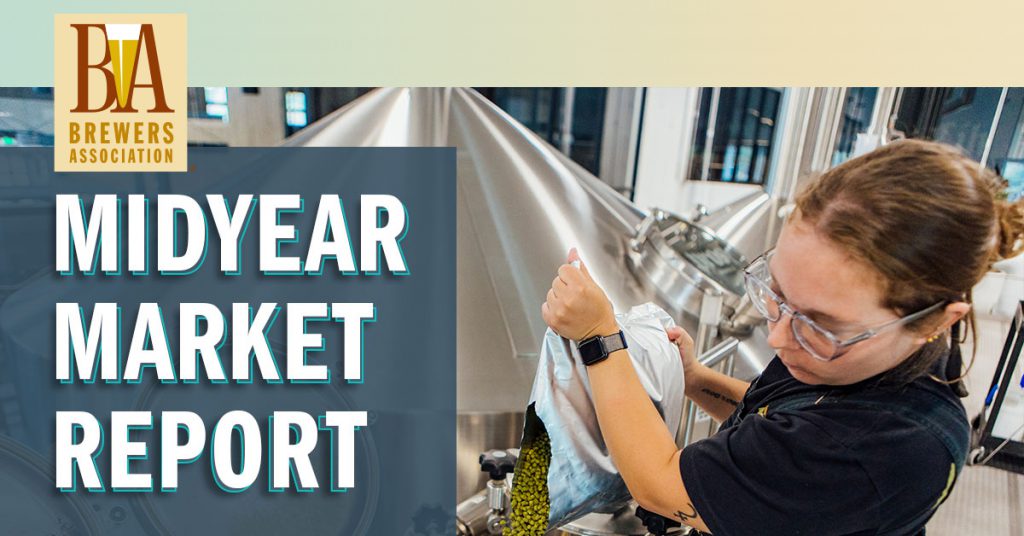
Beer volume from Brewers Association-defined (BA) craft breweries has declined 5% through the first half of 2025 compared to 2024, according to the trade organization’s midyear market report, which was published Wednesday following a survey of members.
That decline is an estimate using “an adjustment for response bias and triangulation with other supporting data,” BA staff economist Matt Gacioch wrote.
Another caveat Gacioch noted is that some craft brewers have begun producing offerings other than craft beer, such as hard cider, hard seltzer, flavored malt beverages (FMB), spirits-based cocktails and hemp-infused drinks. These are excluded from the BA’s volume figures.
“Swapping some beer production for other products has been a way for brewers to diversify their revenue by meeting the needs of their ever-evolving consumers,” Gacioch wrote.
Last year, full-year craft volume declined 3.9% compared to 2023. 2025 would mark the third straight year of craft volume declines, a slide that began in 2023, when the industry saw the first volume drop of its modern era, excluding 2020 declines driven by closures due to the COVID-19 pandemic.
“Overall, the results of this midyear survey indicate that for many breweries, the challenges they’ve faced over the past few years have either continued or accelerated,” Gacioch wrote. “Some breweries that found marginal growth in 2024 experienced slight decreases in the first six months of this year.”
The BA defines a craft brewer as a business that holds a brewer’s license from the Alcohol and Tobacco Tax and Trade Bureau (TTB), makes fewer than 6 million barrels of beer annually and is not more than 25% owned by a non-craft brewer beverage-alcohol producer. Under this definition, New Belgium and Bell’s Brewery, owned by major Japanese brewer Kirin are not craft brewers, but Cigar City and Oskar Blues, owned by energy drink producer Monster, are.
To account for varieties of size across its member base, the BA classifies members by business model and volume. Regional brewers primarily sell their beer through distribution and produce more than 15,000 barrels annually. Microbreweries also sell through distribution, but produce fewer than 15,000 barrels. Taproom brewers and brewpubs sell at least 75% of their volume on their own premises, rather than through distribution. Brewpubs operate on-site restaurants, while taprooms do not.
Across these four classifications, BA members reported varying degrees of decline so far in 2025. Regional breweries and brewpubs both reported flat volume compared to 2024, on average. Microbreweries’ volume declined an average of 3%, while taprooms’ volume declined 1%.
When combining the off-premise models (regionals and microbreweries) and the on-premise models (taprooms and brewpubs), the latter “have slightly outperformed” the former so far in 2025, Gacioch wrote.
“There were negligible changes in channel share, without much motion among distributed draught, distributed package or onsite sales,” he added.
Nearly half of respondents (49%) told the BA their production has grown in 2025, while 47% reported a decline in production.
Those gains skew toward smaller breweries, which make up the bulk of the BA’s members. Of breweries producing fewer than 1,000 barrels annually, 50% reported growth, versus 43% who said production had declined.
“Although taprooms and brewpubs make up just a small percentage of the overall volume in the industry (15% in 2024), they represent an outsized 73% of craft businesses,” Gacioch wrote.
Craft beer’s volume declines are far from unique in beverage-alcohol. According to scan data from NIQ, which does not include beer sold at breweries or in bars and restaurants, overall beer’s volume declined 4.2% through the first half of the year, slightly outpacing BA-defined craft beer at -4.1%, Gacioch noted.
“Retailer and wholesaler rationalization, increased competition for limited shelf space, and consumers becoming tighter with their proverbial pocketbooks are all contributing to craft contraction in the off-premise channel where the bulk of beer is sold,” Gacioch wrote.
Wine (-7.7%) and spirits (-4.2%) both posted mid-single-digit declines in the 12-month period through May 2025, according to data from SipSource that Gacioch cited from the Wine and Spirits Wholesalers of America
By comparison, the only bev-alc category to record growth in any metric in NIQ’s midyear report was ready-to-drink (RTD) canned cocktails, which include malt, wine and spirit bases. RTDs’ volume declined 3.2% through July 5.