
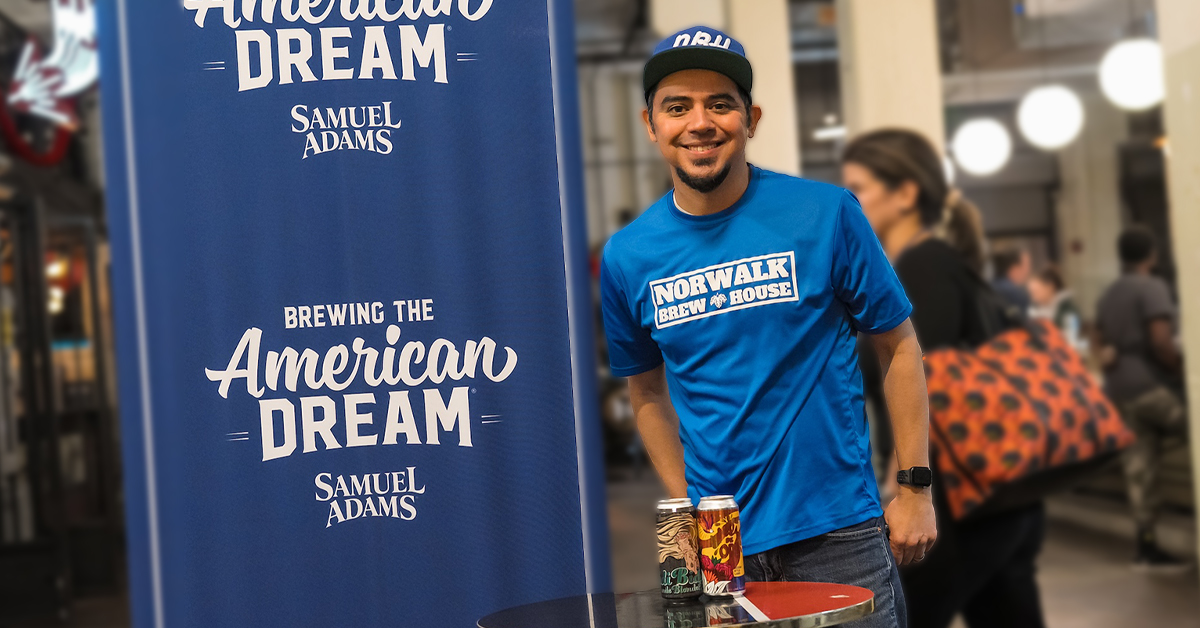
Ray Ricky Rivera has a classic craft story: He started as a homebrewer and decided to turn his passion into a business, launching Norwalk Brew House and its flagship beer Bidi Bidi Blonde Blonde Mexican-American ale in early 2022. Over the past few years, Norwalk Brew House has existed as a contract-brewed brand, with Ray Ricky hand delivering cases and kegs to accounts across California.
This month, Ray Ricky announced plans to open a brick-and-mortar location. To support the move, Norwalk Brew House has launched a Indiegogo campaign that will go live August 5 (link to be posted on Norwalk’s social media pages at launch).
In the latest A Round With – a weekly Q&A feature for Brewbound Insiders – Ray Ricky dishes on Norwalk’s journey so far, how he created a brand and following without a taproom and the lessons he’s learned along the way.
You turned your craft brewing hobby into a business in early 2022 through contract brewing and self distribution. What made you want to make your homebrewing passion into a career?
Ray Ricky: I spent 20 years working in the music industry in a myriad of roles, and the similarities between the music industry and the beer industry always intrigued me.
In 2020, two opportunities arose that propelled me to decide to chase the dream definitively. Norwalk Brew House did a beer collaboration with Eagle Rock Brewery, which allowed me to leverage my background in music to produce a fun beer project that was tied to a social cause. It was everything I’m about in a beer can. It was exciting!
And I was also fortunate to be a finalist in the Brewbound Pitch Slam. Those two experiences really gave me the confidence and motivation to go all in.
You’re one of a few members of the SoCal Cerveceros homebrew club who has turned pro. What do professional brewers need to know about the homebrew community?
Ray Ricky: It’s no secret pro brewers like to poke fun at homebrewers. Especially the passionate ones who visit a brewery and can’t help but proclaim their love for brewing. People should know that the homebrewing community is passionately supportive.
If you’re a new brand or brewery, connect with a local homebrew club and let them help you establish a customer base. It’s a no-brainer. Homebrewers are loyal and if your product is subpar they’ll definitely let you know about it.
What was the greatest lesson you learned in the first year?
Ray Ricky: Be ready to adapt. You can plan and prepare all you want, but things will not go as planned. And when things don’t pan out as expected you need to move quickly and solve the problem.
Get comfortable with adapting, become great at problem solving and don’t panic. Do the work, be patient and course-correct as needed.
How did you craft a brand identity for Norwalk without a physical location?
Ray Ricky: It was important for me first to establish our brand values. To execute that I did 10 different collaborations with local breweries before releasing our first commercial release. Each of those collaborations was tied to a social cause that speaks to issues I find important to bring attention to.
The key for me as a brand builder is to do my best to be honest and to unapologetically communicate that Norwalk Brew House is a Mexican-American-owned-and-operated brand. One way I do that is by exclusively working with Mexican-American women designers, who culturally identify with the themes and ideas the brand is trying to communicate. Our designers must be of the culture and communities we represent, which informs what the brand should be aesthetically.
After dialing in the brand’s values and voice, I work hard to leverage the media to get as many eyeballs on the brand as possible. I pull heavily from my past experiences booking and promoting bands.
In my eyes, each beer is like releasing a new album. Once the album is out you work to let people know it exists. Word of mouth reigns supreme, but I do anything to gain attention. Everything from traditional print media, to local TV news, social media, newsletter blasts to hounding Brewbound writers on Twitter (just kidding, sorta).
You just announced that a flagship location is in the works. Why was now the right time to create a brick-and-mortar location?
Ray Ricky: The truth is there’s never a “right time” to open, or start. Any time you make a move like this it’s going to be difficult.
Right now is one of the most turbulent times in the industry. It’s scary out there. Anytime you start a business underfunded, and you’re learning as you go, every day is scary! I feel I’ve done all I can with limited resources to establish a presence in the market.
As a direct-to-retail operation I have no control over how the end consumer experiences our beer. If a bar has dirty lines or a restaurant has subpar customer service, it can affect the experience. I want to create the ideal environment where customers can consistently have an enjoyable experience consuming our beer. That, and my little car is begging me to stop abusing it to make deliveries.
As you mentioned in your announcement video, you’ve been hand delivering every Norwalk beer that fans see on shelves or order from bars & restaurants – something that would probably surprise many consumers. Any wild stories about getting beers in the right hands?
Ray Ricky: Two things stick out as just super cool stories for me. Last year, I participated in a pitch competition [Brewing the American Dream] at Angel City Brewery, sponsored by the Boston Beer Company. Unbeknownst to me, Sam Calagione was in the audience. He asked to meet me after and I got to pour him a sample of our Agua De Oro Mexican lager. I know it’s probably cliche for some of your subscribers, but I too read his book, Brewing Up A Business, and I was inspired by Sam’s story. If we lived in the same city we’d totally be homies.
An account of ours once ordered a few cases of our flagship, Bidi Bidi Blonde Blonde. They mentioned it was for a private party. I later found out it was a super exclusive house party hosted by Jessica Alba. It was a who’s who of famous Latino movers and shakers. I thought that was pretty cool.
Neither of those instances changed anything for the business, but the unexpectedness of it is a fun reminder that you never know where the beer will end up.
Norwalk collabs with lots of folks, including an Olympian (how timely!). What do you look for in a collaborator?
Ray Ricky: Most of what we’ve done has happened organically. Usually, it happens with people I have an existing relationship with. For example, Norwalk Brew House has collaborated with Brewjeria Company and South Central Brewing Company five times now. We’re all friends who met as SoCal Cerveceros club members. In Los Angeles, all the Latino brewers know each other. We’re a small bunch relative to the wider industry. Most collaborations happen through that network.
I do get pitched collab ideas often. When that happens I consider who is behind the brand, what are their brand values and do they align with Norwalk Brew House? In the case of our collaboration with Olympian Brenda Villa, that too happened organically. We got connected via Instagram after she posted a pic holding some Bidi Bidi Blonde Blonde. After learning how down-to-earth she is and learning about her foundation, it just felt like we should do something together.
If you could wave a magic wand and change one thing about the industry, what would it be?
Ray Ricky: It would be great to see more women in prominent roles throughout the industry. I believe the industry could benefit from more women of color in ownership and roles of leadership.
You’re quoted on the brewery website saying ‘The world doesn’t need another beer company, but the beer industry could use some diversity. So here we are.” What makes a brewery worth creating in a time where there’s 10,000 breweries for U.S. consumers to choose from?
Ray Ricky: What makes it worth creating to me is the city of Norwalk hasn’t experienced what Norwalk Brew House aims to deliver. I’m not talking about new beer innovations and a menu of 100 taps and $4 micheladas on Cinco de Mayo (no way Jose, ours will be $2.50!).
I envision a hyperlocal space that speaks to the community’s soul. A space where the people behind the bar understand your language and might remind you of someone you grew up with. A space where culture is honestly reflected and celebrated, where the people are kind, and the beer is great, “and you’re always glad you came.”