
Brand extensions of some of Anheuser-Busch InBev’s (A-B) top brands helped the company outpace U.S. beer industry trends in Q2, the company shared Thursday in its quarterly earnings release.
Total A-B volumes declined 1.9% year-over-year (YoY) in Q2 (ending June 30, 2025), with beer volume down 2.2% and non-beer volume up 0.3%.
Total revenue increased 3% YoY, while revenue per hectoliter increased 4.9% in the quarter. Revenue increased in 70% of the company’s total markets, with “top and bottom line growth across four of our five operating regions,” CEO Michel Doukeris shared in a call with investors and analysts following Thursday’s financials release.
Q2 underlying profit was 1.95 million in the quarter, up from 1.811 million in Q2 2024. Normalized earnings before interest, taxes, depreciation and amortization (EBITDA) increased 6.5%, to $5.301 million, while margin increased 116 basis points, to 35.3%.
“While the operating environment remains dynamic, the consistent execution of our strategy by our teams and partners drove a solid first half of the year and reinforces our confidence in delivering on our outlook for 2025,” Doukeris said in the release.
Through the first half of the year (H1), A-B’s total volume declined 2% YoY, led by beer declines (-2.3%), while non-beer volume was flat. The company has also “gained or maintained market share in 60%” of its markets through H1.
H1 revenue grew 2.3% (+4.3% in revenue per hectoliter). Underlying profit was $3.556 million, up from $3.320 million in the first six months of FY24. Normalized EBITDA increased 7.2%, to $10.156 million, while margin grew 166 basis points, to 35.5%.
In North America, A-B’s total Q2 volumes grew 0.3%, while beer volume was flat.
In the U.S. alone, shipments (sales to wholesalers) increased 0.2% YoY, while depletions (sales to retailers) declined 2.1%, outpacing the industry, which was down 4.7% in case sales in Circana-tracked off-premise channels through July 13. U.S. revenue increased 2.1% (revenue per hectoliter +1.8% YoY), “driven by revenue management initiatives and premiumization,” according to the release.
A-B’s U.S. beer business was boosted in the quarter by innovations from two of its stronger brands, Busch Light and Michelob Ultra, Doukeris shared.
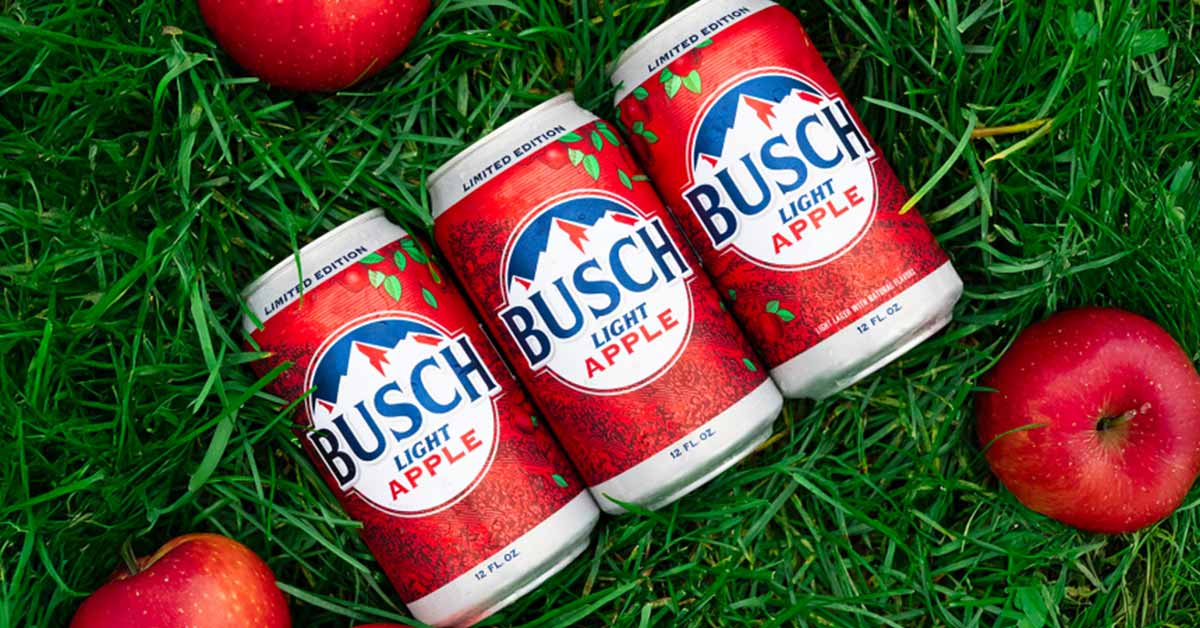
For Busch Light, that was Busch Light Apple, a seasonal offering brought back in Q2 after a short hiatus. The offering was the No. 1 beer innovation in H1, connecting with the youngest legal-drinking-age consumers, according to Doukeris. Purchase rates for the offering were 6X the average among 21- to 24-year-olds making beer purchases, Doukeris said.
Meanwhile, Michelob Ultra made strides with Michelob Ultra Zero, which was the No. 2 beer innovation and No. 6 volume share gainer in the first half of the year, according to A-B. The offering was launched in Q1, but “really hit [shelf] sets” in Q2, Doukeris said.
“Because [we had] the intentionality of the innovations that we had during the year – so less innovations, but more meaningful innovations – you get a boost on [our] share, especially on the quarter two,” Doukeris said.
A-B plans to continue with its calculated approach to innovation. However, the company is not completely holding back, as it still sees opportunities “for innovation and expansion of tools to increase penetration” in areas such as “the non-alcohol, the gluten free, the zero sugar and the beyond beer choices.”
“The learnings from this is consistency,” Doukeris added. “We’ve been talking a lot about this. So a long-term plan, a very consistent view on the category, on our portfolio choices and the investments we made for the long term.”
Those investments include continued focus on the expansion of Michelob Ultra and Busch Light, which are the No. 1 and No. 2 volume share gainers in beer year-to-date (YTD), respectively, leadership shared.
Michelob Ultra is “growing this year in all 50 states,” and has up to 11% share in its strongest markets, Doukeris said. But it still has space to grow, with “only 6% share” in the Northeast and West Coast, he said.
Similarly, Busch Light is “the leading brand in the mainstream,” and has more than 10% share in some markets, “but the distribution is still very limited, so the brand can continue to find growth areas across most of the U.S.,” Doukeris said.
Michelob Ultra, A-B’s largest brand by dollar sales, continues to post single-digit growth in dollar sales (+4.4%) and volume (+4.3%) in Circana-tracked off-premise channels YTD (data through July 13). Trends have slowed slightly in the last four weeks (L4W), with dollar sales up 3.7% YoY and volume increasing 4%.
Michelob is the third-largest beer brand family in Circana-tracked channels (measured by dollar sales YTD), with 8.59% share of category dollar sales and 8.91% share of volume.
Busch Light, A-B’s third-largest brand, has posted even larger growth YTD (dollar sales +5.3%, volume +3.2%), with trends accelerating in the L4W (dollar sales +7.1%, volume +5.9%). The brand now has a 3.21% share of total beer off-premise dollars (+0.26 percentage points YTD), and 4.97% share of case sales (+0.38 points).
Busch is the eighth-largest beer brand family YTD, with 4.42% share of beer dollar sales and 6.79% share of beer volume.
Meanwhile, A-B’s second-largest brand (No. 1 by volume) Bud Light continues to post declines (dollar sales -9.2%, volume -10% YTD), with losses holding steady in the L4W (dollar sales -9.5%, volume -10.5%). The brand has a 6.95% share of category dollar sales YTD (-0.47 percentage points) and 8.53% share of volume (-0.5 points).
Bud is the No. 2 beer brand family in Circana-tracked channels YTD, with 10.27% share of dollar sales and 12.53% share (the largest share) of case sales.
Doukeris acknowledged that there is still “work to be done” across Bud Light, Budweiser and other brands.
“We are more advanced with [Michelob] Ultra, more advanced with Bush Light, while we continue to work on the other brands and make, of course, the right choices in terms of allocation of capital and investments for these brands,” Doukeris said.
“Of course, the improvements are never overnight,” he added.
Looking ahead, A-B is projecting EBITDA to growth between 4-8%, in line with its previously shared medium-term outlook. The company did not share volume expectations.