
21st Amendment Brewery is ceasing operations after 25 years, as founders Shaun O’Sullivan and Nico Freccia seek a buyer for the legacy craft beer brand.
Over the next 60 days, 21st Amendment will wind down operations at its San Leandro production facility with a target date to cease operations during the first week of November, Freccia told Brewbound.
The company plans to maintain its taproom at the facility and 2nd Street San Francisco brewpub as long as possible, depending on staffing, he added.
The news is a reversal of a plan announced last week by O’Sullivan on social media, which would have seen 21st Amendment’s founders step away from the daily operations and transition to board roles while a new CEO took over with the goal of building a platform.
“This is all very new,” Freccia said. “A week ago, we were moving in a different direction, and we were excited about a potential path forward with building a platform. But it just wasn’t tenable. So a pivot has been made.”
Those plans had been in the works since early July but changed “relatively suddenly” this week, Freccia explained. A financial lender that 21st Amendment was working with to grow the business ultimately decided against moving forward with the transition due to the industry’s mounting challenges and no “clear path forward.”
“We just thought it was going to be a really good, elegant and optimistic way forward for us and for the brand, with a good steward that was willing to invest, and they were really bullish on the brand too,” Freccia said. “They wanted to grow the brand. We were about to make some hires.
“The lenders aren’t necessarily craft beer people,” he continued. “They’re money people, and they can see the challenges ahead. At a certain point, I think somebody decided ‘We better step back before we get in too deep.’”
Freccia and O’Sullivan are still open to exploring a sale of the 21st Amendment brand.
“Our hope is that the brand will live on and there’ll be opportunities coming down the line,” he said.
For now, the focus is on doing “the most humane and orderly wind down that we can and keep our employees front of mind,” while wrapping up operations in a large-scale facility that is no longer sustainable to operate with “excessive overhead,” Freccia said.
21st Amendment’s workforce was informed of the plans on Wednesday, he added. Retailer and wholesaler partners will be notified in the coming days.
Declining alcohol sales, moderation trends, tariffs and economic uncertainty added to mounting headwinds facing the business, Freccia said. The 2023 pivot to a co-packing model proved successful early on, but the industry’s increasing challenges this year led to struggles for those partners whose contract volume slowed.
Without the lender’s support, 21st Amendment’s path forward became untenable. Freccia said the business has not been profitable for a few years now, and its San Francisco location is operating at about 40% of pre-pandemic business, which Freccia described as “a little microcosm of the bigger world.”
“We built a big facility at a time when the industry was growing rapidly and we were growing 30%, 40%, 50% a year,” Freccia said. “And that growth came to a slowdown and then a standstill right after we opened.”
Freccia continued that there could be a book – “and it’s going to be a good book with some unbelievable twists and turns” – about 21st Amendment’s rise and fall. He recalled several challenges that came to a head during the pandemic, from the sale of its home market distributor DBI to Reyes in 2019 to a transition to the Anheuser-Busch network between fall 2019 and spring 2020 during the pandemic
“That turned out to be not only disruptive, but with the addition of COVID[-19] into the equation, just terrible timing,” Freccia said. “We’re trying to essentially build new partnerships with new distributors in our home territory, where we were doing significant volume, and it’s already a challenge anytime you switch wholesalers, but doing that in the middle of COVID added another wrinkle.”
On top of the distributor transition, 21st Amendment was getting “stiff armed” by its can supplier, Ball Corporation, which put the brewery on allocation and prevented the company from shipping beer that was on order.
“At that time, we were kind of middle size, where we were too big to be making our money out of our taprooms, and too small to be one of the main go-to pulls off the shelf at retail,” Freccia said. “It really was a sledgehammer blow.”
Meanwhile, a national sales platform partnership with Brooklyn Brewery dissolved at the start of the COVID-19 pandemic, forcing 21st Amendment to rebuild its sales team, he continued.
“A series of unfortunate events over the years and but really all precipitated with COVID that we could never really recover from,” Freccia said.
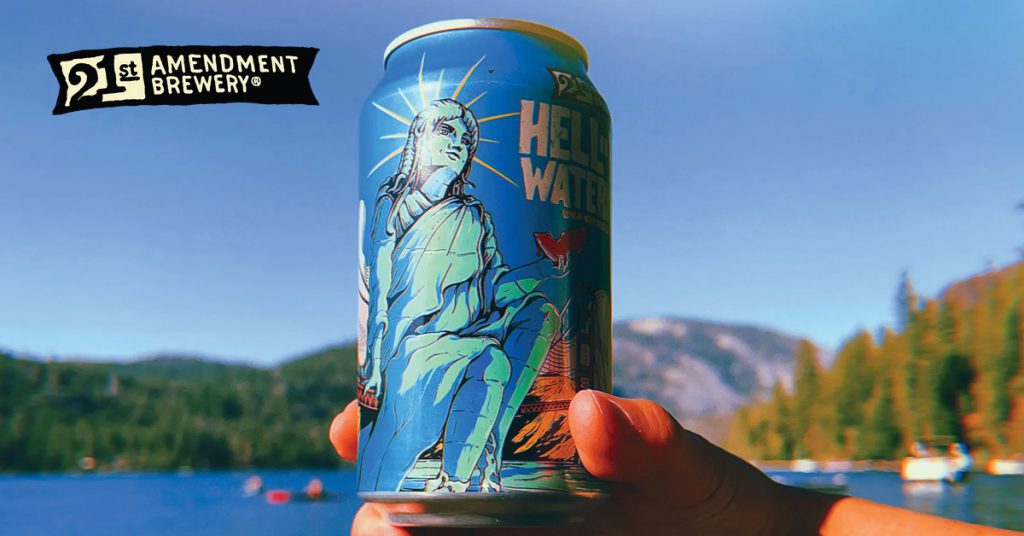
Freccia and O’Sullivan founded 21st Amendment in 2000 as a brewpub within walking distance of Oracle Park, the San Francisco Giants’ home stadium. The company quickly established itself for being among the first craft brewers to can its beers, such as flagships Hell or High Watermelon and Brew Free! or Die IPA.
In 2018, 21st Amendment ranked as the 26th largest Brewers Association-defined craft brewery by volume, with 112,845 barrels of output. The company rode craft’s early 2010s growth wave, with double-digit growth from 2012 through 2015 (according to available BA data, which begins in 2012) when it reached a 100,000-barrel milestone (102,709 barrels).
21st Amendment remained above the 100,000-barrel threshold until the COVID-19 pandemic in 2020, but the company wasn’t able to recover after, suffering double-digit volume declines every year since 2019:
- 2019: 101,860 barrels (-10% year-over-year [YoY]);
- 2020: 70,522 barrels (-11% YoY);
- 2021: 62,843 barrels (-21% YoY);
- 2022: 45,400 barrels (-28% YoY);
- 2023: 32,046 barrels (-29% YoY);
- 2024: 23,217 barrels (-28% YoY).
“The craft beer world has changed a lot since we opened in 2000, and we are proud of the role we played in shaping it,” O’Sullivan said in an announcement shared with Brewbound and expected to be released today. “While this chapter is closing, I hope our story inspires the next generation of brewers and dreamers.”
“When you’re losing money and you’re trying to make a pivot and the runway for that break-even point just keeps going out farther and farther or at the very least, doesn’t get closer, it’s a tough decision,” Freccia told Brewbound.
“Fortunately, we’ve got the runway and the support to give all of our team that 60 days’ notice and try to wind things down in a way that we can celebrate what we’ve built, and hopefully invite people into our taprooms and pubs over the next 60 days to enjoy it for a final pint and a final baseball game, and have some conversations with some folks that might be interested in the brand and the IP and keep the beers alive, and we’ll go from there.”