

Anheuser-Busch (A-B) InBev recorded mid-single-digit losses in revenue (-5.1%), shipments (-6.7%) and depletions (-5.4%) in the U.S. during the first quarter of 2025, the company reported Thursday.
A-B estimated that its depletions (sales to retailers) decline “outperformed the industry, which was negatively impacted by adverse weather and Easter shipment phasing,” it wrote in a press release. Shipments (sales to wholesalers) declines were in part attributed to one fewer selling day in Q1 2025 compared to Q1 2024.
“In the U.S, our portfolio is building momentum and has reached an inflection point, and we are increasing investments in our brands to fuel growth,” CEO Michel Doukeris said during a conference call with analysts. “We gained volume market share of both the beer industry and spirits based ready-to-drink category.”
Doukeris called out the company’s Michelob Ultra and Busch Light brands as “the top two volume share gainers in the industry for the second quarter in a row.”
Year-to-date (YTD) through March 23, which includes almost the entire first quarter, Michelob Ultra gained 0.64 dollar sharepoints and 0.79 case sharepoints at off-premise retailers tracked by Circana. In the same period, Busch Light gained 0.26 dollar sharepoints and 0.37 case sharepoints.
The American market accounts for more than 20% of A-B’s business, so while A-B’s quarter in the U.S. may have been marked with losses, its global business had a more mixed quarter, Doukeris said. The company’s overall revenue increased 1.5% and volumes declined 2.2%.
A-B’s non-alcoholic (NA) beer portfolio has delivered gains in the U.S. and worldwide, Doukeris said. Revenue of A-B’s NA beers increased 34% globally, and increased volume “in the high-twenties” in the U.S., where the company is “the leader in no-alcohol beer” with a portfolio that includes Budweiser Zero, O’Doul’s NA and Busch NA.
Michelob Ultra Zero launched in January 2025 and has become the fifth largest NA brand in the U.S., Doukeris said. The brand has reached a 10.3% share of NA beer in the country., according to data A-B shared with Brewbound. A-B has “just started” a media campaign for the brand, because it used Q1 to focus on distribution expansion.
“We expect to see some acceleration,” Doukeris added.
In addition to its NA offerings, A-B is focusing on its “balanced choices” portfolio – products with better-for-you attributes that “today are a big business for us” and have generated more than $5 billion in revenue, Doukeris said.
“Non-alcohol is one that we’ve been talking [about] and it’s becoming very obvious because 60% are either new consumers coming into the category or the same current beer consumer having beer in more occasions, because now the non-alcohol opens up this opportunity to them,” he said. “But this goes beyond only the non-alcohol because we see these barriers for consumers to interact with beer. And when we solve for these barriers, they actually prefer our balanced choices rather than other alcoholic beverage[s].”
A-B holds the No. 1 NA brand position in 50% of its markets (except the U.S., where Heineken 0.0 has the top spot). Globally, much of its NA growth is driven by Corona Cero, which is growing revenue by “triple-digits.”
Highlighted attributes of “balanced choices” vary by market and consumer preference, but A-B’s various offerings range from gluten-free, to NA, to sugar-free, to low-alcohol, to low-carb and low-calorie. Doukeris pointed to the latter two as to why Michelob Ultra has become dominant in the U.S.
Michelob Ultra is A-B’s No. 1 brand in off-premise scan data. YTD through March 23, its dollar sales increased 6%, to $707.8 million. It was also the top draft brand in Q1 with 15.7% share of retailer invoices tracked by Fintech, according to a presentation the firm hosted last month.
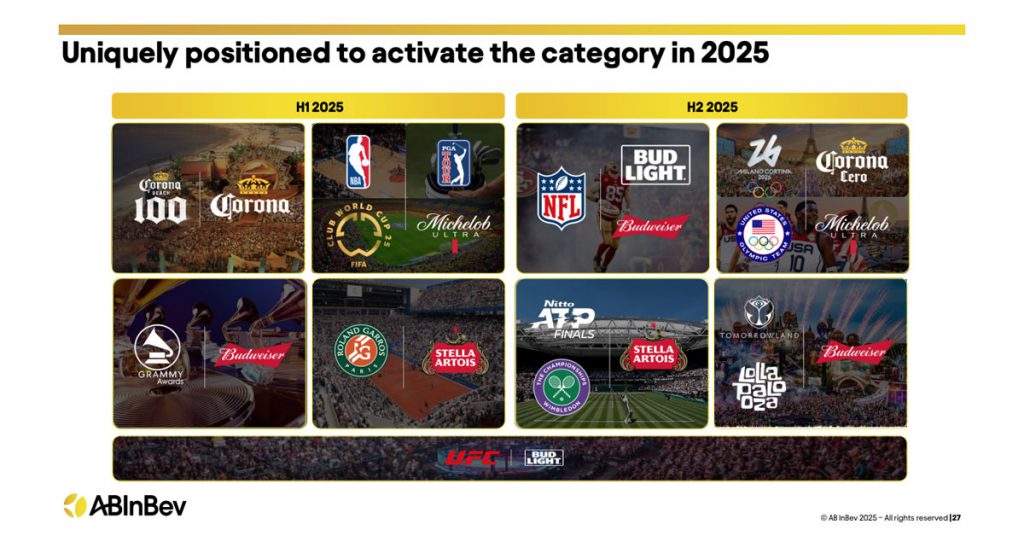
A-B’s partnership and activation calendar is stacked through the rest of 2025 and into 2026, with Michelob Ultra as the hero brand for most of its sports sponsorships, including the NBA, the PGA Tour, FIFA World Cup and the Winter Olympics.
“Looking ahead to the summer and the rest of the year, we are uniquely positioned to activate the category,” Doukeris said. “The combination of our mega brands with the key global platforms that consumers love and that bring people together is a powerful opportunity to lead and grow the category.”
Stella Artois anchors A-B’s tennis sponsorships (Wimbledon, Roland Garros, Nitto ATP Finals), and Budweiser is the designated brand for music-related events (the Grammy Awards, Tomorrowland and Lollapalooza). Bud Light and Budweiser are the featured brands of A-B’s NFL partnership.
The investment in large-scale partnerships is part of a multi-year plan to generate growth for A-B’s key brands in the U.S., Doukeris said.
“It only makes sense to continue to support the growing part of the portfolio and the sustaining part of the portfolio,” he said. “Momentum is good for our team now in the U.S. Summer, we will have a lot of activation.”
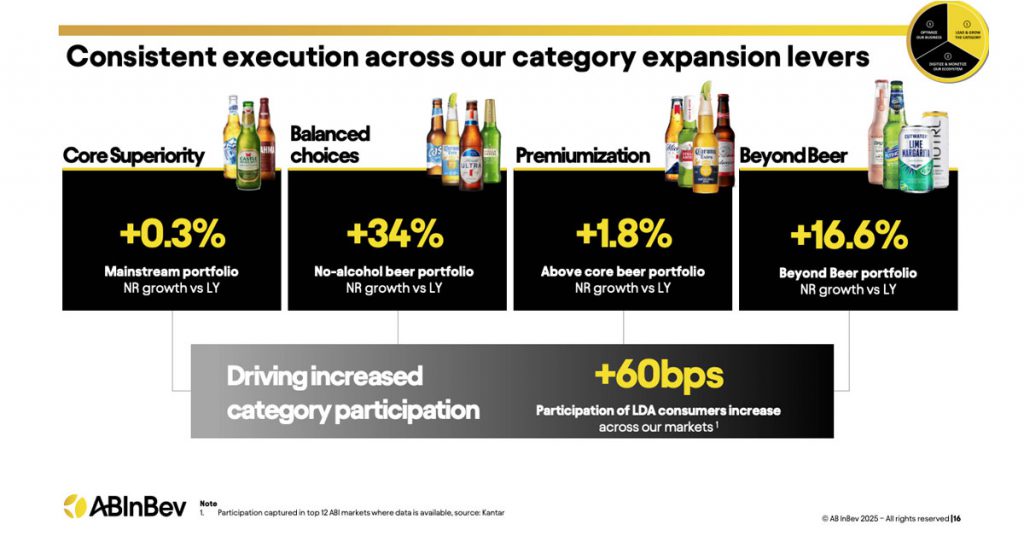
A-B’s category expansion strategy hinges on four product buckets: core (+0.3% net revenue growth year-over-year [YoY]), balanced choices (+34% YoY), premiumization (1.8% YoY) and beyond beer (+16.6% YoY). These levers have driven a 60-basispoint increase in consumer participation in A-B’s portfolio across 12 markets tracked by Kantar, the company said.
In beyond beer, A-B has been a key player in the U.S. with its Cutwater Spirits ready-to-drink (RTD) cocktail brand, which is the No. 1 spirits-based RTD, according to data from A-B. The company’s beyond beer portfolio also includes NÜTRL, which is the country’s No. 2 vodka-based seltzer behind Gallo’s High Noon Sun Sips.
“Both had double-digit volume and dollar growth in Q1 and grew share of the ready-to-drink cocktail category,” a spokesperson told Brewbound.
Globally, A-B eliminated 30% of the SKUs in its beyond beer portfolio to prioritize Cutwater, NÜTRL, BEATS, Flying Fish and Brutal Fruit, with the latter three being sold outside the U.S. The company has opted to develop new brands for these products, rather than extend existing ones, due to consumer preference.
“People want to buy brands here. They don’t want generic liquids,” Doukeris said. “And they like brands that are new to the world. That’s why NÜTRL does well, that’s why Cutwater does well or Flying Fish.”
Asked how the cultural narrative that gen Z consumers eschew alcohol at higher rates than their predecessors affects A-B’s business, Doukeris posited that the COVID-19 pandemic’s effect on socializing was a culprit.
“Any of the behaviors that are naturally evolving when you are 21, 22, 23 years old for this generation was a little bit later,” he said. “So from the college that you had to be one year or two years out of your home, or from the dorms, to participating in sports events, music events, gatherings with friends. When we look at that, it’s somehow the same everywhere, but it’s recovering and moving everywhere as well because behaviors, they normalize a lot as we look at the 24-, 25[-year-old] cohorts.”
At the other end of the age spectrum, older consumers continue to buy bev-alc products because they are “living longer, going out more, spending more money,” Doukeris said.
However, purchasing behavior among beer’s key consumer class remains steady, he added.
“There is a big normalization on the core of the category – from 24 to 35 looks very normal,” Doukeris said. “Of course, we are monitoring this very carefully. We are working on our balanced choices portfolio because it resonates very well with consumers from zero sugar to gluten-free, to low carb to non-alcohol. So we are offering a proposition that caters for every different taste in the moment.”