
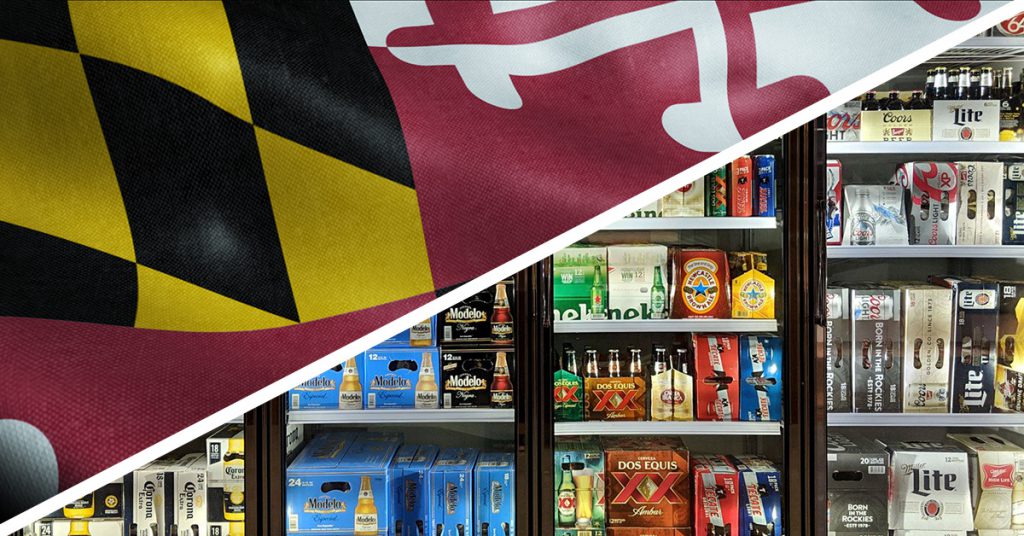
Maryland lawmakers are considering a bill that would expand beer and wine sales licenses to the state’s grocery, convenience, mass retail and warehouse stores.
However, House Bill 1379 “faced tough questioning in committee and faces a tough road to passage in the House,” Maryland Matters reported, citing a nearly three-hour debate over it last week.
To help assuage concerns that opening beer and wine sales to the state’s largest retailers would hurt small independent liquor stores, Del. Marlon Amprey proposed adding a 5% surcharge to beer and wine sales at large retailers, amid other concessions.
H.B. 1379 would allow larger retailers to apply for Class A beer, beer and wine or beer and light wine permits. Beer and wine sales would be limited to 9 a.m.-8 p.m. Monday through Saturday, and licensees would be prohibited from selling the products via self-checkout registers or delivery. Outdoor signage advertising beer or wine would also be prohibited, according to the bill.
Maryland is one of just a few states that bans beer and wine sales at grocery stores outright, though a few grocery stores hold licenses that predate the existing legislation, according to Maryland Matters. Other states, including Massachusetts and New Jersey, offer a limited number of licenses for the channel.
At the House Economic Matters Committee hearing last week, independent bev-alc retailers spoke out against H.B. 1379.
“If you have a pie and I cut it eight ways, then we all get an eighth. If I cut it 16 ways, we get a 16th,” Baltimore County pub owner Jack Milani said. “So unless you know you can grow this pie in a great way, we’re going to get hurt.”
The proposed 5% surcharge would be used as a carrot to induce grocery stores to open in “food deserts,” Amprey said.
The state’s Department of Housing would create a fund to offer financial incentives to “developers willing to establish grocery stores in low-income areas, offering gap funding or low-interest loans to make such ventures financially viable,” according to an interview Amprey gave to WBAL News Radio.
Amprey also proposed that grocery stores be required to purchase existing Class A licenses so as not to flood the market.
“The premise there is that if you are going to deliver convenience, to ensure that the cost of that convenience is captured, that we as a state can make some revenue off that convenience in order to support distressed communities that don’t have grocery stores,” Amprey said, according to Maryland Matters.
Another potential compromise would be to permit Sunday bev-alc sales exclusively at liquor stores, according to WBAL.
Bills to expand beer and wine sales have been proposed in Maryland’s General Assembly in 2024 and 2023, but have not made it beyond committee hearings. Last year, Gov. Wes Moore said he supported the efforts because they had public backing, Maryland Matters reported.
Maryland’s distributor and retailer tiers have united against H.B. 1379.
“If there was a bill that we thought would increase our sales throughout the state, we would be supportive, but this bill does not do that,” Maryland Beer Wholesalers Association lobbyist Nick Manis said.
A similar expansion of wine sales took place in Colorado in 2022 following a ballot question that received 50.6% of the vote, the Denver Gazette reported. Nearly 400 independent liquor stores are expected to close in the state by the end of 2026, according to a study cited by the newspaper.