
Ninety-five percent of bev-alc brand launches fail, according to Gustavo Aguirre, VP of brand innovation at investment firm InvestBev.
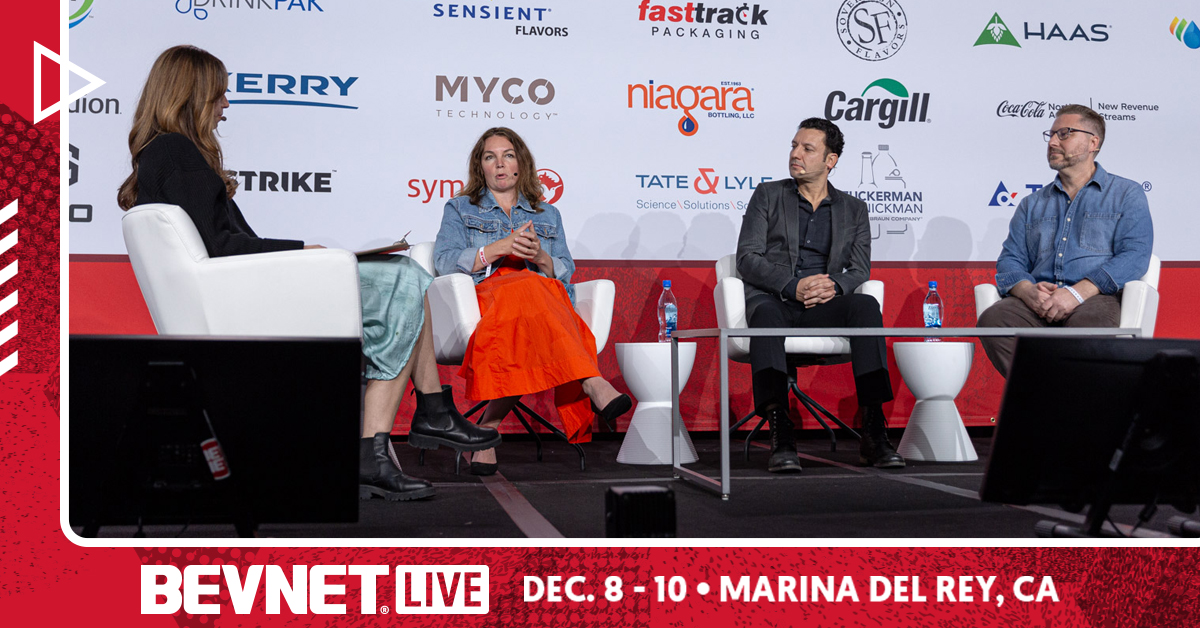
Aguirre spoke during BevNET’s Spirits Sunday event in Marina del Rey, California. Aguirre was joined by GHJ advisory partner Maria Pearman and 5:30 Somewhere founder Dale LeFlam. Each gave a short presentation on keys for bev-alc startups to succeed in today’s crowded marketplace.
Editor’s Note: BevNET Live kicks off today, with two days of beverage business conversations. Watch the livestream here.
Aguirre named six of the most common reasons brands fail.
1. Lack of product-market fit
“Many brands create a product, but they don’t have a good understanding of what are they solving for [and] what is the need that they are meeting for consumers,” Aguirre said.
Brands need to understand who their “super consumers” are – the brand’s core repeat customers – and why they’re purchasing the product instead of a competitor.
2. The product doesn’t deliver on its promise
Companies need to understand what promises they’re making to consumers when it comes to quality, taste, availability and more, Aguirre said.
“It is not only about the taste,” he said. “It’s also about that emotional benefit that consumers will get. Because if you don’t deliver on that, they will not come back.”
3. Lack of understanding the competition
There is no question that bev-alc brands are entering a crowded market with competition from all forms of intoxicating beverages. However, startups need to understand “what is your role in the universe, what you stand for and what sets you apart,” as well as how your competition answers those questions, Aguirre said.
“You have to have a very good understanding of your competition and how you can win against them,” he said.
4. An ineffective go-to-market strategy
Aguirre encouraged startups to find the “pillars” that set up their business for expansion, evaluating what their business ambitions are and the realistic cost to achieve those ambitions.
5. The founding team does not have ‘the capabilities to execute’
“Founders need to be self-aware of their gaps, and not only on the things that they need to work on, but also on the things that their team needs to have in order to execute,” Aguirre said.
6. A failure to turn the idea into a business case
“Any idea has to be financially viable,” Aguirre said.
For a brand to succeed, its founders need to be able to articulate “in detail” how the business is going to make money, he said.
“The expectation that a great tasting product is enough is probably the biggest mistake that they can make,” Aguirre said.
“Don’t tell me about how great your product tastes, and how great you are as a founder – I assume you are on both,” he added. “Tell me what’s next and how you’re going to be executing, the resources that you’re going to be using, how you’re going to stay competitive.”
Pricing Mistakes
Pearman highlighted the financial mistakes many startups make, including having “unrealistic pricing.”
There is a common misunderstanding of “how to appropriately price your product in the market,” that comes from a lack of understanding both the right sales price and the real internal costs of making a product, Pearman said.
“Oftentimes I come across brands who are not really prepared to put shelf price on their product that will yield a reasonable margin for that product,” she said. “And oftentimes that’s because for small and emerging growth companies, the cost of the inputs is pretty, pretty tight.
“A lot of times small and emerging companies, they’re on the shelf next to a company that is owned by one of the big boys with bottomless pockets, who have a lot more cushion to absorb smaller margins than these small emerging brands,” she continued.
Some brands are hesitant to raise prices because it might impact their velocity. However, the “little more velocity” from a lower shelf price “does not make up for the diminished margin that you’re giving up,” Pearman said.
Companies also need to have an understanding of internal costs from a “SKU-level basis” to create an appropriate price point, she said.
Pearman also warned of cash flow mistakes, with cash management sometimes taking a back seat when a company is focused on cost savings.
“I see a lot of times where if you need to buy cans, people will say, ‘Well, I could get an entire truckload for just a little bit more than half a truckload,’ but then you’re out this huge chunk of cash all at once,” Pearman said. “The rate at which you’re going to go through the inventory is really slow, and it just does not make sense.”
Bloated supply inventory can lead to a “very short runway” of cash flow, and “once your cash runway gets short, there’s not much cushion for unexpected things to come,” she said.
Additionally, Pearman warned startups not to sell equity in their companies too soon.
“Start on the front end of the process with a real conservative eye to what you think the financial forecast will be, map that out over a long period of time, and really have a good idea of how much cash it’s going to take to get this thing off the ground,” Pearman said. “If you know that on the front end, then you can do a much better job of being orderly in how you go to the markets and ask for equity, and you’re not going to put yourself in a situation where you continue to get diluted.”
A diluted equity means a loss of control, and that can lead to founders doing “the brunt of the work” with “very little of the pie,” Pearman said. Additionally, too many voices at the table can lead to founders having to tackle “investment management,” which “becomes a job in and of itself.”
Don’t Be Afraid to Be Small and Local
LeFlam encouraged startups to “win your backyard first.”
“Too often I see brands come out of the gates, and their idea is, ‘The faster I get to different markets, the faster I grow – that equals success,’” LeFlam said. “And it’s usually the very opposite.”
LeFlam encouraged companies to stay small and get “proof of concept” in a small market, allowing for better testing of pricing, branding, product and more.
“I promise you, in your first six months to a year and beyond, something is going to change,” LeFlam said. “You’re going to have something that didn’t work. Something is going to evolve. And it’s a lot easier to course correct that in your backyard.”
Staying small also means not spreading a brand into too many accounts, prioritizing velocity over volume.
“I’d rather see you in 50 accounts doing five cases a week than 100 accounts doing two and a half cases a week,” LeFlam said.
“Velocity is ultimately the story that you need to be telling, and it’s ultimately going to determine what success looks like for your brand,” he continued.
LeFlam also highlighted the importance of founders continuing to be “the boots on the ground” when building a brand.
“You are the best person to build your brand,” LeFlam said. “But not only that, this is where the learning happens. This is where the opportunities come for you to see what is the consumer feedback? Is there an issue with my juice? Do I need to change something?”