
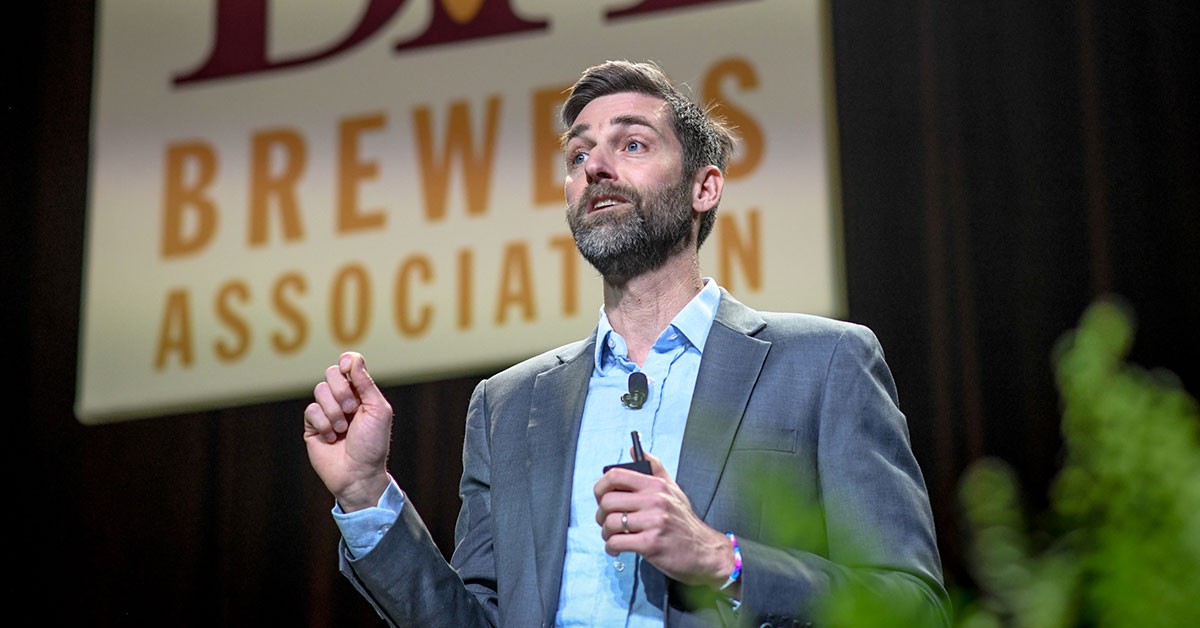
For craft breweries to return to growth, they have to do more than just make great beer, Brewers Association (BA) chief economist and VP of strategy Bart Watson said during his state of the industry address Tuesday on Day 2 of the Craft Brewers Conference (CBC) in Las Vegas.
Small and independent craft production declined -1% in 2023, according to the BA’s annual production survey. More than half (54%) of surveyed breweries recorded a decline in production, and the gap between openings (495) and closings (418) narrowed.
Much of craft’s decline is due to demand, which has followed a “textbook” S-curve pattern of increasing rapidly 10+ years ago, to now becoming static as product is easily accessible and no longer new. From 2012 to 2019, the number of craft drinkers was growing an average of +3.5% annually. From 2019 to now, that growth has compounded to +1.6%.
The cost to make, market and sell beer has also continued to increase, as “pretty much everything has gone up in cost in recent years,” and craft revenue has been unable to keep up.
“The crux of this challenge is not necessarily the input price increases [for operations], but the combination of that with our inability to follow them up in pricing,” Watson said.
“When you look at other consumer product goods categories, some of them would just pass those prices on to the customer,” he continued. Craft’s hesitancy to do so is a response to the state of supply and demand, and how relevant companies feel their brand is “relative to the total category.”
There is still room – and reason – for optimism, according to Watson. Forty-four percent of craft breweries who responded to the survey, recorded an increase in production in 2023.
“That 44% represents thousands of companies that faced all those challenges that I already laid out for you, and still found ways to rise above and find growth,” he said.
Craft breweries are also starting to redefine what “growth” means to them.
“When I talk to brewers about distribution in the past, it was always, ‘Where can I go next? How much beer can I sell?’” Watson said. “This year, I’ve heard a lot of reframing around where are the places and brands that I can sell that are actually going to make me money.
“Craft is entering its era of operations,” he continued “People are recognizing that it’s not just about the great beer you make, but you have to have a profitable business behind it.”
Craft has the ability to “restart” growth as a segment, but it will rely on companies either finding more occasions for their brands, or bringing new drinkers into the segment. Both pathways require companies to lean into what makes them different in a sea of choice across not just beer, but all bev-alc.
“It made a lot of sense in that era of rapid growth to stick close to the herd, to do what was working, to make the styles that everyone else was making, to have the industrial chic warehouse taproom that everybody would expect with craft,” Watson said. “That said, in an era of incremental growth, that’s not going to work for everyone collectively.
“To find those new customers, win those new occasions, we’re going to need companies to find different paths, find their own unique paths,” he continued.
Regionals Post Nearly +1% Growth, Driven Heavily By Top Companies
Watson also dove into production growth and declines for different business models.
Brewpubs took one of the largest hits, with production declining -4% in 2023. The model “has seen more change and disruption” than any other, and is feeling the impact of the added financial burden of running a business centered around food, Watson said.
Watson noted that food away from home is up +14% from December 2021 to December 2023. Additionally, consumers have grown accustomed to luxuries such as food delivery and endless entertainment through smartphones and streaming services.
“Getting people out is harder than it has been in the past, and talking to brewpub operators in preparation for this talk, they are hyper aware of this,” Watson said. “They’re thinking about the hospitality concept and thinking about what differentiates them, and they’re thinking about how to actually get people off their couches and actually come through their doors.”
Taprooms declined -2% in 2023. The model has been able to “fly above” the challenges that other models have not in the past, but that ended in 2023, according to Watson. Still, taproom openings outpaced taproom closings. Nearly half of taprooms (47%) recorded production growth, while 51% recorded a decline.
Watson also noted that taprooms that had a higher percentage of their business from distribution grew faster than those who leaned more heavily in the own-premise. Brewpubs were the opposite, with those who had more onsite business recording the most growth.
Turning to production breweries: Regionals increased production +0.5%, which Watson rounded up to +1%. That growth was “driven heavily” by the largest players.
“If you remove the top three regional growth companies, this number goes from +1% to -4%,” Watson said. “So the typical regional experience is not necessarily growth.”
The higher regional breweries’ onsite percentage, the more likely they were to increase production. While onsite sales are still a small piece of the pie for regionals, making up less than 2% of total sales, the pattern suggests that regional breweries are focusing more on branding, and asking, “How can I build an experiential brand even at a time where it’s harder and harder to attract customers?” Watson said.
Microbreweries took the biggest hit, with dollar sales declining -5%, as they got “squeezed” between small local players and larger regional and national brands. Microbreweries are having to think more about geography and their distribution strategy, Watson said.
“It’s not the total size of your brand that matters to the distributor, they don’t care how many barrels you make,” Watson said. “They do care what percentage of their portfolio you want.
“Microbreweries are really facing this tough trade off: To think critically about which distributors and markets can I actually grow in and actually invest in, and which ones do I have, to be honest, are no longer relevant to my brand,” he continued.