
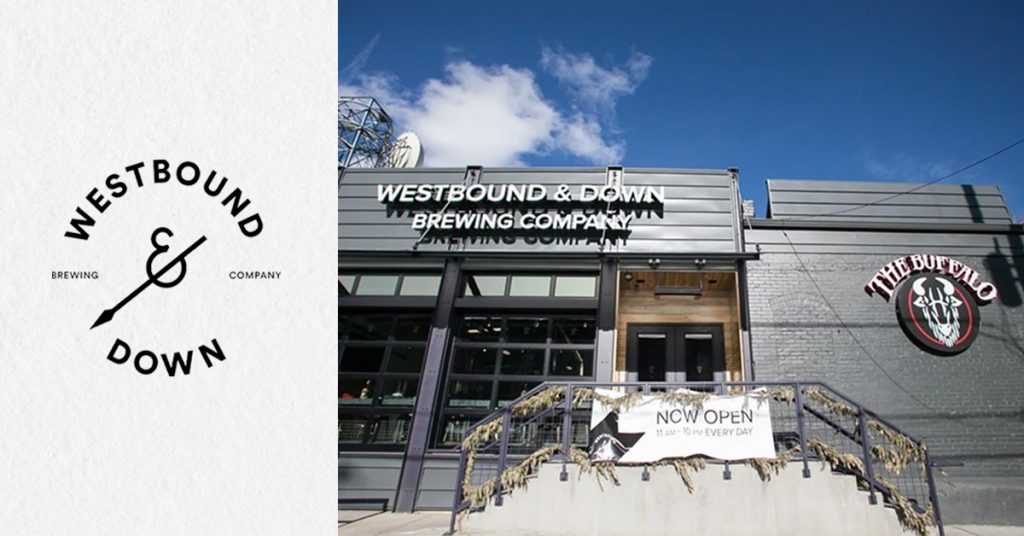
Westbound & Down Brewing Company is aiming to quadruple its production and achieve $3 million in profits by 2028.
The Colorado craft brewery, with five taprooms across the state (Denver, Idaho Springs, Lafayette, Basalt and Aspen), is in the midst of a $1.2 million crowdfunding (CF) raise. In the first month of the campaign, nearly 270 investors have signed on with a minimum investment of $735.75 each at an individual share price of $2.25.
Westbound & Down CEO and director of brewing operations Jake Gardner told Brewbound that the company is offering around 6% of its equity to investors. He added that at CF raise was the company’s preferred method due to the ability to offer a piece of the business to non-accredited investors, including many of the brewery’s patrons.
“We thought what better way to raise the capital than with the same community that brought on the demand for more product, the people that sit in our pubs that we sit next to and drink beer with and eat pizzas and burgers with,” he explained.
Westbound & Down wasn’t interested in limiting itself to accredited investors or private equity as that may come with strings attached and demands on “how the business should be run,” Gardner said.
In 2024, Westbound & Down produced around 5,000 barrels of beer, maxing out the brewery’s production capacity. The company’s growth trajectory “bottlenecked” in 2023 due to an inability to scale due to “capital constraints,” per the fundraising page.
The additional investment is aimed at helping the company increase capacity and meet consumer demand. It’s all part of a strategic plan to carry the business through 2028 that includes:
- Expanding production to 8,000 barrels this year;
- Entering Arizona, Illinois and Oregon and increasing capacity to 11,500 barrels in 2026;
- Adding California, Texas and New York and scaling production to 14,500 barrels in 2027;
- And growing production to 19,000 barrels in 2028.
In its most recent fiscal year, Westbound & Down generated nearly $10.2 million in revenue, growing from more than $7 million the prior year, according to an offering statement filed April 14 with the U.S. Securities and Exchange Commission (SEC). However, the company reported a loss of $1.5 million in its most recent fiscal year, following a $492,903 loss the prior year.
Westbound & Down has more than $1.7 million in short-term debt and more than $5.67 million in long-term debt, per the filing.
The company’s strategy is to generate $3 million in profits by 2028. The brewery is already in the process of expanding capacity, and last year added enough tanks to bring capacity to 8,000 barrels, Gardner said.
Westbound & Down has also taken over a former Smashburger location adjoining its Lafayette taproom and transformed it into a canning and packaging hall. Other moves such as upgrading its glycol system should help the brewery approach 15,000 barrels over the next two years.
Also helping drive the business is moving its distribution business to Elite Brands of Colorado in December. Westbound & Down’s previous distributor, Two Six Craft Distributors, sold to independent Anheuser-Busch house Eagle Rock Distributing Company, opening the door for a move to Elite, which Garnder called “the best distributor in the state.”
He added that Elite’s team “has a long history” of putting “quality beer first” and “we’re proud to be with them.”
Westbound & Down’s distribution covers 298 bars and restaurants and 329 off-premise retailers, including Whole Foods statewide in Colorado. Gardner said 65% of Westbound & Down’s beer is sold through distribution, while 35% is sold via its taprooms.
Westbound IPA is the company’s top-selling beer, accounting for around 28% of the brewery’s annual volume. Next, at 25%, is Juice Caboose hazy IPA and a portfolio of core brands in approachable styles, including Westbound Italian Pils, the Coloradoan Mexican-style Lager, Don’t Hassle the Hef hefeweizen and Colorado Pale Ale.
Gardner stressed that Westbound & Down’s top priority is producing quality beer. He believes the company’s beer has only gotten better as the company has scaled and its ability to negotiate better pricing on raw materials. The crowdfunding campaign is part of trying to keep up.
“Based on what we’re seeing with Elite though, we’re not positive that’s going to be enough,” Gardner said of the brewery’s most recent capacity expansion. “We want to take care of our home turf first and foremost, and certainly aspire to sell beer and surrounding states in the future, but really with a high focus on taking care of the four corners of Colorado first and foremost.”