
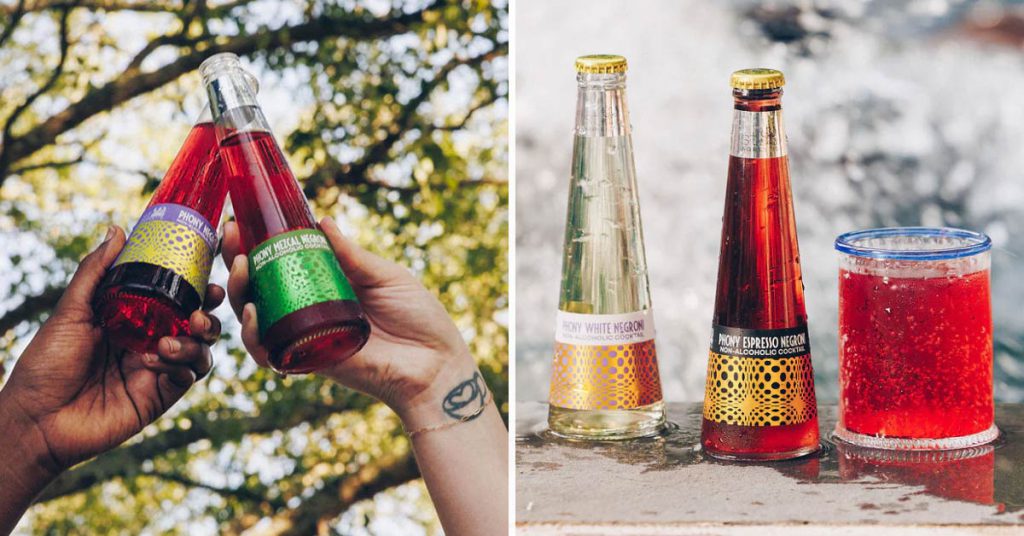
St. Agrestis is sometimes still called a Brooklyn-based amaro company, but the distiller is more of a Phony Negroni business at this point.
With nearly three million bottles sold in the past 12 months, the makers of the negroni alternative have made a name for themselves as a gold standard in non-alc alternatives, all while avoiding outside investment.
St. Agrestis was launched by brothers Louis and Matt Catizone and industry veteran Steven DeAngelo in 2017. Channeling their Italian roots, the brothers opened the Greenpoint distillery to capitalize on the hipster-sparked aperitif craze picking up in the U.S. They created a line of craft aperitivos, amaros and RTDs in glass, can and box formats. In 2022, they launched a version of their bottled negroni that could ride a new trend.
It was good timing to get into the now nearly $1 billion adult non-alc (ANA) industry, particularly as drinkers were reemerging in bars and restaurants after the pandemic, but looking to moderate.
However, non-alc ready-to-drink (RTD) cocktails were still niche, and for many founders who debuted their products online, major retail was and still is the holy grail of mainstream adoption. St. Agrestis took a different path: despite current positive sales at Costco and Total Wine & More, most retail victories “are yet to come” for the Phony Negroni – and the founders are okay with that.
On-Premise For The Win
The Phony Negroni, which now comes in five varieties and retails at about $5 per single-serve bottle, has made gains by planting a flag on restaurant and bar menus. The founders discovered early on that the product solved two problems: the wholesale price allowed operators to meet the same margins as a cocktail sale and skip making their own non-alc libations.
Initially limited by minimal bottling equipment, the brand built buzz as the founders were forced to be more selective with their partners and focus exclusively on New York. Press and New York visitors headed home with a taste for the product gave them a boost: the company is now with 42 distributors across the country, and Louis estimates 35 came to them.
“It’s been the script since then: get onto more bar and restaurant menus, let the retail trickle in from there,” Louis said.
Despite its hands-off approach to distribution, the brand will have 12 1,000-case markets this year with California approaching 10,000 and New York hitting 15,000. Phony Negroni’s sales are split 60/40 between on-premise and off-premise, with 5% more tilted towards retail this year without making the channel a priority.
The Innovation Thesis
The makers of the Negroni box (now called the Negroni Fountain), have developed a high threshold for a successful product launch since launching the first Phony Negroni. The testing starts with a seasonal release sold online – a healthy outlet for the brand boosted by paid marketing starting in 2023 – and is followed by trial in New York before becoming a permanent member of the Phony line.
So far, the Phony White Negroni, Espresso Negroni, Mezcal Negroni, and Amaro Falso have made the cut. The thesis is that each product can live on a different menu – if the Phony Negroni isn’t a fit at a Mexican concept, for example, the Phony Mezcal Negroni could be.
But how do new innovations avoid cannibalizing the flagship product?
“We’re careful about how we incentivize our dedicated salespeople and how we communicate with reps from distributors about new product launches,” Louis said. “By and large, the Phony Negroni is unbelievably sticky.”
Bittersweet Independence
As the company scales, St. Agrestis has been fortunate to find available real estate adjacent to the distillery. But as an independently financed company, every move is carefully measured.
“If we need another tank, it comes out of cash flow,” Louis said. “Running the business that way, we thought it was our kryptonite, but I think it turned into our secret weapon. We learned to spend really intelligently and carefully.”
Next up, the company plans to hire reps in cities where the brand is organically performing, part of a philosophical shift to “swim where the water is warmer,” said Louis.
“We’re just scratching the surface in a place like Los Angeles, so we’re looking to build out a team and hire as profitability allows for it,” he said.
As for new channels, the Phony Negroni plays well in gift and home goods shops, and the team would like to crack bring-your-own-booze operations, as well as more corporate music venues.
They haven’t started with retailers like Whole Foods or Sprouts, where many adult non-alc brands are ahead of them – and even building their brands.
“If we’re not in 400 Whole Foods by the end of the year next year, it’s not a failure,” Louis said. “We’d rather do things the right way and sustainably in a step-by-step strategy.”