
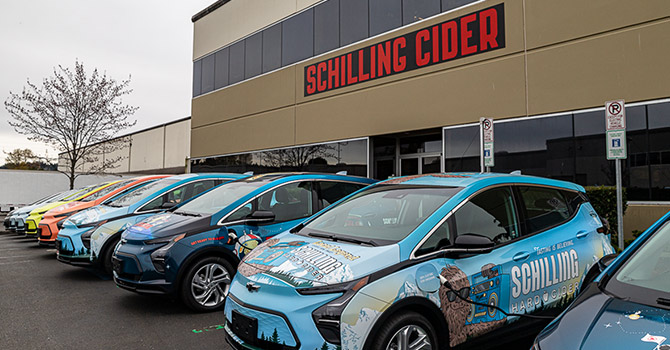
Schilling Hard Cider has gone electric. The Seattle, Washington-based hard cider maker is continuing its mission to reduce its carbon footprint by investing in eight new electric-powered vehicles (EVs), that will be used by its Pacific Northwest sales team.
The fleet of custom-branded 2023 Chevy Bolt EVs, rolling out now, are estimated to travel 100,000 miles per year, saving a predicted 33.4 metric tons of carbon emission annually, according to a press release. The new fleet will also help eliminate “other emissions associated with traditional gasoline-powered vehicles, including nitrogen oxides and particulate matter,” and will reduce noise pollution in the area.
Schilling’s existing Pacific Northwest-headquartered sales force, as well as some of its marketing team, were given the choice to opt in to using the fleet, or use their personal EVs and be reimbursed, Schilling co-founder and CEO Colin Schilling told Brewbound. Moving forward, the company’s standard will be to assign future hires an EV, Schilling added.
The transition to EVs cost Schilling about $250,000, but “there are a number of great state and federal EV incentives right now, so we are hoping to get a good chunk of that outlay back next tax season,” Schilling said.
“The Chevy Bolts we chose are made with a very high percent U.S. sourced materials and are of course manufactured in the U.S. so they not only support our domestic economy, but they will continue to qualify for the $7,500 EV credit at the federal level for individuals and businesses,” Schilling said.
The transition comes nearly two years after Schilling completed its first carbon inventory and started setting “carbon reduction goals.” The switch to EVs was a “top priority” to “significantly reduce its carbon emissions,” but took time due to supply chain shortages, requiring the company to order the eight vehicles “well into last year, and adding more will take longer than we want,” Schilling said.
Schilling also faced the challenge of making sure the fleet had access to charging stations, as “the public charging network for non-Tesla EVs is still terrible, so that’s really not an option,” Schilling said.
“We worked with each person taking a car directly to get a home charging solution and that was different for each person,” Schilling said. “It is our hope that the public charging network gets better quickly so that can be relied on.
“I am also really proud of the PNW team who all jumped on the opportunity to help us pave the way in our industry full well knowing it would not be as easy as going to the gas station and filling up when needed, at least for now,” he continued. “As an EV driver myself – once you get used to starting off every morning with a full battery going to a gas station starts to look very inconvenient!”

The EV fleet is just one of several steps Schilling has made to be energy efficient and sustainable. Other steps include:
- Committing to packaging all in aluminum cans instead of glass starting in 2013, becoming “the first cidery in the U.S. to transition from bottles to cans;”
- Using printed cans in place of wraps or stickers and 100% recyclable packaging, including its cartons, shrink wrap and pallets;
- Building a proprietary canning line that operates at different speeds, “making it much more energy efficient than typical on-or-off machines;”
- Using a tunnel pasteurization process that regenerates energy and is “85-90% more efficient;”
- And adding carbonation immediately before packaging during the production process to reduce the amount of CO2 released by up to 50%.
Schilling also launched its Keep It Wild campaign this month, committing to donate 5% of the profit from every can or draft pour of Local Legend and Excelsior Imperial Apple sold to eight different nonprofit organizations. Each nonprofit works to protect and restore wild spaces, representing different states, including Alaska, Arizona, California, Idaho, Wyoming, Oregon, Utah and Washington.
“We are committed to leading our industry forward to a more sustainable future,” Schilling said in the release. “Our commitment to reducing our carbon emissions and our environmental impact with electric cars makes sense because clean energy solutions are the path forward if we want to mitigate the effects of climate change and put our planet in a better place for future generations. While we’ve implemented many carbon-reducing initiatives, there are more in the works!”