
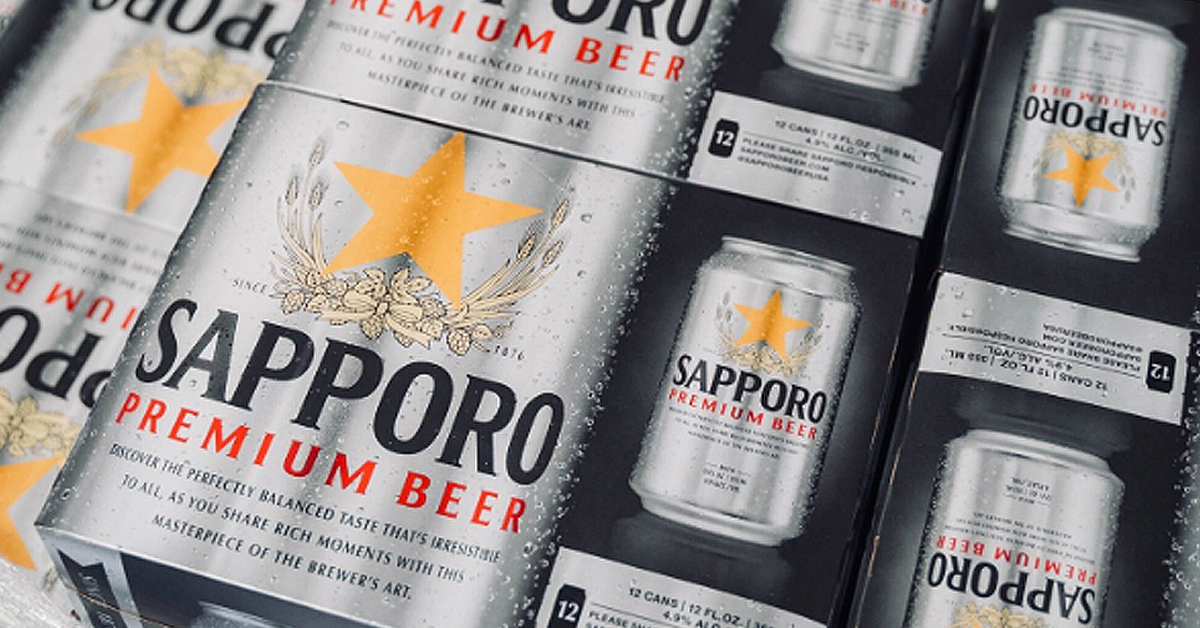
With wind in its sails from accelerating grocery sales, Sapporo has set its sights on multi-channel expansion.
The 149-year-old brand has been invigorated in recent years as Sapporo-Stone, the combined entity born from the former’s acquisition of the latter in 2022, takes shape.
Sapporo’s flagship lager is now produced at Stone’s facilities in Escondido, California, and Richmond, Virginia, and the company restructured its workforce earlier this year. During Q1, the brand reprised its specialty Chinese zodiac packaging, designed by global tattoo artist Tokyo Hiro, with Year of the Snake art, which expanded to 22 oz. single-serve chalice cans for the first time.
Sapporo has gained nearly a quarter of a share point of non-Mexican imported beer, according to NIQ data a spokesperson shared. The brand holds a 1.97% share of imported beer when the eight largest Mexican imports are removed from the segment, an increase of +0.23 sharepoints from 1.74% last year, according to NIQ Total US x AOC+Convenience for the 52-week period ending March 15.
Of non-Mexican imports, Sapporo is the fifth largest brand behind Heineken, Guinness, Labatt and Peroni. The brand has recorded the strongest dollar sales growth (+16%) among the top 10 import vendors, according to NIQ data (total U.S., year-to-date [YTD] through March 8), and is No. 4 in YTD dollar sales growth among the 60 largest brand families in the grocery channel.
YTD through April 20, Sapporo recorded double-digit growth in dollars (+18.6%) and volume (+18.8%) in grocery stores tracked by market research firm Circana. Those metrics have accelerated to +23.3% and +23.6% in the four-week period ending April 20.
Compared to other imports, Sapporo’s depletions have outpaced other brands in off-premise chain retailers, increasing 19.6%, compared to the segment’s 6.4% decline YTD through February 28, according to Beer Institute data provided by Sapporo.
“It’s beyond just imports now,” Sapporo-Stone CEO Zach Keeling told Brewbound last month. “It’s beyond certainly Asian imports. It’s now one of the largest growth drivers in all of beer, which is incredibly, incredibly exciting.”
Sapporo’s grocery channel gains are likely to expand, as Sapporo secured 12-pack placements in the “majority” of Publix locations for spring resets, chief revenue officer Tom McReavy said.
“Combined with all other distribution gains with Kroger and whatnot, our 12-packs will be up close to 50% in terms of total distribution year-over-year (YoY),” he said. “There probably aren’t many brands that can say that.”
Even before adding new Publix locations, Sapporo has the fastest-growing import 12-packs, with dollar sales up 49% for the 52-week period ending March 15 (NIQ total U.S. xAOC). Sapporo’s dollar sales growth is more than twice that of the next largest competitor, Constellation Brands’ Pacifico (+21%).
Sapporo’s connection to sushi has created cross-merchandising opportunities for at-home food-pairing occasions, McReavy added.
“The large-format grocery chains, every single one of them has a sushi counter, so we’re finding great partnership opportunities to put Sapporo right next to those sushi counters,” he said. “When people are taking out sushi, they grab a 6-pack and they go.”
Company leadership is turning to the nearly untapped convenience channel to fuel growth momentum, using Sapporo’s single-serve chalice’s success as proof of concept. The chalice is among the top 20 best-selling single-serve items at grocery stores, and has a 10,000-store gap in points of distribution between it and the best sellers.
However, the package has a much smaller footprint in c-stores and is outside the top 150 single-serve packages in the channel, according to NIQ data shared by Sapporo. Convenience stores represent a “massive, massive opportunity” for the chalice, McReavy said.
“We’re in less than 1% of all c-stores at this point in time with a classic, unique chalice package that screams ‘premium’ that would be beautiful in every c-store set we can possibly get,” he said.
As the company works to grow its c-store presence in the off-premise, it’s also targeting on-premise accounts beyond the sushi restaurants that have been a natural fit for the brand.
“We say expand from sushi, but there’s few foods I’d like to be associated with more than sushi,” Keeling said. “It’s quality, it’s premium, it’s a great experience when you’re having that and you’re out. It’s shareable – all these things that translate back to how a beer occasion should be too, so we’re really proud of that connection.”
Sushi restaurants grew 3.5% YoY to nearly 17,000 in 2024, according to IBISWorld. But placements in broader bars and restaurants may help widen consumers’ perception of the brand, as Mexican imports have done in recent years.
“The Modelos and the Coronas of the world, we’re not just seeing them in Mexican restaurants anymore,” McReavy said. “A great-tasting, quality beer that’s now made here in the United States can live anywhere in the on-premise.”
Plus, the expansion of raw fish dishes across restaurants of all cuisines provides ample opportunity to pair Sapporo, he continued.
“I would also challenge you to go to a popular on-premise place that does not have some type of poke bowl or some type of seafood or sushi option that we should pair with just naturally,” McReavy said. “At the end of the day, it’s a great-tasting, easy-drinking lager. It happens to be a Japanese lager, but it is a great-tasting lager that can pair well with any food.”
For its next innovation play, Sapporo will enter the booming non-alcoholic (NA) segment with Sapporo Non-Alcoholic, for which the company does “not yet have timing, but can confirm it’s on the horizon and it tastes great,” according to a spokesperson. Sapporo is targeting the on-premise channel for the beer’s eventual roll out.
“It gives another occasion to the Sapporo consumer, an occasion that’s obviously growing across beer right now,” Keeling said. “We have such a strong presence in the on-premise with Sapporo, having that NA option, bringing that to the table at our on-premise locations to go next to our alcoholic options is a really interesting way to launch it and then grow from there.”
Sapporo Non-Alcoholic will be produced at the company’s Canadian brewery and sold in 12 oz. can 6-packs, Keeling said.
YTD through April 20, the Sapporo-Stone portfolio grew in both dollar sales (+3.1%) and volume (+6.6%) at off-premise food stores tracked by Circana. Those gains accelerated in the latest four weeks (L4W) to +3.6% and +7.9%, respectively. The brewer is the 16th largest beer category vendor in grocery.
In multi-outlet grocery, mass retail and convenience stores (MULO+C), Sapporo-Stone ranked 21st by YTD dollar sales, which have declined YTD (-0.5%) but improved in the L4W (-0.1%). Despite declining dollars, the company has recorded accelerating volume growth (+1.6% YTD, +2.6% L4W).
Sapporo-Stone does not rank among the top 25 largest beer category vendors in the convenience channel.