
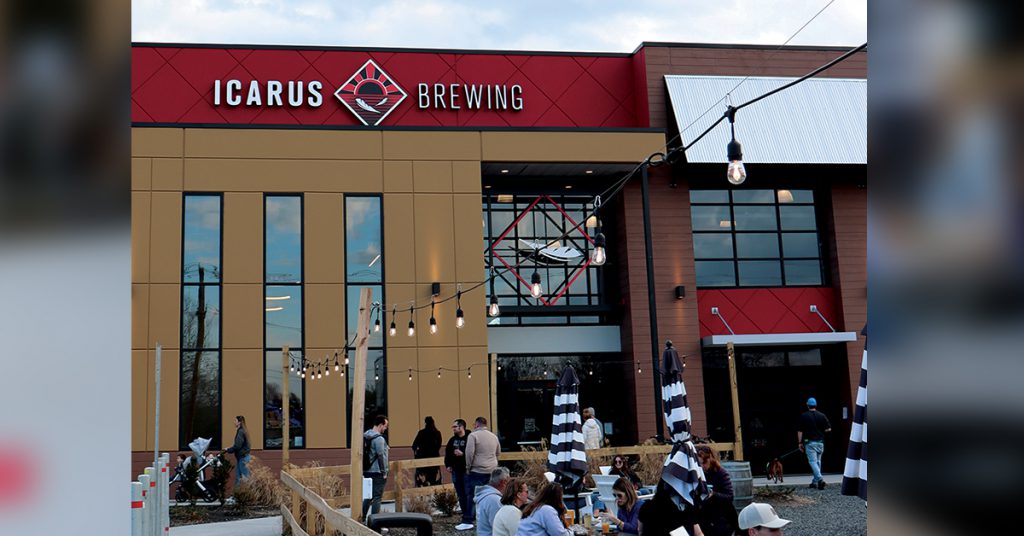
When long-time regulars pine for Icarus Brewing’s original location, founder and owner Jason Goldstein reminds them the good old days weren’t always so good.
Icarus just celebrated its first anniversary at its new home in Brick, New Jersey, about 13 miles east of its former brewery and taproom in neighboring Lakewood, where it occupied space in an industrial park downwind from the town recycling center. There, the backless bar seats were uncomfortable and parking spots were scarce, Goldstein told Brewbound during a visit to the new brewery.
“Our beer garden there was the parking lot,” he said. “We just put up some posts in the parking lot, with the glycol chiller being nice and loud, right there with trucks whizzing by. Whereas here, it’s nice.”
Icarus opened its doors in Lakewood in January 2017 and secured approval to begin work on its bigger Brick location in August 2021, according to the Asbury Park Press. At its new facility, Icarus’ custom BrauKon system can produce 6,000 barrels annually, with 2,000 more barrels of capacity expected to come online soon as the brewery acquires additional equipment from the now-shuttered Greenpoint Beer Co.
In 2024, Icarus’ output increased 4%, to 4,100 barrels, according to data from the Brewers Association (BA). That growth followed a rare 13% decline in 2023, the only down year in Icarus’ history. Volume peaked at 4,500 barrels in 2022, per BA data.
At its spacious new brewery, Icarus has added five more draft lines, bringing its total to 30, and two private event spaces, which have become an additional revenue stream. The brewery has hired an event coordinator and already hosted one wedding, with two more on the books, Goldstein said.
Icarus’ staff includes 16 full-time employees, several of whom were promoted from part-time roles, including the head and lead brewers.
“It’s my favorite way to hire, honestly, internally,” Goldstein said. “They already understand and love the culture. They love the brand.”
An additional 25 part-time taproom employees round out the team, many of whom are teachers, whose seasonal availability helps Icarus ramp up for the Jersey Shore’s busy summer season.
The move nearly quadrupled the brewery’s space, where it occupies more than half of a 22,000 sq. ft. building that also houses an outpost of Burger 25, a Jersey Shore chain that delivers food to taproom customers.
Icarus’s reliance on a neighboring business to feed patrons is standard procedure in the Garden State, where craft breweries cannot offer more than de minimis snacks.
Nearly two years after the state repealed the more draconian of its taproom operating restrictions, taproom-centric craft brewers in New Jersey may feel as though they’re fighting with one hand tied behind their back. Any beverages that move through the state’s three-tier system cannot be sold in taprooms, so Icarus makes its own root beer and hop water as non-alcoholic options on-site, Goldstein said.
Tension continues to exist between New Jersey craft breweries and the state’s on-premise retailers, some of whom view them as competitors for consumers’ dollars. A cornerstone of the yearslong stand off is the cost difference between liquor licenses – which bars and restaurants need to sell beer, wine or spirits and are capped by population, creating scarcity – and brewing licenses.
“I understand where they’re coming from,” Goldstein said of retailers. “They dropped a million dollars. And my response is, why does it cost a million dollars? That’s a completely made up thing that should go the way of taxi medallions. Find some way that works for everybody, rather than making our lives harder because your life had to be hard.”
Icarus sells its beer statewide via self-distribution, which gives the brewery a front-row seat to buyer objections.
“We’ll have certain accounts where they will only buy from breweries within, say, 30 miles, and some that won’t buy from any brewery,” Goldstein said. “We’ve had other other bars tell us they won’t buy any beer from us, because we’re within 30 miles because now we’re competition, because that’s what the restaurant lobby is pushing.
“If we’re selling you this keg for $200 and you’re selling [it] for $7 a pint, and that keg costs us $120, we made $80,” he continued. “You made $600 and we’re competitors?”
Icarus’ core consists of three flagship beers:
- Yacht Juice hazy imperial IPA (8% ABV);
- Drinking Crayons hazy imperial IPA with oats (7.9% ABV);
- Furio Italian-style pilsner (5% ABV).
“Our model has always been to package three to four beers a week, where probably two of those are flagships,” Goldstein said. “One is a returning favorite and one is just either brand new or double dry hop or just something special.”
The flagships are always available, along with rotating limited releases; the majority of Icarus’ offerings are sold off-site in addition to the taproom.
“Eighty percent of our varieties go into distro, even if it’s a small amount,” Goldstein said. “An Applebee’s doesn’t care to get much more than Yacht Juice, Drinking Crayons or Furio. They just want the flagships.
“We have so many good craft beer bars in this state that we make sure the triple dry hopped Drinking Crayons or this 14% Russian imperial stout that we only kegged three kegs of, one of those kegs is going to that craft beer bar,” he continued.
Furio – which takes its name from Furio Guinta, a character on HBO’s The Sopranos who joined the fictional New Jersey crime family after mob boss Tony Soprano met him in Italy – has gained a toehold in the on-premise.
“A lot of bars are making [it] just their house beer,” Goldstein said. “An Italian lager is just so different than anything else they have on tap. They have their American lagers, and they don’t need another Miller, Bud or Coors.
“It’s hoppy enough for the people that want that, but clean enough that no one’s ever gonna say no to it.”
Icarus has been canning its beer for distribution since its first year in business.
“That was back before anyone else was really canning, and it got our beer on shelves,” Goldstein said. “I always thought about it back then – still now – that really attractive-looking can sitting at a liquor store in that cold space was our marketing.”
Most of Icarus’ portfolio is sold in 16 oz. can 4-packs, with the exception of Shrinking Crayons (4.8% ABV), Drinking Crayons’ more sessionable sibling offered in 12 oz. can 12-packs.
“At the same time, we’re always exploring every option,” Goldstein said. “We’re looking at, for our new palletizer, adding 19.2s onto it, just because we’ve had a lot of requests from liquor stores,” adding that stores most interested in the single-serve cans are near train stations, ostensibly for train passengers to bring them along for the ride.
Receiving and acting on feedback that way is one of craft beer’s super powers, Goldstein said.
“What’s always helped craft breweries whether it be regionals or micros, is that flexibility of being able to actually be at that ground level talking to, whether it be your customers in your taproom, whether it be the beer buyers at liquor stores and bars, and just asking what’s working?
“We can push Yacht Juice all day, but until someone finally says, ‘People, they don’t want 8% they want 4%’ or ‘They don’t want 4% anymore, they want 9%’” Goldstein said. “Those things change. But unless you listen to the customer, you won’t notice until it’s too late and you’re sitting on a lot of inventory.”