
More than five years beyond the start of the COVID-19 pandemic, the U.S. continues to battle a “loneliness epidemic,” where consumers feel isolated, concerned and alone in a world of economic uncertainty, rising costs, political turmoil and more online socialization than in-person interactions.
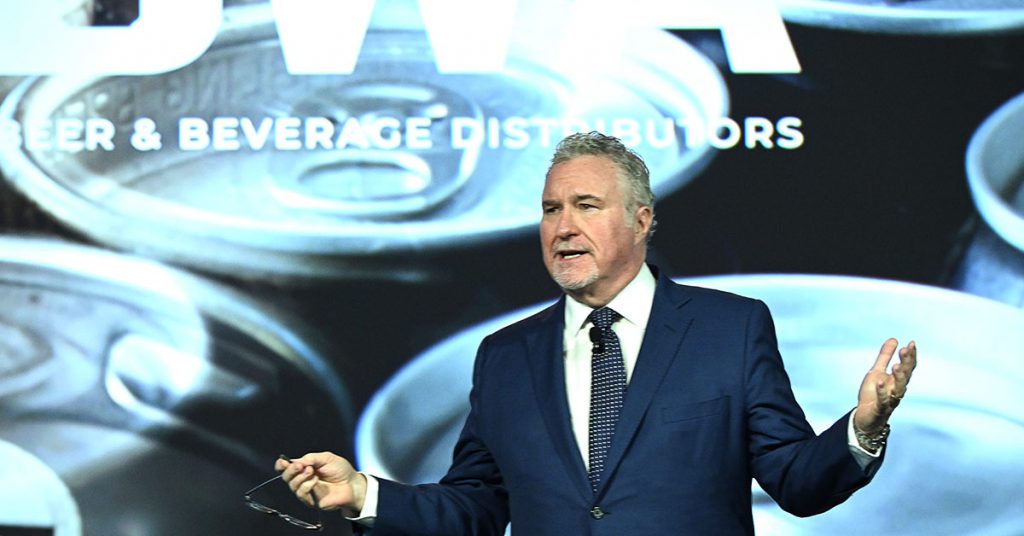
All of those headwinds have plagued beer, which thrives as a conduit for social occasions. However, the category is also primed to help “turn this loneliness epidemic around,” National Beer Wholesalers Association (NBWA) president and CEO Craig Purser said Monday, during Day 1 of the trade group’s Annual Convention in Las Vegas.
“The data shows that people are hungry to go out and get together,” Purser said, citing positive on-premise trends with increasing traffic at bars and restaurants.
“People want to go out and have a drink,” he continued. “Whether it’s non-alc, low-alc, high-alc or somewhere in between, you are here to deliver those options for consumers.”
Purser acknowledged the paradoxical nature of 2025 for beer wholesalers, who are facing low volume sales and fleeing supplier partners, while also celebrating major legislative accomplishments.
“If 2025 were a football game, we wouldn’t feel very good about how team beer has been playing,” Purser said. “The first quarter was horrific. Spring, the second quarter, didn’t get much better. Analyst Kaumil Gajrawala referred to the third quarter as ‘the summer that got away.’
“The industry hasn’t been pretty when it comes to volume sales,” he continued. “Yet, at the same time, your association has put some big wins on the board related to our advocacy agenda particularly on taxes and then in the regulatory and legal environment.”
One of those wins was the passage of the “One Big Beautiful Bill Act” this summer, that included the permanent enactment of tax cuts for distributors and brewers – a move that outgoing NBWA chair Rebecca Maisel called a “once-in-a-generation win” during her own opening remarks.
Purser also celebrated the decision of “some suppliers” to “divest of distribution ownership and allow independent distributors to own these assets,” likely referring to PepsiCo transferring bev-alc distribution rights away from its distribution business Blue Cloud to independent beer wholesalers – a transition that played out over the course of the last year.
“We should welcome this news – it’s better to have those independent operators inside our tent, working to strengthen the system,” Purser said. “And non-beer companies like Gallo, Pepsi, Coke [Coca-Cola] and Monster are working with local distributors, demonstrating they understand the value you add. These are all good things.”
The “elephant in the room” during Purser’s positivity was increased “pressures from suppliers,” primarily reports that Anheuser-Busch InBev (A-B) is attempting to terminate several distributors for allegedly not meeting the beer giant’s product turnover standards or rollout plans.
“Technology mandates, onerous performance standards, jamming your warehouse with inventory and pricing pressures all create tension between trading partners,” Purser said. “Unfortunately, these actions aren’t new, and we can look at similar examples from the not-too-distant past.
“It wasn’t right then, and it isn’t right now.”
In a meeting with media members following his opening remarks, Purser noted that this is not the first time a major supplier has made notable distribution changes, recalling the various moves made during the combination of Molson Coors and SABMiller in 2008 to create the MillerCoors joint venture. However, wholesalers have “not seen it done this way before.”
“They need to be educated and understand their rights under the distribution agreement and the rights under the law, and then they need to consider exercising that,” Purser told Brewbound. “But every business is different, every family is different, every dynamic is different. And often, in many of these cases, the facts are different.”
In his mainstage remarks, Purser acknowledged that “greater collaboration” and improved communication is necessary from both distributors and suppliers to build back “trust” between partners.
“When suppliers take a product or a brand away from dedicated distributors, that challenges the partnership,” he said. “It creates division. Forcing distributors to accept product they didn’t order, without concern for the consequences, that calls into question the relationship and it makes folks wonder if they are on the same team.
“When brewers effectively dictate distributor pricing by reaching back to grab your margins, especially at times like this, that damages the relationship. It feeds a feeling of insecurity. And when long-time partners seek to terminate highly performing distributors without the opportunity to cure, that erodes trust for everyone.”
Retailers are also seeking greater communication across the three-tier system, Walmart U.S. VP of adult beverage Katie Smith shared on stage later in the session.
“You have to be building a relationship with the store, you have to be talking to the store, and the better relationship you build, the better you’ll be in our stores,” she said. “It’s still the old-school selling techniques.”
The strained supplier-distributor relationship isn’t exclusive to beer, as some beer wholesalers have also been tackling the loss of major energy drinks brands. But trucks are being filled with a wider variety of products than ever before, and Purser highlighted that many emerging beverage segments – including intoxicating hemp beverages, non-alcoholic (NA) beer and spirits-based ready-to-drink cocktails (RTDs) – are prioritizing relationships with beer distributors.
“The term that some forward-thinkers in this room, in this industry coined of being a ‘total beverage distributor’ is becoming a reality,” Purser said.
He noted that while some industry changes may “seem strange or unconventional” now, they may “be accepted parts of life in the future.
“We all have to adjust to change, whether it’s technology, social norms or consumer preferences,” he said. “And the good news is, being mindful and being nimble in the face of changing dynamics is what you all do every day. With the foundation of everyone’s business being core beer.”