
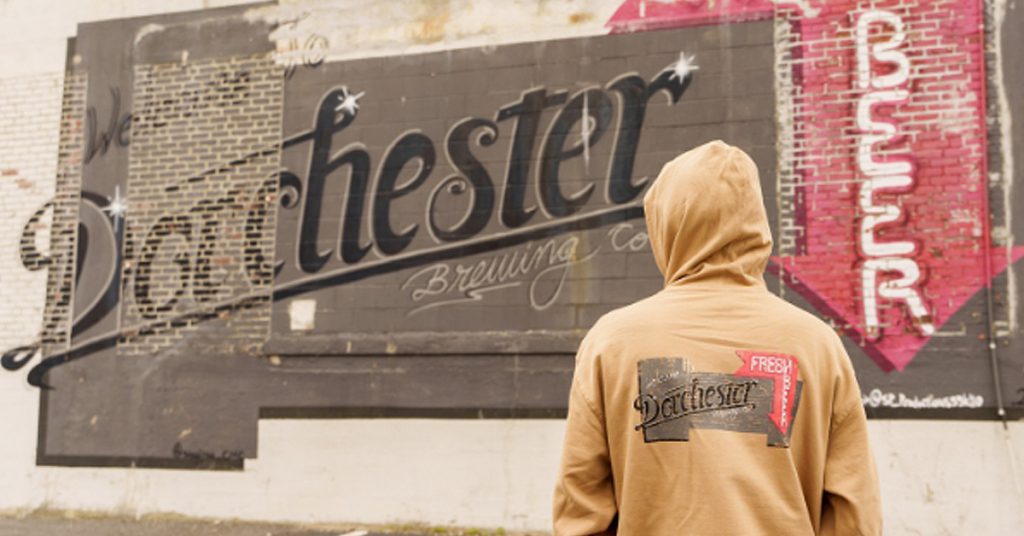
Boston-based Dorchester Brewing is wrapping up its contract brewing business, the company announced last week.
The brewery opened in Boston’s Dorchester neighborhood in 2016 with a dual business model of contract production and brewing under its own brand for distribution and taproom service.
“Over the years we’ve had the pleasure of brewing beer for some of the best breweries in the world, we grew our own Dorchester brand, and served the most incredible community out there,” Dorchester wrote on Instagram. “We’ve also seen a lot of change happen in the beer industry over this time, and as a result we’ve made the difficult decision to wind down the contract brewing side of our business.”
Dorchester co-founder and CEO Matt Malloy pointed to the lingering effects of the COVID-19 pandemic on the craft beer industry as a reason to walk away from what the company has always called “partner brewing.”
“Pre-COVID, it was great,” he told Brewbound. “Beer consumption was there, and everything was lining up. And then COVID happened.”
The move away from contract production is a bit of a zag when other breweries are zigging, as several craft breweries across the country have turned to contract brewing as a way to fill otherwise empty tanks and bring in revenue. However, Malloy cautioned that the practice is “a different discipline” that needs to be approached with certain sensibilities.
“In many cases, we see a lot of these breweries that have never done contract brewing try to help out one or two breweries, and that’s fine – that’s great,” he said. “The key thing, though, is to do it for 14 or 15 breweries at a time, it requires a different discipline that requires different processes and a bigger staff to actually make sure that you run it like a business, and you run it so that you’re hitting your dates – predictable dates – with great quality for your partners.”
Dorchester had not raised its partner brewing rates in several years, despite input costs rising throughout the industry. However, partners pushed back, saying their margins were being crunched in sales to wholesalers, Malloy said.
“This multi-tiered market is a challenge for a lot of small and growing breweries that are using other people to make beer,” he added.
Dorchester’s partner roster has included buzzed-about nomadic breweries such as Omnipollo, Evil Twin and Stillwater – “some of the best breweries in the world,” Malloy said.
The unstable state of the craft beer industry has forced the pause of the announced merger of Dorchester and Somerville, Massachusetts-based Aeronaut Brewing into the Tasty Liquid Alliance. The proposed union, revealed in December 2023, was scheduled to close this quarter.
Dorchester is continuing to brew for Aeronaut, Malloy said.
“We decided to put the merger on pause and look at 2025 to see what happens with both of us, see what makes sense,” Malloy said. “We’re still going to partner, and we’re still going to do collabs and things of that nature. Over the last year and a half, we’ve done a lot of cool stuff together. We’re going to continue to do that. But, right now the merger is on pause.”
With partner brewing coming to an end, Dorchester will eliminate the jobs of at least 10 employees, who have been given several months’ notice.
“We’re doing a three-month ramp down and taking care of people at the end of that, which is the right thing to do,” Malloy said. “I would encourage more people in the brewing industry that if you can do it, do it.
“It’s a very human way for all these people that give us all their hard work and all their expertise,” he continued. “It’s really important for me and the other owners that we do that for people. It’s not perfect, right? But at the same time, we’re doing what we can do.”
Dorchester’s partner brewing team includes “very specialized people” who have “made hundreds of different recipes every year, not the same six SKUs,” Malloy said.
“All the team – be it brewers, cellar people and packaging people – they’ve got to innovate, and they’ve got to be on their feet all the time, because every beer is different,” he continued. “Anybody that would come from my facility, I would highly recommend, because they have seen a lot. They’ve been in battle.”
Dorchester’s own brand has recorded +5% year-over-year growth with Craft Collective, which distributes its products throughout Massachusetts, Malloy said.
The brewery’s taproom hosts “a lot” of private events, and Dorchester has secured a farmer winery license to expand its available offerings.
“We’re doing slushies, seltzers, cider, wine, beer – name it – which is what you need to in this environment, because the people that are under the age of 30 that are going out want variety,” Malloy said.
Reorienting the business to focus exclusively on Dorchester’s own brand will allow the brewery to dig into innovation and keep the taproom’s 20-line system full.
“I still have several brewers that will be staying at the brewery of course, making their own beer,” Mallow said. “They’re excellent, seasoned brewers, and they’re already leaning in and doing more experimentation with beer. Where we made a lot of beer for a lot of other people now is focusing on creating fun and outlandish beverages.”