
After working hard to earn its name in a tough category, Chicago-based Luna Bay is now working harder to shed it.
“In the last year we’ve expanded our company to the point where we really don’t even say we’re a hard kombucha company anymore,” founder Bridget Connelly told BevNET last week, fresh from touring the production facility in Wisconsin where Luna Bay’s Zero Percent tea mocktails are manufactured. “We really say we’re a tea-based beverage line of products.”
The occasion for our call is Luna Bay’s Zero Percent tea mocktails, now its fastest growing line, are getting a label design change, one that in some ways mirrors the brand’s own journey since launching in 2022. In its first iteration as a craft hard kombucha brand, Luna Bay’s vibes were “a little bit more delicate, almost a little bit more granola,” Connelly said. When a period of prodigious early growth helped the brand scale to chains like Target and Walmart in 2023, the founder updated the packaging to become more user friendly: Blueberry Palo Santo was simplified to Blueberry Fizz, Hibiscus Lavender became Hibiscus Spritz, and so on. That cocktail-inspired naming convention continued on its three-SKU line of Sparkling Hard Tea (5% ABV), launched in 2023.
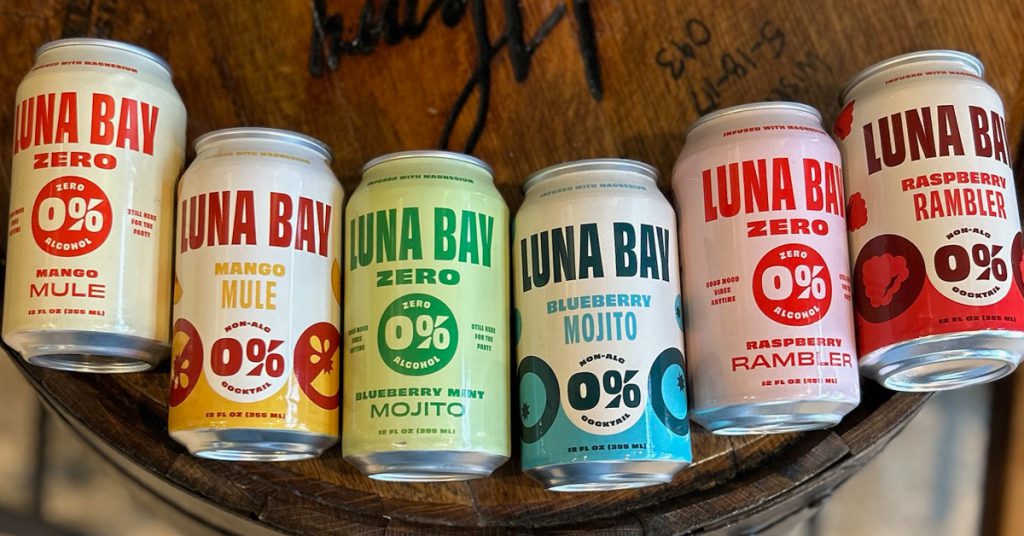
That shift helped both consumers and distributors to grasp the core proposition, and is now being extended to Luna Bay’s Zero Percent, launched last November in 12 oz. cans in three flavors: Raspberry Rambler, Cucumber Mint Mojito (revamped now as Blueberry Mint Mojito) and Mango Mule.
The updated design for Zero Percent, ideated and finalized over just six weeks this spring, visually aligns Luna Bay’s products across both sides of the alcohol divide. The SKU name has been shifted higher (above the 0% alcohol callout), while fruit imagery and stronger color accents have been added. Variety 12-packs have also been formalized as “Essential Variety Packs.”
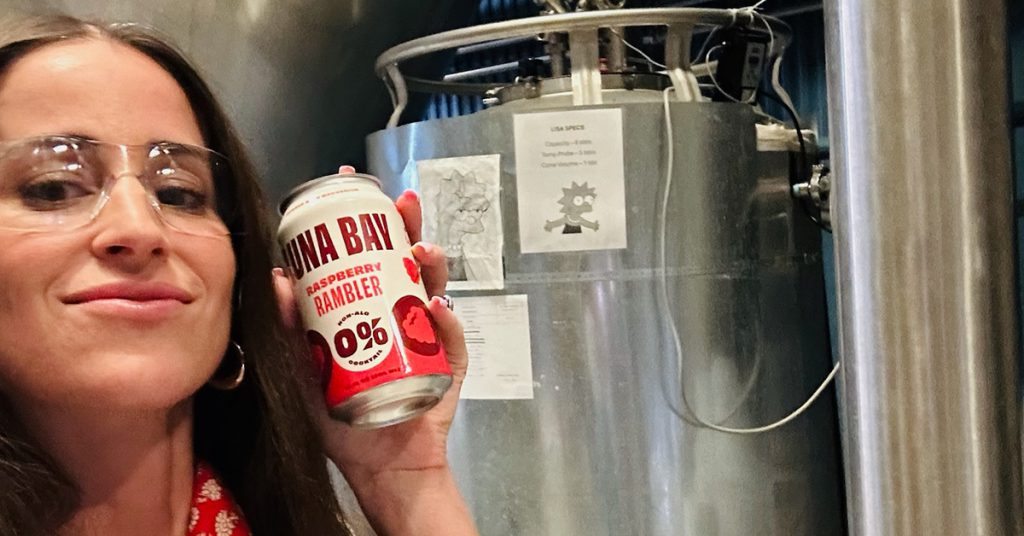
That doesn’t mean the brand is going conventional, though: Along with retailers such as Whole Foods, Kroger and now Sprouts nationwide, the non-alcoholic mocktails are moving through on-premise accounts like luxury hotel chain 1 Hotels and Lifetime Fitness as a premium wellness product. Luna Bay’s unique process — all its drinks are made from a base of yerba mate tea steeped in beer tanks — produces a non-alc cocktail that’s “brewed like a beer.”
“I think for [those customers], they like the simplicity and the ease of not having to add anything to the product, because it is so flavor-forward,” said Connelly. “But a lot of that is from the base of the tea, which is really amazing that we can kind of innovate off of a really simple, clean base.”
The pivot comes after a year of soul searching around the business, Connelly admits. Upon launching the brand, the founder had tried to be “everything to everyone” but found that tactic a recipe for disappointment, with fundraising stalled by lack of proven velocity. Now the company is operating on a two-track strategy, with “around 70%” of Luna Bay’s alcohol products being worked exclusively through just five states — Illinois, California, Colorado, Texas and Florida — at chains like the aforementioned Whole Foods and Sprouts, plus some airports (via Delaware North) and stadiums like Climate Pledge Arena in Seattle. Republic National Distributing Company (RNDC) and Breakthru Beverage are its two primary distribution partners.
In contrast, Connelly sees non-alcoholic drinks as the national play with partners like KeHe and US Foods; along with the previously mentioned accounts, it’s also sold at Trader Joe’s in Colorado and at San Diego’s Petco Park.
As much as Connelly is backing Luna Bay’s evolved identity, there’s also a recognition that spending on influencer campaigns and other awareness campaigns may be dialed back in favor of going “back to basics” with heavy sampling and high-touch activations that directly engage with consumers.
“No matter how many times I say the non-alcoholic doesn’t have kombucha in it, we still get called a hard kombucha brand, and we really are this yerba mate tea company with three different lines,” Connelly said. “I think for a while when people would try Luna Bay Zero, they’d say it’s kombucha. I think there was that kind of trying to figure out how do you expand and identify that we have different lines and how do we show up in that way?”