
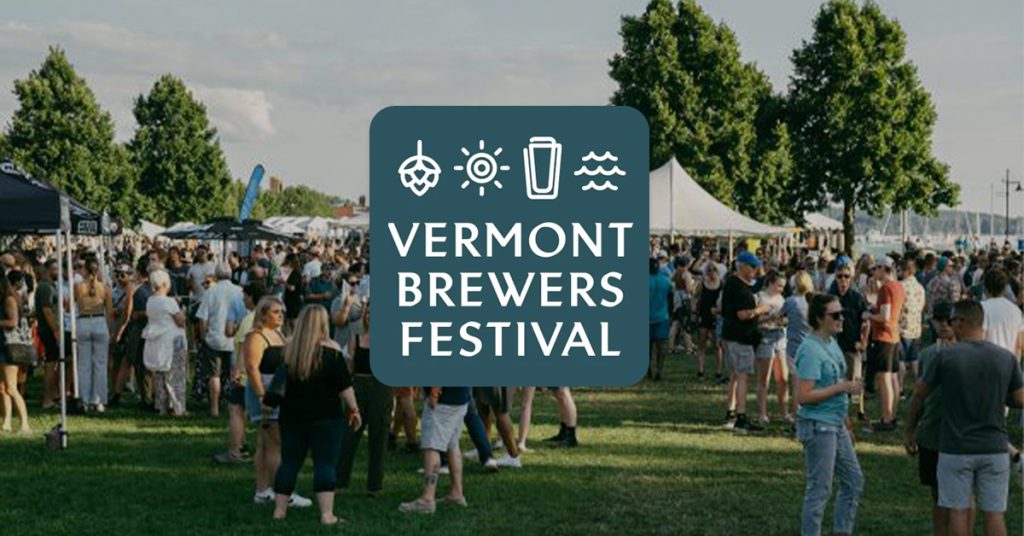
To entice Canadian beer fans to cross the border for the 32nd annual Vermont Brewers Festival, the Vermont Brewers Association (VBA) has created at-par ticket pricing, which offers northern neighbors a discount on the exchange rate.
Canadian attendees can now pay $43 USD for a ticket (equivalent to about $60 CAD), while tickets for U.S. residents are $60, effectively getting “rid of the exchange rate in order to incentivize Canadians to come down,” VBA executive director Emma Arian told Brewbound.
The move is in response to a significant dip in Canadian attendance, which is far off-track from its normal 10% of festivalgoers, Arian shared.
“Typically, we would see about 500 to 700 participants come from Canada,” Arian said. “We’re 45 minutes to the border in Burlington.”
With less than a week before the festival, 50 at-par tickets have been sold. The three-session event kicks off at 5:30 p.m. Friday, July 18, followed by noon and 5:30 p.m. on Saturday, July 19, at Burlington’s Waterfront Park. Nearly 40 breweries are slated to pour, including Vermont breweries von Trapp Brewing, Zero Gravity, Four Quarters, Foam and Lawson’s Finest Liquids, and out-of-state breweries Fox Farm, Schilling, Jack’s Abby and Maine Beer Company.
While proposed tariffs are a concern for VBA members, a more pressing issue is the loss of Canadian tourism, which began to nosedive earlier this year when President Donald Trump threatened to make Canada the 51st state and has proposed and changed various tariffs on the country’s goods.
In Vermont, border crossings year-to-date through May have declined 23.3% year-over-year (YoY), according to the Vermont Agency of Commerce and Community Development (ACCD). In May, as the summer tourism season should have been ramping up, those declines accelerated to 39.6%, driven by a 57.2% decline in bus crossings.
“These are our friends and our family,” Arian said. “I go to Montreal all the time to go shopping, and just do day trips, and they do the same to come to breweries. So we’re really missing it.”
Earlier this year, Maine Brewers’ Guild executive director Sarah Bryan told Brewbound her members share the same concerns about the potential loss of tourism.
“Maine cherishes every tourist, every visitor we rely on, and our peak season is short,” she said in an episode of the Brewbound Podcast. “Every guest that doesn’t walk through the doors is earnestly missed and earnestly felt.
“In our northern communities, it’s families that straddle borders too,” Bryan continued. “We’re so close in so many ways that the loss of easy travel will affect our smaller breweries, especially in the rural regions where every dollar matters.”
To celebrate the VBA’s 30th birthday this year, members have teamed up to collaborate on 25 different beers using one of two proprietary hop blends provided by Hopsteiner, Arian said. Members helped select the hops months ago and created a blend for each ale and lager.
Participating breweries had the option to select a partner or brew on their own, and beers will be available at the festival and through distribution.
Beers include Burly Irish Red IPA by the Vermont Pub & Brewery and Lawson’s Finest Liquids, B-DAY Pils by 1st Republic and Two Heroes, VBA 30 Hoppy Heferweizen by Ten Bends and 14th Star and Thirsty Thirty by Black Flannel and Weird Window, among others.
“All 25 beers are going to be completely different,” Arian said. “With a lot of collabs, it floods the markets with the same exact label and the same exact beer. And obviously the end goal is usually a fundraiser, which this one is, but we just wanted folks to have fun with it and be creative, go back to their old roots of brewing, about what makes them excited and come up with a beer style that matches that.”
In its 30th year, the VBA is “on the older end” of state craft guilds, Arian said. Vermont Pub & Brewery founder Greg Noonan, a monumental figure in the early days of the New England craft beer industry, established the guild in 1995 after several years of running the festival to raise funds and awareness for the state’s fledgling craft brewers.
Today, nearly 90% of Vermont’s 77 breweries belong to the VBA, Arian said. The Green Mountain State ranks 35th for number of craft breweries, but is No. 1 in breweries per capita, according to the Brewers Association (BA).
Last year, those breweries brewed a combined 353,032 barrels of beer, ranking 18th in production but first in gallons per capita per legal-drinking-age adult. Vermont’s craft industry also ranks first in economic impact per capita, generating $460 million in economic impact last year, per the BA.
Still, an evolving craft landscape has led some Vermont brewers to reevaluate their business models and strategies, Arian said.
“Folks are shifting what they want to do, whether that’s adding a restaurant to their taproom and increasing their taproom growth, or pulling back from distribution in Vermont and going out of state more, or shifting the model, whether that’s producing Delta-9 beverages or hop seltzers, or getting into distilling or NA [non-alc] beers,” she said. “It’s really a year of creativity.
“We’ve seen breweries open, and we’ve seen breweries close and we’re pretty much flatlined for that in Vermont over the past two years,” Arian continued.
In addition to craft’s challenged state, Vermont brewers have dealt with the double blow of losing two craft-focused distributors in the last two years. Independently owned Beer Shepherd abruptly shut down in April, and Sheehan Family Companies shuttered Craft Vermont in late 2023.
Vermont’s size has helped the industry coalesce during the COVID-19 pandemic and the current stormy seas craft is navigating, VBA president and Burlington-based Simple Roots Brewing co-founder Kara Pawlusiak said.
“It’s great that we’re in a small state, because people are really connected and can lean on one another and help one another out,” she said. “That’s something that’s really helped.”
Eleven-year-old Simple Roots has expanded its taproom offerings to accommodate changing drinker preferences, she said.
“Even in our taproom, we now carry non-alcoholic beverages, which we didn’t do even three years ago, but now it’s like a must,” Pawlusiak said. “We don’t currently carry an RTD [ready-to-drink], but we’ve talked about it. We want to satisfy as many customers that are there.”