
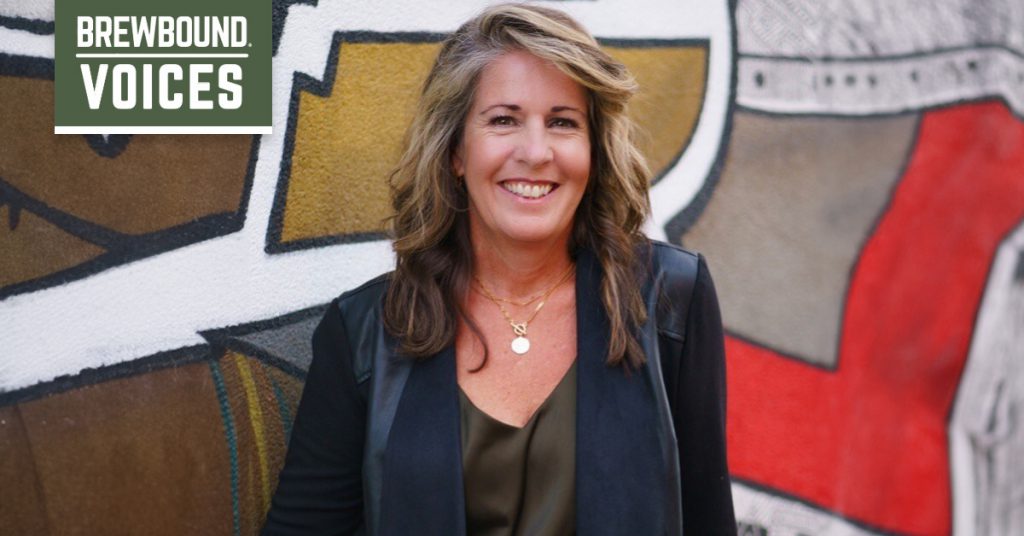
Editor’s Note: Jennifer Briggs is the CEO The Synergy Group, producer of certified organic nutritional and herbal supplements. Her craft beer career included leadership roles at New Belgium, Modern Times and Karl Strauss.
I’ve been around craft beer long enough to see the word “craft” stretch, bend, and in some cases, break.
My own journey started behind the bar during college and later grew into leadership at New Belgium Brewing. For me, “craft” has always been more than marketing language; it’s been a lens for how people create, connect and care.
Today, though, “craft” is everywhere – and sometimes nowhere. At the Denver airport, I spotted a concession advertising “Crafted Milkshakes.” What they meant was: take a cup, add a flavor packet to some soft-serve, and voilà – “crafted.”
Marketers learned that “craft” could be shorthand for human-made and cared-for. It could signal community and belonging. But too often, it’s reduced to a hollow emotional cue. Ownership drifts further away, vision gets diluted into two-by-two charts, and employees get detached. The result is “craft” as a veneer rather than a lived practice.
And yet … craft is still real.
A brewer I once worked with put it bluntly: “If you’re relying on human backs where automation makes sense, that’s not craft. That’s corporate irresponsibility.” I agree. Making work unnecessarily hard isn’t romantic; it’s exploitative. Work for work’s sake doesn’t build dignity or good jobs. It’s just extraction.
True craft comes when humans apply skill, judgment and creativity to the parts of the process that matter most, while letting machines handle the repetitive, back-breaking or easily standardized tasks. Lifting grain bags isn’t what makes beer authentic; it’s the thoughtful selection of ingredients, design of the recipe, dedication to quality and the eye contact of the bartender. Automation, when used well, frees people to focus on those higher-order elements of craft.
But consistency and efficiency aren’t the definition of craft.
Craft, at its core, is about connection. Beer and wine have always been ancient technologies for gathering. The toast – a clink of glasses, a glance in the eye, a hopeful word – isn’t just ritual. It’s energy exchanged. And as “craft” became commodified, that connection thinned.
We also have to acknowledge the environment we’re in now: a world of abundance. Options are endless, but paradoxically, marketers seem to have given up. We have more data and technology than ever, yet much of it has fed a hackbook of performance marketing: algorithms obsessed with short-termism, moving people to the point of purchase as fast as possible.
The result? Digital gruel. Mass-produced messaging that fills the pipeline but starves the spirit. What gets lost is the kind of crafted marketing that once mirrored crafted companies: the stories that highlight vision, aspiration, passion and human connection.
Not all big beer is soulless. Take Constellation Brands’ Modelo. I’ll admit – I like their beer, and I love their advertising. The abuela at the table, the children laughing, the food, the family, it’s an aspirational community that feels genuine. That’s long-term brand building.
But here’s the rub: does that qualify as craft? In a marketing sense, maybe. They’re telling real stories that resonate. However, Grupo Modelo, owned by Anheuser-Busch InBev (A-B) and whose products are imported to the U.S. by Constellation Brands, lacks the proximity that defines craft. There’s no direct link between the people making the beer and the people drinking it. Passion, vision and connection get filtered through layers of corporate distance.
The machine is effective. According to ad-spend analytics firm iSpot, Constellation Brands spent roughly $155 million on traditional TV advertising for Modelo in 2023, making it the largest TV advertiser in beer, even outspending A-B’s Bud Light and Michelob Ultra, according to Marketing Brew. That kind of visibility ensures Modelo’s messaging reaches dynamic audiences, making their brand feel ever-present, even if, at the end of the day, it lacks proximity.
But real craft companies live in another reality. Most of us are middle-market firms. We are real, we have the passion, the proximity, the vision – but we don’t have the money. We don’t have private equity pumping in capital, we don’t have a big-company sugar daddy, and more importantly, we strive to find a different way.
What we want is to build businesses that keep their soul. The challenge is finding ways to do that while competing in a world where mass-brand budgets drown out the signal of genuine connection.
That’s why I find so much inspiration in the brands I’ve been privileged to work with. At Karl Strauss Brewing, I’ve seen firsthand how a San Diego original still leans into bravery and quality to stay true to its roots. At RationAle, moderation and mental health aren’t marketing gimmicks; they’re core to how the brand helps people balance connection and wellbeing. And now, as CEO of The Synergy Company, an organic supplements company, I get to extend that spirit of craft into a completely different space: botanical nutrition.
The same way craft beer once redefined what beer could be, we’re working to redefine what supplements can be, and what Synergy is, anchoring them in impeccable ingredient selection, uncompromising manufacturing quality and a belief that health should feel as genuine as the best pint you’ve ever shared with a friend. The Synergy Company is a bright light in an industry that is also highly competitive.
At the National Center for Employee Ownership Fall Forum, I heard Guy Raz tell stories of entrepreneurs who sold to their employees or trusts. His framing clarified something for me: Craft is proximity, passion and vision. It’s where the maker’s passion meets the consumer’s passion, their hardships, their hopes, their aspirations. That’s what makes craft matter.
Many call the next phase professionalization, bringing in systems, processes and leadership beyond the founder. But at its best, it’s not just professionalization; it’s also mission integration. It’s the moment when a company proves that discipline and values can live side by side.
Patagonia did this exceptionally well under leaders like Casey Sheahan, whom I’ve been fortunate to spend time with. Casey demonstrated how professional rigor and a fierce commitment to purpose can reinforce each other, rather than being at odds.
Growth, handled that way, doesn’t dilute craft – it amplifies it.
What ties brands like Karl Strauss, RationAle and The Synergy Company together is conviction. The leaders behind them don’t just want to sell products; they want to help people enjoy life. That’s the throughline you can feel whenever you interact with them or buy what they make. It’s palpable, visceral and close. And it matters, because people don’t actually want nihilism. They don’t want empty consumption. What they want is joy, mental wellness, physical health and the sense of becoming more than they were yesterday.
As Martin Seligman has argued, flourishing is about meaning, engagement and positive emotion. Real craft, in any sector, is about helping people flourish.
So what is craft now?
It’s the aspirational act of creation. It’s vision, purpose and passion made real. It’s choosing to do the work with love and excellence: in beer, in supplements, or anywhere people are trying to make something that matters.